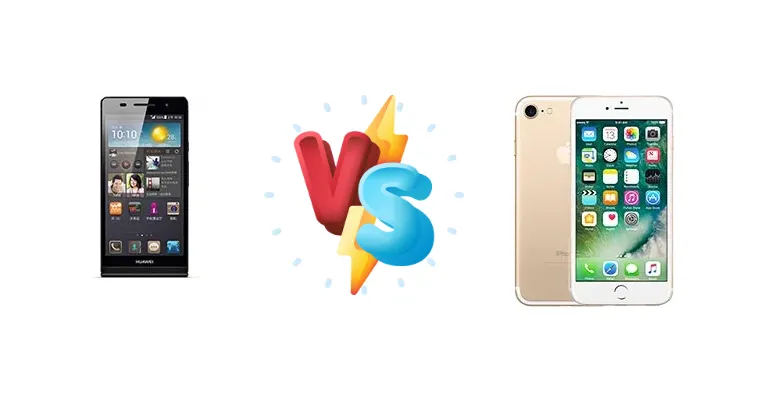
The Huawei Ascend P6 S and Apple iPhone 7 represent different eras of smartphone technology. The P6 S, a sleek Android offering, faced off against the iPhone 7, a benchmark for iOS devices. Let's dive into a comprehensive comparison to see which phone holds up best today.
🏆 Quick Verdict
The iPhone 7 decisively wins this comparison. While the P6 S was impressive for its time, the iPhone 7's superior performance, camera, and significantly longer battery life make it the clear victor, especially considering its age and continued software support.
| Network |
|---|
| 2G bands | GSM 850 / 900 / 1800 / 1900 - SIM 1 & SIM 2 | GSM 850 / 900 / 1800 / 1900 - A1660, A1778 |
| 3G bands | HSDPA 850 / 900 / 1700 / 1900 / 2100 | HSDPA 850 / 900 / 1700(AWS) / 1900 / 2100 - A1660, A1778 |
| 4G bands | - | 1, 2, 3, 4, 5, 7, 8, 12, 13, 17, 18, 19, 20, 25, 26, 27, 28, 29, 30, 38, 39, 40, 41 - A1660, A1778 |
| Speed | HSPA 21.1/5.76 Mbps | HSPA 42.2/5.76 Mbps, LTE (3CA) Cat9 450/50 Mbps, EV-DO Rev.A 3.1 Mbps |
| Technology | GSM / HSPA | GSM / CDMA / HSPA / EVDO / LTE |
| | - | CDMA2000 1xEV-DO & TD-SCDMA - A1660 |
| Launch |
|---|
| Announced | 2014, January. Released 2014, January | 2016, September 07. Released 2016, September 16 |
| Status | Discontinued | Discontinued |
| Body |
|---|
| Build | - | Glass front (Corning-made glass), aluminum back, aluminum frame |
| Dimensions | 132.6 x 65.5 x 6.5 mm (5.22 x 2.58 x 0.26 in) | 138.3 x 67.1 x 7.1 mm (5.44 x 2.64 x 0.28 in) |
| SIM | Dual SIM, (Micro-SIM, dual stand-by) | Nano-SIM |
| Weight | 120 g (4.23 oz) | 138 g (4.87 oz) |
| | - | IP67 dust/water resistant (up to 1m for 30 min)
Apple Pay (Visa, MasterCard, AMEX certified) |
| Display |
|---|
| Protection | Corning Gorilla Glass | Ion-strengthened glass |
| Resolution | 720 x 1280 pixels, 16:9 ratio (~312 ppi density) | 750 x 1334 pixels, 16:9 ratio (~326 ppi density) |
| Size | 4.7 inches, 60.9 cm2 (~70.1% screen-to-body ratio) | 4.7 inches, 60.9 cm2 (~65.6% screen-to-body ratio) |
| Type | IPS+ LCD | Retina IPS LCD, 625 nits (typ) |
| | - | 3D Touch display & home button |
| Platform |
|---|
| CPU | Quad-core 1.6 GHz | Quad-core 2.34 GHz (2x Hurricane + 2x Zephyr) |
| Chipset | - | Apple A10 Fusion (16 nm) |
| GPU | - | PowerVR Series7XT Plus (six-core graphics) |
| OS | Android 4.2.2 (Jelly Bean), upgradable to 4.4.2 (KitKat), EMUI 2 | iOS 10.0.1, upgradable to iOS 15.8.5 |
| Memory |
|---|
| Card slot | No | No |
| Internal | 16GB 2GB RAM | 32GB 2GB RAM, 128GB 2GB RAM, 256GB 2GB RAM |
| | - | NVMe |
| Main Camera |
|---|
| Features | LED flash, HDR | Quad-LED dual-tone flash, HDR |
| Single | 8 MP, AF | 12 MP, f/1.8, 28mm (wide), 1/3.0", PDAF, OIS |
| Video | 1080p@30fps | 4K@30fps, 1080p@30/60/120fps, 720p@240fps |
| Selfie camera |
|---|
| Features | - | Face detection, HDR, panorama |
| Single | 5 MP | 7 MP, f/2.2, 32mm (standard) |
| Video | 720p | 1080p@30fps |
| Sound |
|---|
| 3.5mm jack | Yes | No |
| 35mm jack | Yes | No |
| Loudspeaker | Yes | Yes, with stereo speakers |
| Comms |
|---|
| Bluetooth | 3.0, A2DP, EDR, LE | 4.2, A2DP, LE |
| NFC | No | Yes |
| Positioning | GPS, GLONASS | GPS, GLONASS, GALILEO, QZSS |
| Radio | FM radio | No |
| USB | microUSB 2.0, OTG | Lightning, USB 2.0 |
| WLAN | Wi-Fi 802.11 b/g/n, Wi-Fi Direct, DLNA | Wi-Fi 802.11 a/b/g/n/ac, dual-band, hotspot |
| Features |
|---|
| Sensors | Accelerometer, gyro, proximity, compass | Fingerprint (front-mounted), accelerometer, gyro, proximity, compass, barometer |
| Battery |
|---|
| Stand-by | Up to 216 h | - |
| Talk time | Up to 17 h (2G) / Up to 12 h (3G) | Up to 14 h (3G) |
| Type | Li-Po 2000 mAh, non-removable | Li-Ion 1960 mAh, non-removable (7.45 Wh) |
| Misc |
|---|
| Colors | Black, White | Jet Black, Black, Silver, Gold, Rose Gold, Red |
| Models | - | A1660, A1778, A1779, A1780, A1853, A1866, iPhone9,1, iPhone9,3 |
| Price | About 300 EUR | About 180 EUR |
| SAR | - | 1.19 W/kg (head) 1.19 W/kg (body) |
| SAR EU | - | 1.38 W/kg (head) 1.34 W/kg (body) |
| Tests |
|---|
| Audio quality | - |
Noise -92.4dB / Crosstalk -80.9dB |
| Battery life | - |
Endurance rating 61h
|
| Camera | - |
Photo / Video |
| Display | - |
Contrast ratio: 1603:1 (nominal), 3.964 (sunlight) |
| Loudspeaker | - |
Voice 67dB / Noise 73dB / Ring 75dB
|
| Performance | - |
Basemark OS II 2.0: 3416 |
Huawei Ascend P6 S
- Slim and lightweight design
- Compact size
- Affordable price (when new)
- Outdated processor
- Limited software updates
- Weaker camera
- Shorter battery life
Apple iPhone 7
- Powerful processor
- Excellent camera
- Long battery life
- iOS ecosystem
- Continued software support (to a degree)
- Older model
- Limited storage options (depending on model)
- Lightning port (not USB-C)
Display Comparison
Both phones feature displays with a nominal contrast ratio of 1603:1 and a sunlight readability score of 3.964. However, the iPhone 7's display generally offers better color accuracy and brightness. The P6 S has a smaller screen size (4.7 inches) compared to the iPhone 7 (4.7 inches), making it slightly more compact.
Camera Comparison
The iPhone 7 boasts a more advanced camera system with better image processing and low-light performance. While both offer photo and video capabilities, the iPhone 7 consistently delivers higher-quality images and videos. The P6 S camera was decent for its time but falls short compared to the iPhone 7.
Performance
The iPhone 7's Apple A10 Fusion chipset and 2.34 GHz quad-core CPU significantly outperform the P6 S's 1.6 GHz quad-core processor. The A10 Fusion provides smoother multitasking, faster app loading, and better overall responsiveness. iOS optimization also contributes to the iPhone 7's superior performance.
Battery Life
The iPhone 7's endurance rating of 61 hours is a substantial advantage over the P6 S. While the P6 S had a reasonable battery for its size, the iPhone 7 offers significantly longer battery life, allowing for extended use without frequent charging.
Buying Guide
The Huawei Ascend P6 S is best suited for those seeking a very budget-friendly, compact Android phone, primarily for basic tasks. The Apple iPhone 7 is ideal for users who prioritize performance, a reliable camera, and the iOS ecosystem, even if it's an older model.
Frequently Asked Questions
❓ Is the Huawei P6 S still worth buying?
Only if you're on an extremely tight budget and need a very small, basic Android phone. Be aware of its limitations.
❓ Which phone has better software support?
The Apple iPhone 7, despite being older, generally receives longer software support than the Huawei Ascend P6 S.
❓ What are the key differences between Android and iOS?
Android offers more customization options, while iOS is known for its user-friendliness and tight integration with Apple's ecosystem.