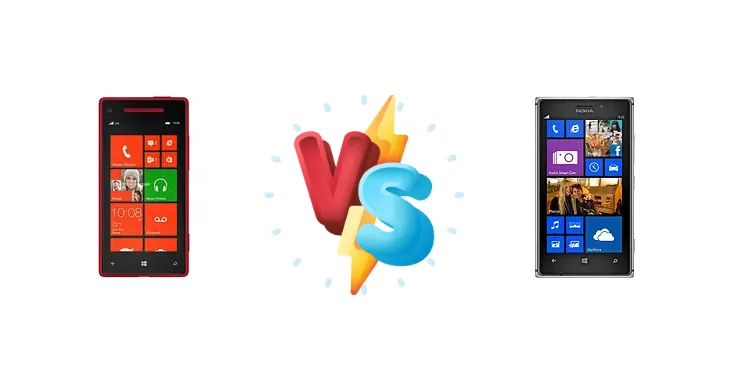
The HTC 8X and Nokia Lumia 925 were flagship Windows Phones vying for dominance. Both offered a compelling Windows Phone 8 experience, but with distinct design philosophies and feature sets. This detailed comparison will help you decide which device was the better choice back in the day.
🏆 Quick Verdict
The Nokia Lumia 925 edges out the HTC 8X thanks to its superior camera, slightly better display visibility in sunlight, and refined design. While both offer similar performance, the Lumia 925’s overall package felt more polished and premium.
| Network |
|---|
| 2G bands | GSM 850 / 900 / 1800 / 1900 | GSM 850 / 900 / 1800 / 1900 - all versions |
| 3G bands | HSDPA 850 / 900 / 1900 / 2100 | HSDPA 850 / 900 / 1900 / 2100 - RM-892 |
| 4G bands | 13 | 1, 3, 7, 8, 20 - RM-892 |
| Speed | HSPA, LTE Cat3 100/50 Mbps, EV-DO Rev.A 3.1 Mbps | HSPA 42.2/5.76 Mbps, LTE Cat3 100/50 Mbps |
| Technology | GSM / CDMA / HSPA / EVDO / LTE | GSM / HSPA / LTE |
| | CDMA2000 1xEV-DO | 2, 4, 5, 17 - RM-893 |
| Launch |
|---|
| Announced | 2012, November. Released 2012, November | 2013, May. Released 2013, June |
| Status | Discontinued | Discontinued |
| Body |
|---|
| Dimensions | 132.4 x 66.2 x 10.1 mm (5.21 x 2.61 x 0.40 in) | 129 x 70.6 x 8.5 mm, 78 cc (5.08 x 2.78 x 0.33 in) |
| SIM | Micro-SIM | Micro-SIM |
| Weight | 132.1 g (4.66 oz) | 139 g (4.90 oz) |
| Display |
|---|
| Protection | Corning Gorilla Glass 2 | Corning Gorilla Glass 2 |
| Resolution | 720 x 1280 pixels, 16:9 ratio (~342 ppi density) | 768 x 1280 pixels, 5:3 ratio (~332 ppi density) |
| Size | 4.3 inches, 51.0 cm2 (~58.2% screen-to-body ratio) | 4.5 inches, 57.6 cm2 (~63.3% screen-to-body ratio) |
| Type | S-LCD2 | AMOLED |
| | - | PureMotion HD+ ClearBlack display |
| Platform |
|---|
| CPU | Dual-core 1.5 GHz | Dual-core 1.5 GHz Krait |
| Chipset | - | Qualcomm MSM8960 Snapdragon S4 Plus |
| GPU | - | Adreno 225 |
| OS | Microsoft Windows Phone 8 | Microsoft Windows Phone 8, upgradable to 8.1 |
| Memory |
|---|
| Card slot | No | No |
| Internal | 16GB 1GB RAM | 16GB 1GB RAM, 32GB 1GB RAM |
| Main Camera |
|---|
| Features | LED flash | Carl Zeiss optics, dual-LED flash |
| Single | 8 MP, AF | 8 MP, 1/3.0", AF, OIS |
| Video | 1080p@30fps | 1080p@30fps |
| Selfie camera |
|---|
| Single | 2.1 MP | 1.3 MP |
| Video | 1080p@30fps | 720p@30fps |
| Sound |
|---|
| 3.5mm jack | Yes | Yes |
| 35mm jack | Yes | Yes |
| Loudspeaker | Yes | Yes |
| Comms |
|---|
| Bluetooth | 3.1, A2DP, EDR | 4.0, A2DP, EDR, LE/ aptX after WP8 Denim update |
| NFC | Yes | Yes |
| Positioning | GPS, GLONASS | GPS, GLONASS |
| Radio | No | FM radio |
| USB | microUSB 2.0 | microUSB 2.0 |
| WLAN | Wi-Fi 802.11 a/b/g/n, dual-band | Wi-Fi 802.11 a/b/g/n, dual-band, DLNA, hotspot |
| Features |
|---|
| Sensors | Accelerometer, proximity, compass | Accelerometer, gyro, proximity, compass |
| Battery |
|---|
| Music play | - | Up to 55 h |
| Stand-by | Up to 300 h | Up to 440 h (3G) |
| Talk time | Up to 15 h | Up to 18 h 20 min (2G) / Up to 12 h 40 min (3G) |
| Type | Li-Ion 1800 mAh, non-removable | Li-Ion 2000 mAh, non-removable (BL-4YW) |
| Misc |
|---|
| Colors | California Blue, Graphite Black, Flame Red | Black, White, Gray |
| Price | About 200 EUR | About 260 EUR |
| SAR | 0.69 W/kg (head) 0.85 W/kg (body) | 1.42 W/kg (head) 1.00 W/kg (body) |
| SAR EU | - | 0.81 W/kg (head) |
| Tests |
|---|
| Audio quality | - |
Noise -82.5dB / Crosstalk -81.2dB |
| Camera | - |
Photo / Video |
| Display | - |
Contrast ratio: Infinite (nominal) / 3.402:1 (sunlight) |
| Loudspeaker | - |
Voice 63dB / Noise 72dB / Ring 66dB
|
HTC Windows Phone 8X CDMA
- Compact and lightweight design
- Slightly more vibrant screen colors
- Good build quality
- Lower camera quality compared to Lumia 925
- Less sunlight readable display
- Less premium feel
Nokia Lumia 925
- Excellent camera with OIS
- Superior sunlight readability
- Premium metal design
- ClearBlack display technology
- Larger size compared to HTC 8X
- Colors slightly less vibrant than HTC 8X
- Windows Phone 8 limitations
Display Comparison
Both phones feature 4.3-inch displays with a 1280 x 768 resolution. The Lumia 925 boasts a significantly better contrast ratio, especially in direct sunlight, thanks to its ClearBlack display technology. While the HTC 8X has slightly more saturated colors, the Lumia 925’s visibility in bright conditions is a clear advantage. The Lumia 925's contrast ratio is reported as 'Infinite' nominally, and 3.402:1 in sunlight, while the HTC 8X's is not explicitly stated but is noticeably lower.
Camera Comparison
The Lumia 925’s camera is the standout feature. It boasts a 20-megapixel PureView sensor with optical image stabilization (OIS), delivering significantly better image quality, especially in low light. The HTC 8X has an 8-megapixel camera, which is decent but lacks the Lumia 925’s advanced features and image processing capabilities. Video recording is also superior on the Lumia 925.
Performance
Both devices are powered by dual-core 1.5 GHz processors, though the Lumia 925 utilizes a Krait CPU within the Qualcomm Snapdragon S4 Plus chipset, generally offering slightly better performance. Real-world usage feels very similar on both phones, with smooth navigation and app loading times. Gaming performance is adequate for the era, but not exceptional.
Battery Life
Battery life is comparable on both devices, typically lasting a full day with moderate usage. Both phones have around 1800mAh batteries. Neither phone was a battery champion, but they were adequate for the time.
Buying Guide
The HTC 8X is a good choice for those prioritizing a more compact design and a slightly more vibrant screen (though less sunlight readable). The Nokia Lumia 925 is ideal for users who value camera quality, a premium metal build, and a more refined overall experience.
Frequently Asked Questions
❓ What chipset does each phone use?
The HTC 8X uses a Qualcomm MSM8960 Snapdragon S4, while the Nokia Lumia 925 uses a Qualcomm MSM8960 Snapdragon S4 Plus with a Krait CPU.
❓ Which phone is better for photography?
The Nokia Lumia 925 is significantly better for photography due to its 20-megapixel PureView sensor and optical image stabilization.