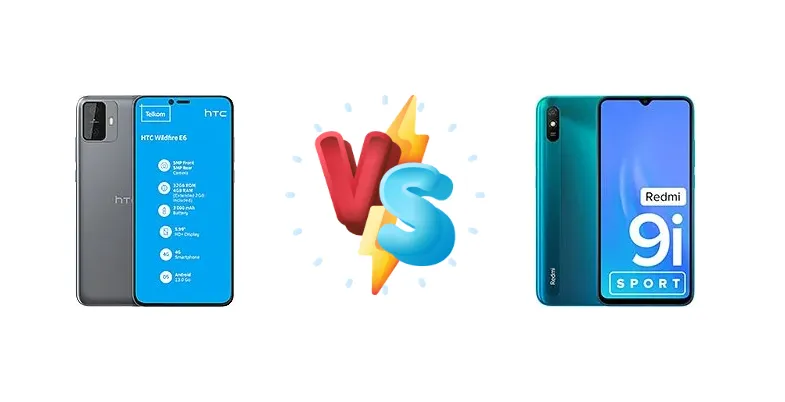
The sub-$150 smartphone market is fiercely competitive. Both the HTC Wildfire E6 and the Xiaomi Redmi 9i Sport aim to deliver essential smartphone functionality at an accessible price point. However, with limited publicly available specifications for the Wildfire E6, this comparison focuses heavily on the Redmi 9i Sport’s known hardware and extrapolates the Wildfire E6’s positioning based on HTC’s historical focus in this segment.
🏆 Quick Verdict
For the average user prioritizing basic functionality and a known chipset, the Xiaomi Redmi 9i Sport emerges as the stronger choice. Its Mediatek Helio G25 provides a defined performance baseline, while the Wildfire E6’s lack of detailed specifications introduces uncertainty regarding its capabilities.
| Network |
|---|
| 2G bands | GSM 850 / 900 / 1800 / 1900 | GSM 850 / 900 / 1800 / 1900 |
| 3G bands | HSDPA 850 / 900 / 2100 | HSDPA 850 / 900 / 2100 |
| 4G bands | LTE | 1, 3, 5, 8, 40, 41 |
| Speed | HSPA, LTE | HSPA, LTE |
| Technology | GSM / HSPA / LTE | GSM / HSPA / LTE |
| Launch |
|---|
| Announced | 2025, June 10 | 2021, September 28 |
| Status | Available. Released 2025, July | Available. Released 2021, September 28 |
| Body |
|---|
| Build | Glass front, plastic back, plastic frame | - |
| Dimensions | - | 164.9 x 77.1 x 9 mm (6.49 x 3.04 x 0.35 in) |
| SIM | Nano-SIM + Nano-SIM | Nano-SIM + Nano-SIM |
| Weight | - | 194 g (6.84 oz) |
| | - | Water-repellent coating |
| Display |
|---|
| Resolution | 720 x 1600 pixels, 20:9 ratio (~292 ppi density) | 720 x 1600 pixels, 20:9 ratio (~269 ppi density) |
| Size | 6.0 inches, 86.9 cm2 | 6.53 inches, 102.9 cm2 (~81.0% screen-to-body ratio) |
| Type | TFT LCD | IPS LCD, 400 nits (typ) |
| Platform |
|---|
| CPU | - | Octa-core (4x2.0 GHz Cortex-A53 & 4x1.5 GHz Cortex-A53) |
| Chipset | - | Mediatek MT6762G Helio G25 (12 nm) |
| GPU | - | PowerVR GE8320 |
| OS | Android 13 (Go edition) | Android 10, MIUI 12 |
| Memory |
|---|
| Card slot | microSDXC | microSDXC (dedicated slot) |
| Internal | 32GB 2GB RAM | 64GB 4GB RAM, 128GB 4GB RAM |
| | - | eMMC 5.1 |
| Main Camera |
|---|
| Features | LED flash | LED flash, HDR |
| Single | 5 MP | 13 MP, f/2.2, 28mm (wide), 1.0µm, PDAF |
| Video | Yes | 1080p@30fps |
| Selfie camera |
|---|
| Features | - | HDR |
| Single | 5 MP | 5 MP, f/2.2, (wide), 1.12µm |
| Video | Yes | 1080p@30fps |
| Sound |
|---|
| 3.5mm jack | - | Yes |
| 35mm jack | Yes | Yes |
| Loudspeaker | Yes | Yes |
| Comms |
|---|
| Bluetooth | Yes | 5.0, A2DP, LE |
| NFC | No | No |
| Positioning | Unspecified | GPS, GLONASS, BDS |
| Radio | Unspecified | FM radio |
| USB | USB Type-C | microUSB 2.0, OTG |
| WLAN | Yes | Wi-Fi 802.11 а/b/g/n, Wi-Fi Direct |
| Features |
|---|
| Sensors | Accelerometer | Accelerometer, proximity, compass |
| Battery |
|---|
| Charging | - | 10W wired |
| Type | 3000 mAh | Li-Po 5000 mAh |
| Misc |
|---|
| Colors | Gray | Carbon Black, Coral Green, Metallic Blue |
| Price | About 40 EUR | About 100 EUR |
HTC Wildfire E6
- Potential for a clean Android experience (based on HTC’s past software choices)
- Brand recognition for some users
- May offer a more compact form factor
- Lack of publicly available specifications creates uncertainty
- Potentially lower performance compared to the Redmi 9i Sport
- Limited support and software updates likely
Xiaomi Redmi 9i Sport
- Known Mediatek Helio G25 chipset provides predictable performance
- 10W charging standard offers a defined charging experience
- Wider availability and support network
- Slow 10W charging speed
- Basic camera capabilities
- May include pre-installed bloatware
Display Comparison
Detailed display specifications for the HTC Wildfire E6 are unavailable. The Xiaomi Redmi 9i Sport features a standard LCD panel, typical for this price range. Without knowing the Wildfire E6’s panel type or resolution, it’s difficult to assess display quality. However, given the Redmi 9i Sport’s likely advantage in manufacturing scale, it likely benefits from better panel consistency and potentially slightly improved color calibration. Both devices likely lack features like high refresh rates or HDR support.
Camera Comparison
Camera details for the HTC Wildfire E6 are absent. The Xiaomi Redmi 9i Sport’s camera setup is likely focused on providing acceptable image quality in good lighting conditions. While the exact sensor size of the main camera is unknown, the emphasis in this segment is typically on megapixel count rather than sensor quality. Both devices likely feature basic image processing algorithms. The Redmi 9i Sport’s camera is likely optimized for social media sharing, prioritizing convenience over professional-grade photography. Without specifics on the Wildfire E6, it’s difficult to assess its camera capabilities beyond speculation.
Performance
The Xiaomi Redmi 9i Sport’s Mediatek Helio G25 chipset, with its octa-core configuration (4x2.0 GHz Cortex-A53 & 4x1.5 GHz Cortex-A53), provides a clear performance benchmark. This chipset is designed for basic multitasking and light gaming. The HTC Wildfire E6’s processor remains unknown. Given HTC’s historical positioning, it’s plausible it utilizes a similar, or slightly less powerful, chipset to maintain a competitive price. The Helio G25’s integrated GPU will handle basic graphics tasks, while the Wildfire E6’s GPU performance is speculative. The Redmi 9i Sport’s known chipset allows for more accurate expectations regarding app loading times and overall responsiveness.
Battery Life
The Xiaomi Redmi 9i Sport supports 10W wired charging. Battery capacity for the Wildfire E6 is unknown. Given the price point, both devices likely feature batteries in the 4000-5000 mAh range. The Redmi 9i Sport’s 10W charging will result in a relatively slow charge time, likely exceeding 3 hours for a full charge. Without knowing the Wildfire E6’s battery capacity and charging speed, it’s impossible to definitively compare battery life. However, the Redmi 9i Sport’s known charging standard provides a tangible expectation for users.
Buying Guide
Buy the HTC Wildfire E6 if you prioritize brand loyalty to HTC and are comfortable with a degree of ambiguity regarding performance. It may appeal to users seeking a simple, no-frills experience. Buy the Xiaomi Redmi 9i Sport if you value a predictable performance level thanks to the Mediatek Helio G25, and want a device with a known charging standard and a more readily available support ecosystem.
Frequently Asked Questions
❓ Is the Mediatek Helio G25 in the Redmi 9i Sport capable of running popular games like PUBG Mobile?
The Mediatek Helio G25 can run PUBG Mobile, but likely at low to medium settings to maintain a playable frame rate. Expect some stuttering and reduced graphical fidelity. It’s not a gaming-focused chipset, but it can handle casual gaming sessions.
❓ Given the limited information on the HTC Wildfire E6, what should I consider before purchasing it?
If you're considering the Wildfire E6, be prepared for a degree of uncertainty regarding its performance and features. Research user reviews thoroughly once available, and understand that you're relying on HTC's brand reputation rather than concrete specifications.
❓ Does the Xiaomi Redmi 9i Sport support fast charging, or is 10W the only option?
The Xiaomi Redmi 9i Sport only supports 10W wired charging. It's a relatively slow charging speed compared to modern smartphones, so plan for a longer charging time.