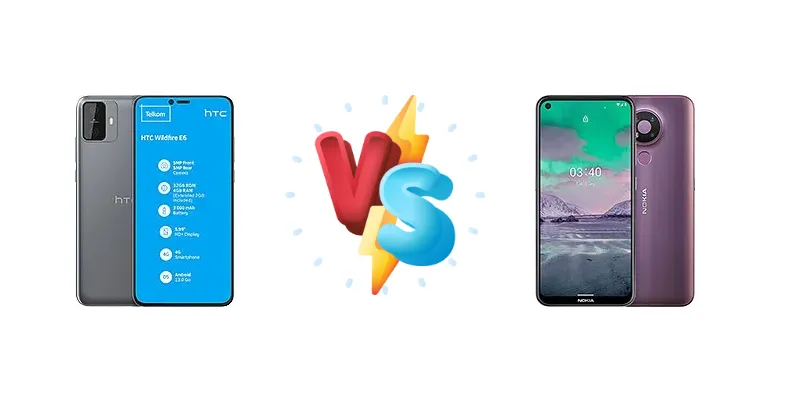
The sub-$150 smartphone market is fiercely competitive. Both the HTC Wildfire E6 and Nokia 3.4 aim to deliver a functional Android experience without breaking the bank. However, they approach this goal with different strategies. The Nokia 3.4 leverages a Qualcomm Snapdragon 460 chipset, while the HTC Wildfire E6's specifications remain largely undisclosed, placing it in a similar entry-level segment based on brand positioning.
🏆 Quick Verdict
For the average user prioritizing a smoother, more responsive experience, the Nokia 3.4 is the clear winner. Its Snapdragon 460 chipset provides a tangible performance advantage over what we can reasonably expect from the HTC Wildfire E6, despite the Nokia's slower 10W charging.
| Network |
|---|
| 2G bands | GSM 850 / 900 / 1800 / 1900 | GSM 850 / 900 / 1800 / 1900 |
| 3G bands | HSDPA 850 / 900 / 2100 | HSDPA 850 / 900 / 1700(AWS) / 1900 / 2100 |
| 4G bands | LTE | 1, 2, 3, 4, 5, 7, 8, 12, 17, 13, 28, 66 |
| Speed | HSPA, LTE | HSPA, LTE |
| Technology | GSM / HSPA / LTE | GSM / HSPA / LTE |
| Launch |
|---|
| Announced | 2025, June 10 | 2020, September 22. Released 2020, October 26 |
| Status | Available. Released 2025, July | Discontinued |
| Body |
|---|
| Build | Glass front, plastic back, plastic frame | - |
| Dimensions | - | 161 x 76 x 8.7 mm (6.34 x 2.99 x 0.34 in) |
| SIM | Nano-SIM + Nano-SIM | · Nano-SIM· Nano-SIM + Nano-SIM |
| Weight | - | 180 g (6.35 oz) |
| Display |
|---|
| Resolution | 720 x 1600 pixels, 20:9 ratio (~292 ppi density) | 720 x 1560 pixels, 19.5:9 ratio (~269 ppi density) |
| Size | 6.0 inches, 86.9 cm2 | 6.39 inches, 100.2 cm2 (~81.9% screen-to-body ratio) |
| Type | TFT LCD | IPS LCD, 400 nits (typ) |
| Platform |
|---|
| CPU | - | Octa-core (4x1.8 GHz Cortex-A73 & 4x1.8 GHz Cortex-A53) |
| Chipset | - | Qualcomm SM4250 Snapdragon 460 (11 nm) |
| GPU | - | Adreno 610 |
| OS | Android 13 (Go edition) | Android 10, upgradable to Android 11 |
| Memory |
|---|
| Card slot | microSDXC | microSDXC (dedicated slot) |
| Internal | 32GB 2GB RAM | 32GB 3GB RAM, 64GB 3GB RAM, 64GB 4GB RAM |
| | - | eMMC 5.1 |
| Main Camera |
|---|
| Features | LED flash | LED flash, HDR, panorama |
| Single | 5 MP | - |
| Triple | - | 13 MP, (wide), PDAF
5 MP, (ultrawide)
Auxiliary lens |
| Video | Yes | 1080p@30fps |
| Selfie camera |
|---|
| Single | 5 MP | 8 MP, (wide) |
| Video | Yes | 1080p@30fps |
| Sound |
|---|
| 3.5mm jack | - | Yes |
| 35mm jack | Yes | Yes |
| Loudspeaker | Yes | Yes |
| Comms |
|---|
| Bluetooth | Yes | 4.2, A2DP, aptX |
| NFC | No | Yes (market/region dependent) |
| Positioning | Unspecified | GPS, GLONASS, GALILEO, BDS |
| Radio | Unspecified | FM radio |
| USB | USB Type-C | USB Type-C 2.0 |
| WLAN | Yes | Wi-Fi 802.11 b/g/n |
| Features |
|---|
| Sensors | Accelerometer | Fingerprint (rear-mounted), accelerometer, gyro, proximity |
| Battery |
|---|
| Charging | - | 10W wired |
| Type | 3000 mAh | Li-Po 4000 mAh |
| Misc |
|---|
| Colors | Gray | Fjord, Dusk, Charcoal |
| Models | - | TA-1288, TA-1285, TA-1283 |
| Price | About 40 EUR | About 100 EUR |
| SAR | - | 0.83 W/kg (head) 1.05 W/kg (body) |
| SAR EU | - | 0.36 W/kg (head) 1.56 W/kg (body) |
HTC Wildfire E6
- Potentially lower price point
- May offer a simpler user experience
- Likely lightweight and compact
- Significantly weaker performance
- Inferior camera quality
- Lack of detailed specifications
Nokia 3.4
- Better performance with Snapdragon 460
- More capable camera system
- More readily available information and support
- Slow 10W charging
- Substantial bezels
- Limited gaming capabilities
Display Comparison
Without specific display details for the HTC Wildfire E6, a direct comparison is difficult. However, given its price point, it likely features a lower resolution and less color accurate panel than the Nokia 3.4. The Nokia 3.4's display, while not exceptional, benefits from a standard 720p+ resolution, offering a sharper image than many competitors in this segment. Bezels are expected to be substantial on both devices, reflecting their budget nature. Color accuracy is likely to be standard on both, prioritizing power efficiency over fidelity.
Camera Comparison
The Nokia 3.4's camera system, while not flagship-level, is more likely to deliver consistently usable results than the HTC Wildfire E6's. While details on the Wildfire E6's camera are absent, budget phones often rely on low-resolution sensors and limited image processing. The Nokia 3.4's main sensor, coupled with Qualcomm's image signal processor, will offer better dynamic range and detail in good lighting conditions. The presence of a dedicated night mode, even a basic one, gives the Nokia 3.4 an edge in low-light photography. We can expect both phones to feature auxiliary cameras of limited utility.
Performance
The Nokia 3.4's Qualcomm Snapdragon 460 (11 nm) is the defining performance factor in this comparison. Its octa-core CPU, comprised of 4x1.8 GHz Cortex-A73 and 4x1.8 GHz Cortex-A53 cores, provides a noticeable uplift in multitasking and app loading times compared to the likely MediaTek or Unisoc chipset found in the HTC Wildfire E6. The 11nm process node also contributes to better thermal efficiency, potentially reducing throttling during sustained use. While neither phone is a gaming powerhouse, the Snapdragon 460 will handle less demanding titles with greater ease. The HTC Wildfire E6, lacking detailed specs, is expected to struggle with even moderate workloads.
Battery Life
Battery life will depend heavily on usage patterns, but the Nokia 3.4's 10W wired charging is a significant drawback. While the exact battery capacity of the HTC Wildfire E6 is unknown, it's reasonable to assume it's in the 4000-5000 mAh range, similar to the Nokia 3.4. However, the slower charging speed on the Nokia 3.4 means a longer time to reach a full charge. The Snapdragon 460's efficiency may partially offset this, providing comparable real-world battery endurance despite the slower charging.
Buying Guide
Buy the HTC Wildfire E6 if you need a basic, ultra-affordable smartphone for essential communication and are willing to compromise on performance. It's likely suited for first-time smartphone users or as a secondary device. Buy the Nokia 3.4 if you prefer a more capable device for everyday tasks, occasional gaming, and a slightly better camera experience, even if it means accepting slower charging speeds.
Frequently Asked Questions
❓ Is the Snapdragon 460 in the Nokia 3.4 powerful enough for social media and basic apps?
Yes, the Snapdragon 460 is more than capable of handling social media apps like Facebook, Instagram, and WhatsApp, as well as common tasks like web browsing and email. It provides a smoother experience than the likely chipset in the HTC Wildfire E6, reducing lag and stuttering.
❓ Does the Nokia 3.4 support software updates and security patches?
Nokia is known for providing relatively consistent software updates and security patches, even for its budget devices. This is a significant advantage over many competitors in this price range, ensuring your phone remains secure and receives bug fixes. The HTC Wildfire E6's update support is less certain.
❓ How long does it take to fully charge the Nokia 3.4 with the 10W charger?
With the 10W charger, the Nokia 3.4 will likely take around 3-4 hours to fully charge from 0%. This is a considerable amount of time compared to phones with faster charging capabilities, but it's a trade-off for the lower price point.