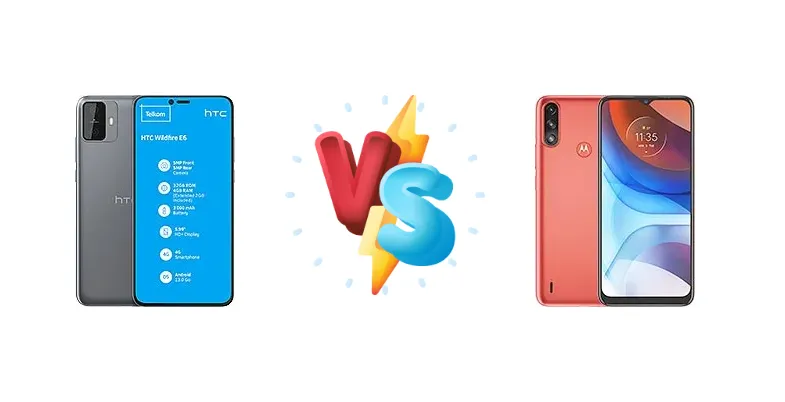
The sub-$150 smartphone market is fiercely competitive. Both the HTC Wildfire E6 and Motorola Moto E7i Power aim to deliver essential smartphone functionality at an accessible price point. However, they approach this goal with different hardware choices, making a direct comparison crucial for budget-conscious buyers. We'll dissect their specifications and performance to determine which device offers the best value.
🏆 Quick Verdict
For the average user prioritizing battery life and a slightly more modern chipset, the Motorola Moto E7i Power emerges as the better choice. While the HTC Wildfire E6's specifications are largely unknown, the Moto E7i Power's Unisoc SC9863A offers a tangible performance advantage, even if modest, and its 10W charging provides a predictable, if slow, power-up experience.
| Network |
|---|
| 2G bands | GSM 850 / 900 / 1800 / 1900 | GSM 850 / 900 / 1800 / 1900 |
| 3G bands | HSDPA 850 / 900 / 2100 | HSDPA 850 / 900 / 1700(AWS) / 1900 / 2100 |
| 4G bands | LTE | LTE |
| Speed | HSPA, LTE | HSPA, LTE |
| Technology | GSM / HSPA / LTE | GSM / HSPA / LTE |
| Launch |
|---|
| Announced | 2025, June 10 | 2021, February 23 |
| Status | Available. Released 2025, July | Available. Released 2021, March 15 |
| Body |
|---|
| Build | Glass front, plastic back, plastic frame | Glass front, plastic back, plastic frame |
| Dimensions | - | 165.1 x 75.9 x 9.2 mm (6.5 x 2.99 x 0.36 in) |
| SIM | Nano-SIM + Nano-SIM | Nano-SIM + Nano-SIM |
| Weight | - | 200 g (7.05 oz) |
| | - | Water-repellent design |
| Display |
|---|
| Resolution | 720 x 1600 pixels, 20:9 ratio (~292 ppi density) | 720 x 1600 pixels, 20:9 ratio (~270 ppi density) |
| Size | 6.0 inches, 86.9 cm2 | 6.51 inches, 102.3 cm2 (~81.7% screen-to-body ratio) |
| Type | TFT LCD | IPS LCD, 380 nits (typ) |
| Platform |
|---|
| CPU | - | Octa-core (4x1.6 GHz Cortex-A55 & 4x1.2 GHz Cortex-A55) |
| Chipset | - | Unisoc SC9863A (28 nm) |
| GPU | - | IMG8322 |
| OS | Android 13 (Go edition) | Android 10 (Go edition) |
| Memory |
|---|
| Card slot | microSDXC | microSDXC (uses shared SIM slot) |
| Internal | 32GB 2GB RAM | 32GB 2GB RAM |
| | - | eMMC 5.1 |
| Main Camera |
|---|
| Dual | - | 13 MP, f/2.0, 26mm (wide), 1/3.1", 1.12µm, PDAF
2 MP (macro) |
| Features | LED flash | LED flash, HDR, panorama |
| Single | 5 MP | - |
| Video | Yes | 1080p@30fps |
| Selfie camera |
|---|
| Features | - | HDR |
| Single | 5 MP | 5 MP, f/2.2, 27mm (wide), 1.12µm |
| Video | Yes | 1080p@30fps |
| Sound |
|---|
| 3.5mm jack | - | Yes |
| 35mm jack | Yes | Yes |
| Loudspeaker | Yes | Yes |
| Comms |
|---|
| Bluetooth | Yes | 4.2, A2DP |
| NFC | No | No |
| Positioning | Unspecified | GPS, GLONASS, GALILEO |
| Radio | Unspecified | Unspecified |
| USB | USB Type-C | USB Type-C 2.0 |
| WLAN | Yes | Wi-Fi 802.11 b/g/n |
| Features |
|---|
| Sensors | Accelerometer | Fingerprint (rear-mounted), accelerometer, proximity |
| Battery |
|---|
| Charging | - | 10W wired |
| Type | 3000 mAh | Li-Ion 5000 mAh |
| Misc |
|---|
| Colors | Gray | Tahiti Blue, Coral Red |
| Models | - | XT2097-13 |
| Price | About 40 EUR | About 120 EUR |
HTC Wildfire E6
- Potential for lower price (depending on availability)
- Brand recognition for some users
- Unknown features may offer unexpected benefits
- Lack of publicly available specifications
- Uncertain performance and camera quality
- Limited support and software updates likely
Motorola Moto E7i Power
- Known Unisoc SC9863A chipset provides predictable performance
- Focus on battery efficiency
- 10W charging offers a reliable, if slow, charging experience
- Entry-level performance may struggle with demanding tasks
- Basic camera system
- Slow charging speed compared to modern standards
Display Comparison
Without specific display details for the HTC Wildfire E6, a comparison is limited. The Motorola Moto E7i Power likely features a standard LCD panel common in this price bracket. Expect 60Hz refresh rates on both devices. The absence of information regarding resolution, brightness, or color gamut on the Wildfire E6 makes it impossible to assess its visual quality relative to the Moto E7i Power, but it's reasonable to assume the Moto E7i Power offers a typical, functional display for basic tasks.
Camera Comparison
Information regarding the HTC Wildfire E6's camera system is unavailable. The Motorola Moto E7i Power likely features a basic camera setup, potentially with a single main sensor and a depth sensor. Image quality will be adequate for casual snapshots in good lighting conditions, but low-light performance will be limited. The absence of Optical Image Stabilization (OIS) on either device means relying on software processing for stabilization, which can introduce artifacts. The focus should be on capturing memories, not professional-grade photography.
Performance
The Motorola Moto E7i Power's Unisoc SC9863A chipset is the defining performance factor. This octa-core processor, built on a 28nm process, features a split core configuration with four Cortex-A55 cores clocked at 1.6 GHz and four at 1.2 GHz. This architecture prioritizes efficiency, offering adequate performance for everyday tasks like browsing, social media, and light messaging. The HTC Wildfire E6's processor is unknown, but given its market positioning, it likely utilizes a similar, entry-level chipset. The 28nm node of the Unisoc SC9863A, while not leading-edge, is a known quantity, allowing for predictable thermal behavior. Users should expect some slowdowns with multitasking or demanding applications on both devices.
Battery Life
The Motorola Moto E7i Power's battery capacity is unknown, but its 10W wired charging suggests a focus on longevity over rapid charging. The 28nm Unisoc SC9863A chipset contributes to power efficiency, potentially allowing for all-day battery life with moderate usage. The HTC Wildfire E6's battery capacity and charging speed are also unknown. However, given the price point, it's unlikely to offer significantly faster charging than the Moto E7i Power. Users prioritizing extended usage between charges will likely find the Moto E7i Power more appealing.
Buying Guide
Buy the HTC Wildfire E6 if you prioritize brand familiarity and can find it at a significantly lower price than the Moto E7i Power, accepting that detailed specifications are unavailable. Buy the Motorola Moto E7i Power if you need a phone with a known chipset, a focus on extended battery life, and a predictable user experience, even if it means sacrificing cutting-edge performance.
Frequently Asked Questions
❓ Is the Unisoc SC9863A chipset in the Moto E7i Power capable of running popular social media apps like TikTok and Instagram smoothly?
Yes, the Unisoc SC9863A is generally capable of running popular social media apps like TikTok and Instagram. However, expect some occasional slowdowns when multitasking or using the apps for extended periods. The chipset is designed for basic tasks and light usage, so demanding features within these apps might experience lag.
❓ How long does it typically take to fully charge the Motorola Moto E7i Power with the included 10W charger?
With the included 10W charger, the Motorola Moto E7i Power will likely take between 3 to 4 hours to fully charge from 0%. While this is significantly slower than modern fast-charging solutions, it's a common trade-off in this price segment. It's best to charge the phone overnight to ensure it's ready for the next day.
❓ Given the limited information about the HTC Wildfire E6, is it worth taking a risk on if the price is significantly lower?
The HTC Wildfire E6's appeal hinges entirely on its price. If it's substantially cheaper than the Moto E7i Power, and you're comfortable with uncertainty regarding its specifications and performance, it *might* be worth considering. However, be prepared for potentially limited software support and a less refined user experience.