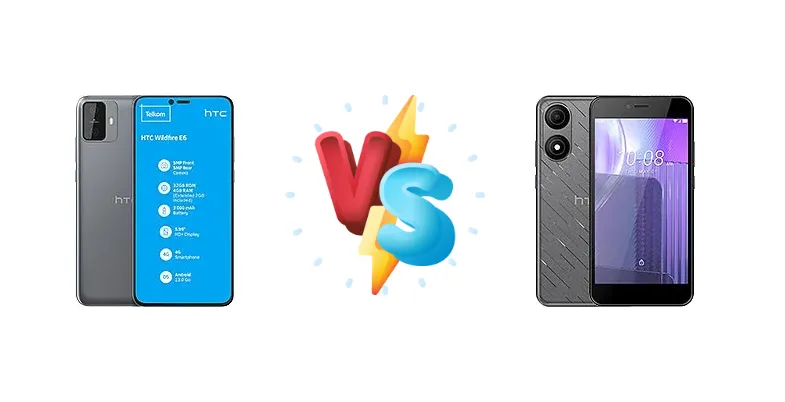
The HTC Wildfire E series represents a commitment to accessible Android smartphones. We're pitting the HTC Wildfire E6 against the E5 Life to determine which offers the best balance of features and performance for the budget-conscious consumer. While the E6's specifications remain largely unknown, the E5 Life's Unisoc SC9832E chipset provides a concrete starting point for comparison.
🏆 Quick Verdict
For the average user prioritizing a known quantity, the HTC Wildfire E5 Life is the better choice. Its Unisoc SC9832E chipset, while not a powerhouse, delivers a predictable level of performance. The E6's lack of publicly available specifications introduces too much uncertainty for a confident recommendation.
| Network |
|---|
| 2G bands | GSM 850 / 900 / 1800 / 1900 | GSM 850 / 900 / 1800 / 1900 |
| 3G bands | HSDPA 850 / 900 / 2100 | HSDPA 900 / 2100 |
| 4G bands | LTE | LTE |
| Speed | HSPA, LTE | HSPA, LTE |
| Technology | GSM / HSPA / LTE | GSM / HSPA / LTE |
| Launch |
|---|
| Announced | 2025, June 10 | 2025, Q3 |
| Status | Available. Released 2025, July | Available. Released 2025, Q3 |
| Body |
|---|
| Build | Glass front, plastic back, plastic frame | Glass front, plastic back, plastic frame |
| Dimensions | - | 155.6 x 77.8 x 10.2 mm (6.13 x 3.06 x 0.40 in) |
| SIM | Nano-SIM + Nano-SIM | Nano-SIM + Nano-SIM |
| Weight | - | 188 g (6.63 oz) |
| Display |
|---|
| Resolution | 720 x 1600 pixels, 20:9 ratio (~292 ppi density) | 540 x 960 pixels, 16:9 ratio (~200 ppi density) |
| Size | 6.0 inches, 86.9 cm2 | 5.5 inches, 83.4 cm2 (~68.9% screen-to-body ratio) |
| Type | TFT LCD | TFT LCD |
| Platform |
|---|
| CPU | - | Quad-core 1.3 GHz Cortex-A53 |
| Chipset | - | Unisoc SC9832E (28 nm) |
| GPU | - | Mali-T820 MP1 |
| OS | Android 13 (Go edition) | Android 14 (Go edition) |
| Memory |
|---|
| Card slot | microSDXC | Unspecified |
| Internal | 32GB 2GB RAM | 32GB 3GB RAM |
| Main Camera |
|---|
| Features | LED flash | LED flash |
| Single | 5 MP | 5 MP |
| Video | Yes | 540p |
| Selfie camera |
|---|
| Single | 5 MP | 2 MP |
| Video | Yes | Yes |
| Sound |
|---|
| 35mm jack | Yes | Yes |
| Loudspeaker | Yes | Yes |
| Comms |
|---|
| Bluetooth | Yes | Yes |
| NFC | No | No |
| Positioning | Unspecified | GPS |
| Radio | Unspecified | Unspecified |
| USB | USB Type-C | USB Type-C |
| WLAN | Yes | Yes |
| Features |
|---|
| Sensors | Accelerometer | No |
| Battery |
|---|
| Type | 3000 mAh | Li-Ion 3000 mAh |
| Misc |
|---|
| Colors | Gray | Gray |
| Price | About 40 EUR | About 30 EUR |
HTC Wildfire E6
- Potentially newer design
- Unknown features may offer unique benefits
- Could be more affordable (depending on pricing)
- Completely unknown specifications
- Uncertain performance
- Higher risk of disappointment
HTC Wildfire E5 Life
- Known Unisoc SC9832E chipset
- Predictable performance for basic tasks
- Affordable price point
- Limited processing power
- Basic camera capabilities
- 28nm process may lead to moderate heat
Display Comparison
Without specifications for the Wildfire E6's display, a direct comparison is impossible. The E5 Life likely features a standard LCD panel common in this price bracket. We can assume both devices prioritize cost-effectiveness over display quality, meaning lower peak brightness and narrower color gamuts. Users should expect adequate readability indoors but potential struggles in direct sunlight. The absence of information regarding the E6's resolution or panel technology suggests it doesn't offer significant advancements over the E5 Life.
Camera Comparison
Details regarding the Wildfire E6's camera are unavailable. The E5 Life's camera configuration is also likely basic, potentially featuring a single rear camera or a dual-camera setup with a low-resolution secondary sensor. Image quality will be acceptable in good lighting conditions, but expect significant noise and a lack of detail in low light. The absence of Optical Image Stabilization (OIS) on either device further limits low-light performance. Users should not expect flagship-level camera capabilities from either phone.
Performance
The HTC Wildfire E5 Life is powered by the Unisoc SC9832E, a quad-core 1.3 GHz Cortex-A53 chipset fabricated on a 28nm process. This chipset is geared towards basic tasks like calling, texting, and light web browsing. The E6's performance remains a mystery, but given its positioning within the Wildfire series, it's unlikely to feature a significantly more powerful processor. The 28nm process of the SC9832E indicates moderate power consumption and potential for thermal throttling under sustained load. Users expecting to play demanding games or multitask heavily will find both devices limiting, but the E5 Life's known performance allows for realistic expectations.
Battery Life
Battery capacity for both devices is unknown. However, given the Unisoc SC9832E's power efficiency, the E5 Life likely offers all-day battery life with moderate usage. The 28nm fabrication process contributes to reasonable power draw. Without knowing the E6's battery size or charging capabilities, it's difficult to assess its battery performance. Users should anticipate that both phones will require daily charging with typical use.
Buying Guide
Buy the HTC Wildfire E6 if you prioritize a potentially newer design or features not yet detailed in public specifications, and are willing to accept the risk of unknown performance. Buy the HTC Wildfire E5 Life if you prefer a reliably functional, if basic, smartphone experience with a known chipset and a focus on affordability. The E5 Life is ideal for first-time smartphone users or those needing a simple, dependable device.
Frequently Asked Questions
❓ Is the Unisoc SC9832E chipset in the E5 Life capable of running popular social media apps?
Yes, the Unisoc SC9832E is sufficient for running most popular social media applications like Facebook, Instagram, and WhatsApp. However, expect some lag when switching between apps or loading media-heavy content. It's designed for light to moderate usage, not intensive multitasking.
❓ What type of storage does the HTC Wildfire E5 Life use, and is it expandable?
The HTC Wildfire E5 Life likely uses eMMC storage, which is common in budget smartphones. Expandability via microSD card is probable, but the maximum supported capacity is unknown. Users should check the product specifications before purchase if expandable storage is a priority.
❓ Given the limited information on the HTC Wildfire E6, is it worth waiting for more details before making a purchase?
Yes, if you're considering the HTC Wildfire E6, it's advisable to wait for official specifications. The lack of information makes it a risky purchase, as you're essentially buying a phone with unknown capabilities. The E5 Life offers a more transparent and predictable experience.