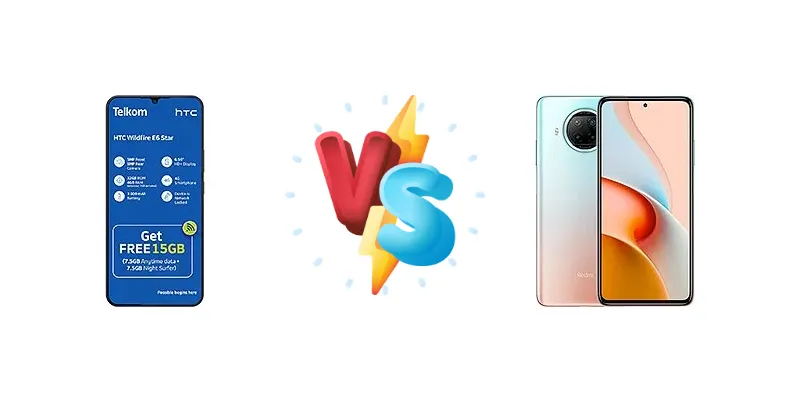
The 5G revolution continues to trickle down to more affordable price points. This comparison pits the HTC Wildfire E6 Star against the Xiaomi Redmi Note 9 Pro 5G, two contenders aiming to deliver 5G connectivity without breaking the bank. However, a significant information gap exists for the Wildfire E6 Star, forcing us to analyze it within the context of its likely market positioning and HTC's historical approach to budget devices.
🏆 Quick Verdict
For the average user prioritizing performance and a well-defined feature set, the Xiaomi Redmi Note 9 Pro 5G is the clear winner. Its Snapdragon 750G chipset and 33W charging provide a tangible advantage over the largely unknown specifications of the HTC Wildfire E6 Star, making it a more reliable and capable 5G device.
| Network |
|---|
| 2G bands | GSM 850 / 900 / 1800 / 1900 | GSM 850 / 900 / 1800 / 1900 |
| 3G bands | HSDPA 850 / 900 / 2100 | HSDPA 850 / 900 / 1900 / 2100 |
| 4G bands | LTE | 1, 3, 5, 7, 8, 34, 38, 39, 40, 41 |
| 5G bands | - | 1, 3, 41, 78, 79 SA/NSA/Sub6 |
| Speed | HSPA, LTE | HSPA, LTE, 5G |
| Technology | GSM / HSPA / LTE | GSM / CDMA / HSPA / EVDO / LTE / 5G |
| | - | CDMA2000 1xEV-DO |
| Launch |
|---|
| Announced | 2025, June 10 | 2020, November 26 |
| Status | Available. Released 2025, July | Available. Released 2020, December 01 |
| Body |
|---|
| Build | Glass front, plastic back, plastic frame | Glass front (Gorilla Glass 5), glass back (Gorilla Glass 5) |
| Dimensions | - | 165.4 x 76.8 x 9 mm (6.51 x 3.02 x 0.35 in) |
| SIM | Nano-SIM + Nano-SIM | Nano-SIM + Nano-SIM |
| Weight | - | 215 g (7.58 oz) |
| | - | IP53, dust and splash resistant |
| Display |
|---|
| Protection | - | Corning Gorilla Glass 5 |
| Resolution | 720 x 1600 pixels, 20:9 ratio (~267 ppi density) | 1080 x 2400 pixels, 20:9 ratio (~395 ppi density) |
| Size | 6.56 inches, 103.9 cm2 | 6.67 inches, 107.4 cm2 (~84.6% screen-to-body ratio) |
| Type | TFT LCD | IPS LCD, HDR10, 120Hz, 450 nits (typ) |
| Platform |
|---|
| CPU | - | Octa-core (2x2.2 GHz Kryo 570 & 6x1.8 GHz Kryo 570) |
| Chipset | - | Qualcomm SM7225 Snapdragon 750G 5G (8 nm) |
| GPU | - | Adreno 619 |
| OS | Android 13 (Go edition) | Android 10, MIUI 12 |
| Memory |
|---|
| Card slot | microSDXC | microSDXC (uses shared SIM slot) |
| Internal | 32GB 2GB RAM | 128GB 6GB RAM, 128GB 8GB RAM, 256GB 8GB RAM |
| | - | UFS 2.2 |
| Main Camera |
|---|
| Features | LED flash | Dual-LED dual-tone flash, HDR, panorama |
| Quad | - | 108 MP, f/1.8, 26mm (wide), 1/1.52", 0.7µm, PDAF
8 MP, f/2.2, 118˚ (ultrawide), 1/4.0", 1.12µm
2 MP (macro)
Auxiliary lens |
| Single | 5 MP | - |
| Video | Yes | 4K@30fps, 1080p@30/60fps, gyro-EIS |
| Selfie camera |
|---|
| Features | - | HDR, panorama |
| Single | 5 MP | 16 MP, f/2.5, (wide), 1/3.06", 1.0µm |
| Video | Yes | 1080p@30fps, gyro-EIS |
| Sound |
|---|
| 3.5mm jack | - | Yes |
| 35mm jack | Yes | Yes |
| Loudspeaker | Yes | Yes, with stereo speakers |
| | - | 24-bit/192kHz audio |
| Comms |
|---|
| Bluetooth | Yes | 5.1, A2DP, LE |
| Infrared port | - | Yes |
| NFC | No | Yes |
| Positioning | Unspecified | GPS (L1+L5), GLONASS (G1), BDS (B1I+B2a), GALILEO (E1+E5a), QZSS (L1+L5) |
| Radio | Unspecified | Unspecified |
| USB | USB Type-C | USB Type-C 2.0 |
| WLAN | Yes | Wi-Fi 802.11 a/b/g/n/ac, dual-band, Wi-Fi Direct |
| Features |
|---|
| Sensors | Accelerometer | Fingerprint (side-mounted), accelerometer, gyro, compass |
| | - | Virtual proximity sensing |
| Battery |
|---|
| Charging | - | 33W wired, 100% in 58 min |
| Type | 3000 mAh | Li-Po 4820 mAh |
| Misc |
|---|
| Colors | Black | Gray, Blue, Red/Mint |
| Models | - | M2007J17C |
| Price | About 40 EUR | About 370 EUR |
HTC Wildfire E6 Star
- Potential for lower price point
- HTC brand recognition (for loyalists)
- Likely lightweight and compact design
- Unknown chipset performance
- Likely slower charging speeds
- Inferior camera system
Xiaomi Redmi Note 9 Pro 5G
- Powerful Snapdragon 750G 5G chipset
- Fast 33W charging
- High-resolution 64MP main camera
- Larger and heavier design
- May include bloatware
- IPS LCD, not AMOLED
Display Comparison
Without specific display details for the HTC Wildfire E6 Star, we can assume it utilizes a standard LCD panel common in its price bracket. The Xiaomi Redmi Note 9 Pro 5G boasts a larger 6.67-inch IPS LCD, but the key advantage lies in its 120Hz refresh rate, offering a smoother scrolling and gaming experience. While not LTPO, the higher refresh rate significantly improves perceived responsiveness. The Redmi Note 9 Pro 5G’s panel likely achieves higher peak brightness, improving visibility in direct sunlight, a feature likely absent on the Wildfire E6 Star.
Camera Comparison
The Redmi Note 9 Pro 5G features a quad-camera system headlined by a 64MP main sensor, offering significantly more detail and dynamic range than what we can reasonably expect from the Wildfire E6 Star. While the Redmi Note 9 Pro 5G includes 8MP ultrawide and 2MP macro lenses (the latter often being of limited practical use), the larger sensor size and image processing capabilities of the primary camera are the key advantages. The Wildfire E6 Star likely features a simpler camera setup with lower resolution sensors and limited image processing features. Optical Image Stabilization (OIS), present on some Redmi Note 9 Pro 5G configurations, is unlikely to be found on the Wildfire E6 Star.
Performance
The Xiaomi Redmi Note 9 Pro 5G’s Qualcomm SM7225 Snapdragon 750G 5G (8 nm) is the defining performance differentiator. This octa-core processor, with its 2x2.2 GHz Kryo 570 prime cores and 6x1.8 GHz Kryo 570 efficiency cores, provides a substantial performance boost over what is typically found in HTC’s entry-level offerings. The 8nm process node also contributes to better thermal efficiency, reducing throttling during sustained workloads. The Wildfire E6 Star likely utilizes a MediaTek Helio P-series or similar chipset, offering adequate performance for basic tasks but falling significantly behind in gaming and demanding applications. The Redmi Note 9 Pro 5G’s LPDDR4X RAM further enhances performance compared to the likely LPDDR3 RAM in the Wildfire E6 Star.
Battery Life
The Redmi Note 9 Pro 5G packs a 4820mAh battery coupled with 33W wired charging, capable of reaching 100% charge in approximately 58 minutes. This rapid charging capability is a significant convenience. The HTC Wildfire E6 Star’s battery capacity is unknown, but given its budget positioning, it’s likely smaller. Without fast charging support, the Wildfire E6 Star will take considerably longer to fully recharge, impacting usability for power users. The Snapdragon 750G’s 8nm process also contributes to better power efficiency, potentially offsetting the Redmi Note 9 Pro 5G’s slightly larger battery.
Buying Guide
Buy the HTC Wildfire E6 Star if you need a basic, functional smartphone and prioritize brand loyalty to HTC, accepting potential compromises in performance and features. Buy the Xiaomi Redmi Note 9 Pro 5G if you prefer a more powerful processor for gaming and multitasking, faster charging, and a more comprehensive set of features, even if it means opting for a different brand.
Frequently Asked Questions
❓ Is the Snapdragon 750G in the Redmi Note 9 Pro 5G capable of handling demanding games like PUBG Mobile?
Yes, the Snapdragon 750G is well-equipped to handle PUBG Mobile at medium to high settings with stable frame rates. While it won't match the performance of flagship chipsets, it provides a smooth and enjoyable gaming experience for most users. The Adreno 619 GPU is a key component in delivering this performance.
❓ Given the limited information on the HTC Wildfire E6 Star, what should I expect in terms of software updates?
Historically, HTC's software update support for its budget devices has been inconsistent. Users should not expect frequent or long-term software updates for the Wildfire E6 Star. The Redmi Note 9 Pro 5G, while not perfect, generally receives more consistent software updates from Xiaomi, including security patches.
❓ Does the Redmi Note 9 Pro 5G support carrier aggregation for improved 5G speeds?
Yes, the Snapdragon 750G supports carrier aggregation, allowing the Redmi Note 9 Pro 5G to combine multiple 5G channels for faster and more reliable data speeds, provided your carrier supports it. This is a significant advantage for users in areas with strong 5G coverage.