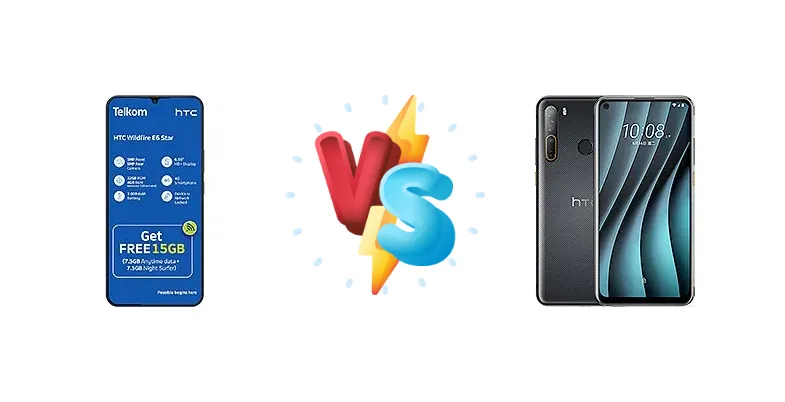
HTC's budget offerings, the Desire 20 Pro and Wildfire E6 Star, represent different approaches to affordability. The Desire 20 Pro, released in 2020, boasts a Qualcomm Snapdragon 665 chipset, while the Wildfire E6 Star's specifications remain largely unknown. This comparison aims to dissect the available data and deduce which device provides the best value for users seeking a low-cost Android experience.
🏆 Quick Verdict
For the average user prioritizing performance and a known quantity, the HTC Desire 20 Pro is the clear winner. Its Snapdragon 665 chipset provides a tangible performance advantage over the likely MediaTek or Unisoc chip found in the Wildfire E6 Star, and the inclusion of Quick Charge 3.0 offers faster charging speeds. However, the Wildfire E6 Star may appeal to those seeking the absolute lowest price point.
| Network |
|---|
| 2G bands | GSM 850 / 900 / 1800 / 1900 | GSM 850 / 900 / 1800 / 1900 |
| 3G bands | HSDPA 850 / 900 / 2100 | HSDPA 850 / 900 / 1900 / 2100 |
| 4G bands | LTE | 1, 2, 3, 5, 7, 8, 20, 28, 38, 39, 40, 41 |
| EDGE | - | No |
| GPRS | - | No |
| Speed | HSPA, LTE | HSPA 42.2/5.76 Mbps, LTE (2CA) Cat13 400/150 Mbps |
| Technology | GSM / HSPA / LTE | GSM / HSPA / LTE |
| Launch |
|---|
| Announced | 2025, June 10 | 2020, June 16. Released 2020, July 18 |
| Status | Available. Released 2025, July | Discontinued |
| Body |
|---|
| Build | Glass front, plastic back, plastic frame | - |
| Dimensions | - | 162 x 77 x 9.4 mm (6.38 x 3.03 x 0.37 in) |
| SIM | Nano-SIM + Nano-SIM | Nano-SIM + Nano-SIM |
| Weight | - | 201 g (7.09 oz) |
| Display |
|---|
| Resolution | 720 x 1600 pixels, 20:9 ratio (~267 ppi density) | 1080 x 2340 pixels, 19.5:9 ratio (~396 ppi density) |
| Size | 6.56 inches, 103.9 cm2 | 6.5 inches, 103.7 cm2 (~83.1% screen-to-body ratio) |
| Type | TFT LCD | IPS LCD |
| Platform |
|---|
| CPU | - | Octa-core (4x2.0 GHz Kryo 260 Gold & 4x1.8 GHz Kryo 260 Silver) |
| Chipset | - | Qualcomm SM6125 Snapdragon 665 (11 nm) |
| GPU | - | Adreno 610 |
| OS | Android 13 (Go edition) | Android 10 |
| Memory |
|---|
| Call records | - | 20 dialed, 20 received, 20 missed calls |
| Card slot | microSDXC | microSDXC |
| Internal | 32GB 2GB RAM | 128GB 6GB RAM |
| Phonebook | - | 1000 entries |
| Main Camera |
|---|
| Features | LED flash | Dual-LED flash, HDR, panorama |
| Quad | - | 48 MP, f/1.8, 26mm (wide), 1/2.0", 0.8µm, PDAF
8 MP, f/2.2, 118˚ (ultrawide), 1/4.0", 1.12µm
2 MP (macro)
Auxiliary lens |
| Single | 5 MP | - |
| Video | Yes | 4K@30fps, 1080p@30fps |
| Selfie camera |
|---|
| Features | - | HDR |
| Single | 5 MP | 25 MP, f/2.0, (wide) |
| Video | Yes | 1080p@30fps |
| Sound |
|---|
| 3.5mm jack | - | Yes |
| 35mm jack | Yes | Yes |
| Loudspeaker | Yes | Yes |
| Comms |
|---|
| Bluetooth | Yes | 5.0, A2DP, LE |
| NFC | No | Yes |
| Positioning | Unspecified | GPS, GLONASS, GALILEO, BDS |
| Radio | Unspecified | FM radio |
| USB | USB Type-C | USB Type-C 2.0, OTG |
| WLAN | Yes | Wi-Fi 802.11 a/b/g/n/ac, dual-band, Wi-Fi Direct |
| Features |
|---|
| Games | - | Yes |
| Java | - | Yes |
| Messaging | - | SMS |
| Sensors | Accelerometer | Fingerprint (rear-mounted), accelerometer, gyro, proximity, compass |
| Battery |
|---|
| Charging | - | 15W wired, QC3 |
| Stand-by | - | Up to 570 h |
| Talk time | - | Up to 8 h 40 min |
| Type | 3000 mAh | Li-Po 5000 mAh |
| Misc |
|---|
| Colors | Black | Smoky Black, Pretty Blue, Crystal Green |
| Price | About 40 EUR | About 660 EUR |
| SAR EU | - | 0.56 W/kg (head) |
HTC Wildfire E6 Star
- Likely the most affordable option
- Functional for basic smartphone tasks
- Potentially longer battery life (depending on capacity)
- Unknown specifications limit assessment
- Likely significantly slower performance
- Inferior camera quality expected
HTC Desire 20 Pro
- Qualcomm Snapdragon 665 provides good performance
- 15W Quick Charge 3.0 for faster charging
- More versatile camera system (likely)
- Higher price point than the Wildfire E6 Star
- LCD display may lack vibrancy
- May not be ideal for demanding gaming
Display Comparison
Without specific display details for the Wildfire E6 Star, a direct comparison is difficult. The Desire 20 Pro likely features an LCD panel, common for its price bracket. Display quality will likely be similar between the two, focusing on basic readability rather than color accuracy or high refresh rates. The absence of information regarding the Wildfire E6 Star's resolution or panel type suggests a focus on cost reduction, potentially resulting in a lower-quality viewing experience.
Camera Comparison
Given the lack of camera specifications for the Wildfire E6 Star, it's reasonable to assume a basic camera setup focused on functionality rather than image quality. The Desire 20 Pro, while not a camera powerhouse, likely offers a more versatile experience. The absence of details on sensor size or aperture for either device makes a precise comparison impossible, but the Desire 20 Pro's likely inclusion of multiple lenses (even if basic) provides more shooting options. It's safe to assume the Desire 20 Pro will outperform the Wildfire E6 Star in low-light conditions and overall image detail.
Performance
The HTC Desire 20 Pro's Qualcomm Snapdragon 665 (11 nm) is the defining performance advantage. This octa-core processor, with its Kryo 260 Gold and Silver cores, offers a significant leap over the likely entry-level chipsets found in the Wildfire E6 Star. The 11nm process node also contributes to better power efficiency compared to older, larger node processes. This translates to smoother multitasking, faster app loading times, and a more responsive user interface on the Desire 20 Pro. Users who play mobile games or frequently switch between applications will particularly benefit from this difference.
Battery Life
Battery capacity for the Wildfire E6 Star is unknown, but given its budget positioning, it's likely to be a smaller capacity than the Desire 20 Pro. The Desire 20 Pro's 15W wired charging with Quick Charge 3.0 support is a significant advantage. Quick Charge 3.0 allows for faster charging speeds compared to standard charging, reducing downtime. Without knowing the Wildfire E6 Star's charging capabilities, it's safe to assume it will take considerably longer to fully charge, potentially offsetting any advantage from a slightly larger battery capacity.
Buying Guide
Buy the HTC Wildfire E6 Star if you need a functional smartphone for basic tasks like calls, texts, and light social media, and your budget is extremely limited. You're willing to accept compromises in performance and features. Buy the HTC Desire 20 Pro if you prefer a smoother user experience, occasional gaming, and faster charging, and are willing to spend a bit more for a more capable device.
Frequently Asked Questions
❓ Is the Snapdragon 665 in the Desire 20 Pro still capable of running modern apps?
Yes, the Snapdragon 665 is a capable chipset for everyday tasks and can handle most popular apps without issue. While it won't deliver flagship-level performance, it provides a smooth and responsive experience for browsing, social media, and streaming video. Demanding games may require lower graphics settings.
❓ What kind of storage options does the Desire 20 Pro offer, and is it expandable?
The HTC Desire 20 Pro typically comes with 64GB of internal storage, which is adequate for basic use. Crucially, it also supports microSD card expansion, allowing you to add up to 512GB of additional storage for photos, videos, and other files. This is a significant advantage for users who plan to store a lot of content on their device.
❓ Given the limited information on the Wildfire E6 Star, is it worth considering at all?
The Wildfire E6 Star is only worth considering if your budget is extremely limited and you only need a phone for the most basic functions – calls, texts, and very light internet browsing. Be prepared for a significantly slower and less feature-rich experience compared to the Desire 20 Pro or other budget smartphones.