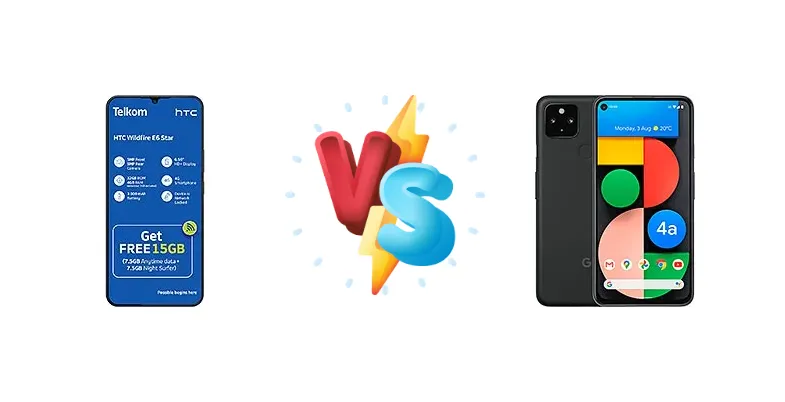
The smartphone landscape is crowded with 5G options, but finding a balance between affordability and performance can be tricky. We pit the HTC Wildfire E6 Star, a budget-focused offering, against the Google Pixel 4a 5G, known for its excellent camera and clean software, to determine which device delivers the best value for your money.
🏆 Quick Verdict
For the average user prioritizing camera quality and software experience, the Google Pixel 4a 5G is the clear winner. Its Snapdragon 765G chipset and Google's computational photography prowess significantly outperform what we can reasonably expect from the HTC Wildfire E6 Star, given its limited publicly available specifications.
| Network |
|---|
| 2G bands | GSM 850 / 900 / 1800 / 1900 | GSM 850 / 900 / 1800 / 1900 |
| 3G bands | HSDPA 850 / 900 / 2100 | HSDPA 850 / 900 / 1700(AWS) / 1900 / 2100 |
| 4G bands | LTE | 1, 2, 3, 4, 5, 7, 8, 12, 13, 14, 17, 18, 19, 20, 25, 26, 28, 29, 30, 32, 38, 39, 40, 41, 42, 46, 48, 66, 71 |
| 5G bands | - | 1, 2, 3, 5, 7, 8, 12, 28, 41, 66, 71, 77, 78 Sub6, mmWave (market dependant) |
| Speed | HSPA, LTE | HSPA, LTE, 5G |
| Technology | GSM / HSPA / LTE | GSM / HSPA / LTE / 5G |
| Launch |
|---|
| Announced | 2025, June 10 | 2020, September 30 |
| Status | Available. Released 2025, July | Available. Released 2020, November 05 |
| Body |
|---|
| Build | Glass front, plastic back, plastic frame | Glass front (Gorilla Glass 3), plastic back, plastic frame |
| Dimensions | - | 153.9 x 74 x 8.2 mm (Sub-6) or 8.5 mm (Sub-6 and mmWave) |
| SIM | Nano-SIM + Nano-SIM | Nano-SIM + eSIM |
| Weight | - | 168 g (5G Sub-6); 171 g ( 5G Sub-6 and mmWave) (5.93 oz) |
| Display |
|---|
| Protection | - | Corning Gorilla Glass 3 |
| Resolution | 720 x 1600 pixels, 20:9 ratio (~267 ppi density) | 1080 x 2340 pixels, 19.5:9 ratio (~413 ppi density) |
| Size | 6.56 inches, 103.9 cm2 | 6.2 inches, 95.7 cm2 (~84.1% screen-to-body ratio) |
| Type | TFT LCD | OLED, HDR |
| | - | Always-on display |
| Platform |
|---|
| CPU | - | Octa-core (1x2.4 GHz Kryo 475 Prime & 1x2.2 GHz Kryo 475 Gold & 6x1.8 GHz Kryo 475 Silver) |
| Chipset | - | Qualcomm SM7250 Snapdragon 765G 5G (7 nm) |
| GPU | - | Adreno 620 |
| OS | Android 13 (Go edition) | Android 11, upgradable to Android 14 |
| Memory |
|---|
| Card slot | microSDXC | No |
| Internal | 32GB 2GB RAM | 128GB 6GB RAM |
| | - | UFS 2.1 |
| Main Camera |
|---|
| Dual | - | 12.2 MP, f/1.7, 27mm (wide), 1/2.55", 1.4µm, dual pixel PDAF, OIS
16 MP, f/2.2, 107˚ (ultrawide), 1.0µm |
| Features | LED flash | LED flash, Pixel Shift, Auto-HDR, panorama |
| Single | 5 MP | - |
| Video | Yes | 4K@30/60fps, 1080p@30/60/120/240fps; gyro-EIS |
| Selfie camera |
|---|
| Features | - | HDR |
| Single | 5 MP | 8 MP, f/2.0, 24mm (wide), 1/4.0", 1.12µm |
| Video | Yes | 1080p@30fps |
| Sound |
|---|
| 3.5mm jack | - | Yes |
| 35mm jack | Yes | Yes |
| Loudspeaker | Yes | Yes, with stereo speakers |
| Comms |
|---|
| Bluetooth | Yes | 5.0, A2DP, LE, aptX HD |
| NFC | No | Yes |
| Positioning | Unspecified | GPS, GLONASS, GALILEO, QZSS, BDS |
| Radio | Unspecified | No |
| USB | USB Type-C | USB Type-C 3.1 |
| WLAN | Yes | Wi-Fi 802.11 a/b/g/n/ac, dual-band, Wi-Fi Direct |
| Features |
|---|
| Sensors | Accelerometer | Fingerprint (rear-mounted), accelerometer, gyro, proximity, compass, barometer |
| Battery |
|---|
| Charging | - | 18W wired, PD2.0 |
| Type | 3000 mAh | Li-Po 3885 mAh |
| Misc |
|---|
| Colors | Black | Just Black, Clearly White |
| Models | - | GD1YQ, G025I, G025E, G025H, G6QU3 |
| Price | About 40 EUR | About 140 EUR |
HTC Wildfire E6 Star
- Potentially very affordable
- 5G connectivity
- Likely lightweight design
- Unknown display quality
- Likely limited performance
- Uncertain camera capabilities
Google Pixel 4a 5G
- Excellent camera quality
- Smooth performance with Snapdragon 765G
- Clean and updated software experience
- Charging speed isn't the fastest
- Larger size may not suit all users
- Higher price point than the Wildfire E6 Star
Display Comparison
Without specific display details for the HTC Wildfire E6 Star, it's difficult to make a direct comparison. However, given its market positioning, we can assume it utilizes an LCD panel. The Pixel 4a 5G features a 6.7-inch FHD+ OLED display. OLED technology inherently provides superior contrast ratios and deeper blacks compared to LCDs, enhancing the viewing experience. The Pixel 4a 5G’s larger screen size also benefits media consumption. The 765G’s GPU will likely drive a smoother experience on the Pixel’s display, assuming comparable refresh rates (which are likely standard 60Hz on both).
Camera Comparison
The Pixel 4a 5G’s camera system is a major differentiator. While the exact sensor details of the Wildfire E6 Star are unknown, it’s unlikely to match the Pixel’s capabilities. The Pixel 4a 5G leverages Google’s renowned computational photography algorithms, delivering exceptional image quality, particularly in low-light conditions. Features like Night Sight and HDR+ significantly enhance photos, even with a relatively modest sensor size. The Pixel’s image processing prioritizes dynamic range and detail, resulting in more visually appealing images. The Wildfire E6 Star likely relies more on hardware specifications, which, without detailed information, are presumed to be less advanced.
Performance
The Google Pixel 4a 5G’s Qualcomm SM7250 Snapdragon 765G 5G (7 nm) chipset is the dominant force here. Its octa-core CPU, with a prime Kryo 475 core clocked at 2.4 GHz, provides a significant performance advantage over the likely MediaTek or Unisoc chipset found in the Wildfire E6 Star. The 765G’s Adreno 620 GPU will deliver a far superior gaming experience, capable of handling more demanding titles at higher settings. The 7nm process node of the Snapdragon 765G also contributes to better thermal efficiency, reducing the likelihood of throttling during sustained workloads. The Pixel 4a 5G’s performance will be noticeably smoother for multitasking and app loading.
Battery Life
The Pixel 4a 5G supports 18W wired charging with PD2.0, offering a reasonable charging speed. Without battery capacity information for the Wildfire E6 Star, it’s difficult to compare directly. However, the Pixel 4a 5G’s optimized software and efficient chipset contribute to good battery life. The Snapdragon 765G’s power efficiency, combined with Google’s software optimizations, allows the Pixel to deliver all-day battery life for moderate users. The 18W charging, while not the fastest available, provides a convenient top-up option.
Buying Guide
Buy the HTC Wildfire E6 Star if you need a basic, functional 5G smartphone and are operating on an extremely tight budget, prioritizing connectivity over advanced features. Buy the Google Pixel 4a 5G if you value a superior camera, smooth software updates, and a more refined user experience, even if it means spending a bit more.
Frequently Asked Questions
❓ Is the Snapdragon 765G in the Pixel 4a 5G still capable of playing modern games?
Yes, the Snapdragon 765G is a capable mid-range chipset that can handle most modern games at medium to high settings. While it won't match the performance of flagship processors, it provides a smooth and enjoyable gaming experience for the majority of mobile titles.
❓ How important are software updates for the Pixel 4a 5G?
Software updates are crucial for the Pixel 4a 5G. Google provides timely security patches and feature updates directly, ensuring the device remains secure and benefits from the latest Android enhancements. This is a significant advantage over devices with less frequent or delayed updates.
❓ Given the limited information on the HTC Wildfire E6 Star, what should I expect in terms of software experience?
Based on HTC's historical software approach, expect a more customized Android experience compared to the Pixel's stock Android. Updates may be less frequent and potentially delayed, depending on HTC's support schedule. The software experience is likely to be less polished and feature-rich than the Pixel 4a 5G.