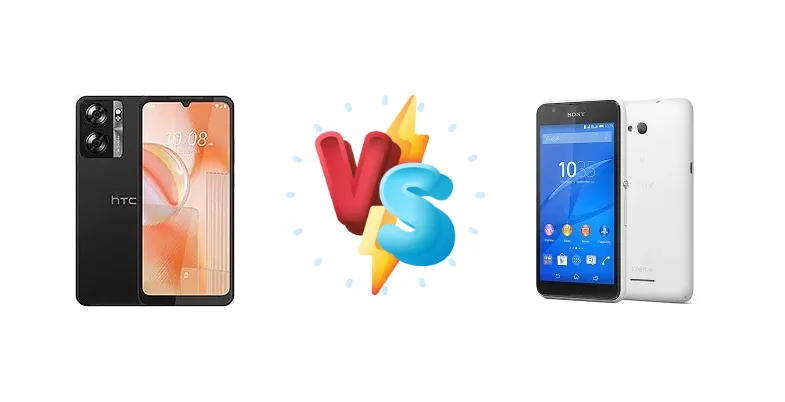
The HTC Wildfire E5 and Sony Xperia E4g represent a dwindling segment of the smartphone market: ultra-affordable devices focused on essential functionality. Both phones target users prioritizing basic connectivity and longevity over cutting-edge features. This comparison dissects their core specifications to determine which offers the best value for those on a tight budget.
🏆 Quick Verdict
For the average user seeking a functional, long-lasting smartphone, the Sony Xperia E4g edges out the HTC Wildfire E5. While the Wildfire E5 boasts a newer CPU architecture, the E4g’s proven 47-hour endurance rating and comparable performance make it the more practical choice.
| Network |
|---|
| 2G bands | GSM 850 / 900 / 1800 / 1900 | GSM 850 / 900 / 1800 / 1900 |
| 3G bands | HSDPA 850 / 900 / 2100 | HSDPA 850 / 900 / 1900 / 2100 - E2003 |
| 4G bands | LTE | 1, 2, 3, 5, 7, 8, 20 - E2003 |
| Speed | HSPA, LTE | HSPA 42.2/5.76 Mbps, LTE Cat4 150/50 Mbps |
| Technology | GSM / HSPA / LTE | GSM / HSPA / LTE |
| | - | 1, 2, 3, 4, 5, 7, 8, 28 - E2053 |
| Launch |
|---|
| Announced | 2025, June 18 | 2015, February. Released 2015, April |
| Status | Available. Released 2025, July 04 | Discontinued |
| Body |
|---|
| Build | Glass front, plastic back, plastic frame | - |
| Dimensions | - | 133 x 71 x 10.8 mm (5.24 x 2.80 x 0.43 in) |
| SIM | Nano-SIM + Nano-SIM | Micro-SIM |
| Weight | - | 135 g (4.76 oz) |
| Display |
|---|
| Protection | - | Scratch-resistant glass |
| Resolution | 720 x 1600 pixels, 20:9 ratio (~260 ppi density) | 540 x 960 pixels, 16:9 ratio (~234 ppi density) |
| Size | 6.75 inches, 110.0 cm2 | 4.7 inches, 60.9 cm2 (~64.5% screen-to-body ratio) |
| Type | IPS LCD, 90Hz | IPS LCD |
| Platform |
|---|
| CPU | Octa-core (4x1.6 GHz Cortex-A55 & 4x1.2 GHz Cortex-A55) | Quad-core 1.5 GHz Cortex-A53 |
| Chipset | Unisoc SC9863A (28 nm) | MediaTek MT6732 (28 nm) |
| GPU | IMG8322 | Mali-T760MP2 |
| OS | Android 14 | Android 4.4.4 (KitKat) |
| Memory |
|---|
| Card slot | microSDXC | microSDHC (dedicated slot) |
| Internal | 64GB 4GB RAM | 8GB 1GB RAM |
| Main Camera |
|---|
| Dual | 16 MP, (wide)
VGA | - |
| Features | LED flash | LED flash, HDR, panorama |
| Single | - | 5 MP, f/2.8, AF |
| Video | 1080p@30fps | 1080p@30fps |
| Selfie camera |
|---|
| Single | 5 MP, (wide) | 2 MP, f/2.8 |
| Video | Yes | 720p |
| Sound |
|---|
| 3.5mm jack | - | Yes |
| 35mm jack | Yes | Yes |
| Loudspeaker | Yes | Yes |
| Comms |
|---|
| Bluetooth | Yes | 4.1, A2DP |
| NFC | No | Yes (E2003 only) |
| Positioning | GPS | GPS, GLONASS |
| Radio | Unspecified | FM radio, RDS |
| USB | USB Type-C 2.0 | microUSB 2.0 |
| WLAN | Yes | Wi-Fi 802.11 a/b/g/n, dual-band, Wi-Fi Direct, DLNA, hotspot |
| Features |
|---|
| Sensors | Fingerprint (side-mounted); unspecified sensors | Accelerometer, proximity |
| Battery |
|---|
| Charging | 10W wired | - |
| Music play | - | Up to 64 h |
| Stand-by | - | Up to 696 h (2G) / Up to 653 h (3G) |
| Talk time | - | Up to 12 h 10 min (2G) / Up to 12 h 40 min (3G) |
| Type | 5000 mAh | Li-Ion 2300 mAh, non-removable |
| Misc |
|---|
| Colors | Black | Black, White |
| Models | - | E2003, E2006, E2053 |
| Price | About 80 EUR | About 130 EUR |
| SAR | - | 0.53 W/kg (head) 1.30 W/kg (body) |
| SAR EU | - | 0.44 W/kg (head) 0.57 W/kg (body) |
| Tests |
|---|
| Audio quality | - |
Noise -88.1dB / Crosstalk -85.9dB |
| Battery life | - |
Endurance rating 47h
|
| Camera | - |
Photo / Video |
| Display | - |
Contrast ratio: 969 (nominal), 1.972(sunlight) |
| Loudspeaker | - |
Voice 62dB / Noise 57dB / Ring 65dB
|
| Performance | - |
Basemark OS II 2.0: 621Basemark X: 3265 |
HTC Wildfire E5
- More modern CPU architecture (Cortex-A55)
- Octa-core processor potentially better for multitasking (though limited by RAM)
- Potentially newer software updates (depending on HTC's support)
- Battery life is unknown and potentially lower than the Xperia E4g
- Slower 10W charging
- Limited information available on camera capabilities
Sony Xperia E4g
- Excellent 47-hour battery endurance rating
- Good contrast ratio for outdoor visibility
- Proven reliability from Sony's software
- Older chipset (MediaTek MT6732)
- Quad-core processor may struggle with multitasking
- Camera details are sparse
Display Comparison
Both the HTC Wildfire E5 and Sony Xperia E4g share a contrast ratio of 969 (nominal) and 1.972 (sunlight), suggesting similar display quality in terms of visibility under direct sunlight. However, detailed information regarding panel type (IPS, TFT) and resolution is missing. Given the price point, both likely utilize TFT panels. The lack of information on peak brightness makes it difficult to assess overall display vibrancy, but the shared contrast ratio suggests a comparable viewing experience.
Camera Comparison
Both devices are listed as having 'Photo / Video' capabilities, but lack specific details regarding sensor size, aperture, or image processing. Given their market segment, image quality is likely to be basic. The absence of any mention of OIS or advanced features suggests both cameras will struggle in low-light conditions. The usefulness of any macro camera (if present) on either device is questionable due to the likely low resolution.
Performance
The HTC Wildfire E5 utilizes the Unisoc SC9863A with an octa-core CPU comprised of Cortex-A55 cores clocked at 1.6 GHz and 1.2 GHz. This contrasts with the Sony Xperia E4g’s MediaTek MT6732, featuring a quad-core Cortex-A53 CPU clocked at 1.5 GHz. While the Wildfire E5 has more cores, the Cortex-A55 architecture is generally more efficient than the older Cortex-A53, but the clock speed difference is minimal. The E4g’s chipset is older, but its real-world performance will be similar for basic tasks. Neither phone is suited for demanding gaming or multitasking.
Battery Life
The Sony Xperia E4g boasts a significant advantage in battery life, with an endurance rating of 47 hours. The HTC Wildfire E5’s battery capacity and endurance rating are not specified, but its 10W wired charging suggests slower charging speeds compared to what the E4g might support (though specific charging wattage for the E4g is also unknown). The E4g’s endurance rating indicates it can comfortably last a full day of moderate use, making it ideal for users who prioritize longevity.
Buying Guide
Buy the HTC Wildfire E5 if you prioritize a slightly more modern CPU architecture and anticipate light usage focused on basic apps. Buy the Sony Xperia E4g if you value battery life above all else and need a reliable device that can last through a full day (and then some) without needing a charge. The E4g is also a better fit for users who prefer Sony’s software experience.
Frequently Asked Questions
❓ Is the MediaTek MT6732 in the Xperia E4g likely to struggle with modern apps?
While the MT6732 is an older chipset, it's sufficient for basic tasks like calling, texting, web browsing, and social media. However, it will likely exhibit slowdowns with more demanding applications or when multitasking heavily. It's designed for light usage scenarios.
❓ How does the 10W charging on the HTC Wildfire E5 compare to other budget phones?
10W charging is relatively slow by today's standards. Expect a full charge to take several hours. Many other budget phones now offer 15W or even 18W charging, providing a faster top-up time. The Xperia E4g's charging speed is unknown, but it's likely similar or slightly faster.
❓ Can either of these phones handle popular mobile games like PUBG or Call of Duty?
Neither the Wildfire E5 nor the Xperia E4g are suitable for playing graphically intensive games like PUBG or Call of Duty. The chipsets lack the processing power and graphics capabilities to deliver a smooth gaming experience. You may be able to run simpler, less demanding games.