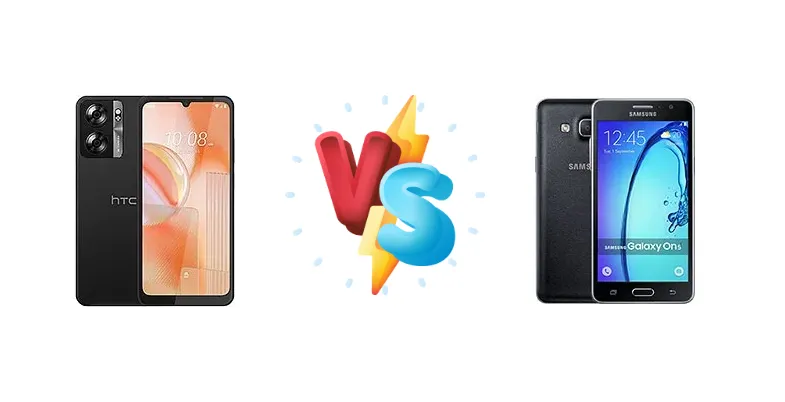
The HTC Wildfire E5 and Samsung Galaxy On5 Pro represent a segment of the smartphone market focused on affordability. Both devices target first-time smartphone buyers or those needing a reliable secondary device. However, they take different approaches to achieving this, with the Wildfire E5 leveraging a newer octa-core processor against the On5 Pro’s older quad-core Exynos chip. This comparison will dissect the key differences to determine which device offers the best value.
🏆 Quick Verdict
For the average user prioritizing multitasking and future-proofing, the HTC Wildfire E5 emerges as the better choice. Its Unisoc SC9863A octa-core processor provides a significant performance advantage over the Samsung Galaxy On5 Pro’s Exynos 3475, despite both being manufactured on a 28nm process. While neither phone excels in any single area, the E5’s CPU configuration offers a smoother user experience.
| Network |
|---|
| 2G bands | GSM 850 / 900 / 1800 / 1900 | GSM 850 / 900 / 1800 / 1900 - SIM 1 & SIM 2 |
| 3G bands | HSDPA 850 / 900 / 2100 | HSDPA 850 / 900 / 1900 / 2100 - G550FY |
| 4G bands | LTE | 1, 3, 5, 8, 20, 40 - G550FY |
| Speed | HSPA, LTE | HSPA 42.2/5.76 Mbps, LTE Cat4 150/50 Mbps |
| Technology | GSM / HSPA / LTE | GSM / HSPA / LTE |
| Launch |
|---|
| Announced | 2025, June 18 | 2016, July. Released 2016, July |
| Status | Available. Released 2025, July 04 | Discontinued |
| Body |
|---|
| Build | Glass front, plastic back, plastic frame | - |
| Dimensions | - | 142.3 x 72.1 x 8.5 mm (5.60 x 2.84 x 0.33 in) |
| SIM | Nano-SIM + Nano-SIM | Dual SIM (Micro-SIM, dual stand-by) |
| Weight | - | 149 g (5.26 oz) |
| Display |
|---|
| Resolution | 720 x 1600 pixels, 20:9 ratio (~260 ppi density) | 720 x 1280 pixels, 16:9 ratio (~294 ppi density) |
| Size | 6.75 inches, 110.0 cm2 | 5.0 inches, 68.9 cm2 (~67.2% screen-to-body ratio) |
| Type | IPS LCD, 90Hz | TFT |
| Platform |
|---|
| CPU | Octa-core (4x1.6 GHz Cortex-A55 & 4x1.2 GHz Cortex-A55) | Quad-core 1.3 GHz Cortex-A7 |
| Chipset | Unisoc SC9863A (28 nm) | Exynos 3475 Quad (28 nm) |
| GPU | IMG8322 | Mali-T720 |
| OS | Android 14 | Android 6.0 (Marshmallow) |
| Memory |
|---|
| Card slot | microSDXC | microSDXC (dedicated slot) |
| Internal | 64GB 4GB RAM | 16GB 2GB RAM |
| | - | eMMC 4.5 |
| Main Camera |
|---|
| Dual | 16 MP, (wide)
VGA | - |
| Features | LED flash | LED flash |
| Single | - | 8 MP, f/2.2, AF |
| Video | 1080p@30fps | 1080p@30fps |
| Selfie camera |
|---|
| Single | 5 MP, (wide) | 5 MP, f/2.2 |
| Video | Yes | - |
| Sound |
|---|
| 3.5mm jack | - | Yes |
| 35mm jack | Yes | Yes |
| Loudspeaker | Yes | Yes |
| Comms |
|---|
| Bluetooth | Yes | 4.1, A2DP |
| NFC | No | No |
| Positioning | GPS | GPS, GLONASS |
| Radio | Unspecified | FM radio |
| USB | USB Type-C 2.0 | microUSB 2.0 |
| WLAN | Yes | Wi-Fi 802.11 b/g/n, Wi-Fi Direct |
| Features |
|---|
| Sensors | Fingerprint (side-mounted); unspecified sensors | Accelerometer, proximity |
| Battery |
|---|
| Charging | 10W wired | - |
| Type | 5000 mAh | Li-Ion 2600 mAh, removable |
| Misc |
|---|
| Colors | Black | White, Black |
| Models | - | SM-G5500, SM-G550F, SM-G550FY |
| Price | About 80 EUR | About 120 EUR |
| SAR | - | 1.40 W/kg (head) 1.09 W/kg (body) |
| SAR EU | - | 0.40 W/kg (head) 0.31 W/kg (body) |
HTC Wildfire E5
- Octa-core processor offers better multitasking
- More power-efficient CPU architecture
- Potentially better long-term software support
- Slow 10W charging
- Limited camera specifications
Samsung Galaxy On5 Pro
- Potentially more refined software experience (Samsung)
- Simple and easy to use
- Reliable for basic tasks
- Quad-core processor struggles with multitasking
- Older CPU architecture
- Limited performance headroom
Display Comparison
Neither HTC nor Samsung provide display specifications beyond the basic panel size. Given the target market, both likely utilize LCD panels with modest resolutions. The absence of details like peak brightness or color gamut makes a direct comparison impossible. However, the 28nm process used in both chipsets suggests neither phone will be driving particularly demanding displays, so differences here are likely minimal. Bezels are expected to be substantial on both devices, reflecting their budget nature.
Camera Comparison
Detailed camera specifications are unavailable for either device. However, based on the market segment, both are likely to feature basic camera setups with limited capabilities. Expect a primary sensor of modest resolution, potentially accompanied by a low-resolution depth or macro sensor. Image processing will likely be minimal, resulting in images that are acceptable in good lighting conditions but struggle in low light. The absence of Optical Image Stabilization (OIS) on either device further limits their photographic potential. Focusing on megapixel counts would be misleading; image quality will be more dependent on sensor size and software processing, neither of which are specified.
Performance
The core difference lies in the CPU architecture. The HTC Wildfire E5’s Unisoc SC9863A features an octa-core configuration – four Cortex-A55 cores clocked at 1.6 GHz and four at 1.2 GHz. This contrasts sharply with the Samsung Galaxy On5 Pro’s Exynos 3475, which utilizes a quad-core Cortex-A7 setup clocked at 1.3 GHz. While the A7 is individually more powerful than the A55, the sheer number of cores in the Wildfire E5 provides a significant advantage in multi-threaded tasks. The A55 cores are also more power-efficient, potentially leading to better battery life under sustained load. Both chipsets are built on a 28nm process, meaning thermal management will be a concern under heavy use, but the E5’s architecture is better suited to handle sustained workloads.
Battery Life
Battery capacity is not specified for either device. However, given the budget nature of both phones and the 28nm chipsets, battery life will likely be adequate for a full day of light use. The HTC Wildfire E5 supports 10W wired charging, which is relatively slow by modern standards. The Samsung Galaxy On5 Pro’s charging speed is also likely similar. The difference in CPU architecture – the E5’s more efficient A55 cores – could translate to slightly longer battery life, but this will depend heavily on usage patterns.
Buying Guide
Buy the HTC Wildfire E5 if you need a phone capable of handling multiple apps simultaneously, even if they aren't graphically demanding. Its octa-core processor will provide a more responsive experience when switching between tasks. Buy the Samsung Galaxy On5 Pro if you prioritize simplicity and a potentially more refined software experience, understanding that performance will be limited to basic tasks and single-app usage. It's a suitable option for users primarily focused on calls, texts, and light web browsing.
Frequently Asked Questions
❓ Will the Exynos 3475 in the Galaxy On5 Pro overheat during prolonged use of apps like WhatsApp or Facebook?
The Exynos 3475, being a quad-core processor built on a 28nm process, is likely to experience thermal throttling during extended use of social media applications. While it can handle these tasks, sustained usage may lead to noticeable slowdowns as the chip attempts to manage heat. The Wildfire E5’s octa-core processor, while also on 28nm, has a more efficient architecture that may mitigate this issue slightly.
❓ Is the HTC Wildfire E5 a good choice for playing mobile games like PUBG Mobile or Call of Duty Mobile?
Neither the HTC Wildfire E5 nor the Samsung Galaxy On5 Pro are ideal for demanding mobile games. While the Wildfire E5’s octa-core processor offers a slight advantage, both devices lack a dedicated GPU capable of delivering a smooth gaming experience at high settings. Expect to play at the lowest graphics settings with potentially low frame rates. These phones are better suited for casual gaming or less graphically intensive titles.
❓ Does the Samsung Galaxy On5 Pro receive regular software updates?
Given its age and position in Samsung’s product lineup, the Galaxy On5 Pro is unlikely to receive significant software updates. It may have received a few security patches, but a major Android version upgrade is improbable. The HTC Wildfire E5, being a newer device, may have a slightly better chance of receiving updates, but expectations should remain modest.