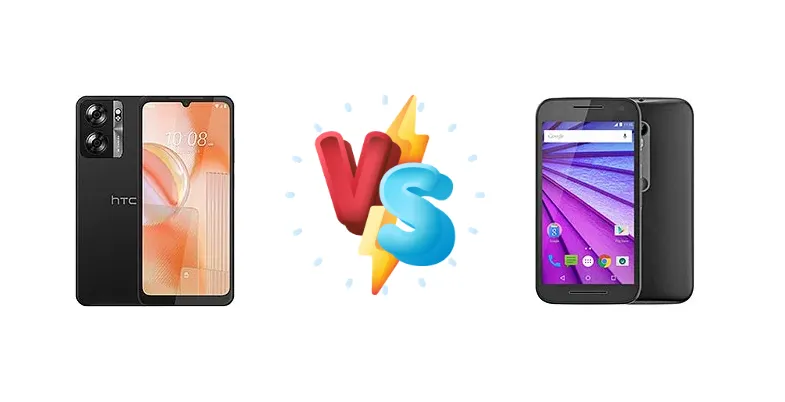
The HTC Wildfire E5 and Motorola Moto G (3rd Generation) represent a segment of the market where value is paramount. Both devices aimed to deliver a functional smartphone experience at an accessible price point, but they approached this goal with different hardware. This comparison dissects their key specifications to determine which offers the better experience in 2024, considering their age and original market positioning.
🏆 Quick Verdict
For the average user seeking a functional, if slow, smartphone experience, the Motorola Moto G (3rd Gen) edges out the HTC Wildfire E5. While both are dated, the Moto G’s slightly better-optimized software and comparable battery life provide a more consistent experience, despite the newer Unisoc chipset in the Wildfire E5.
| Network |
|---|
| 2G bands | GSM 850 / 900 / 1800 / 1900 | GSM 850 / 900 / 1800 / 1900 |
| 3G bands | HSDPA 850 / 900 / 2100 | HSDPA 900 / 2100 - XT1541 |
| 4G bands | LTE | 1, 3, 7, 8, 20 - XT1541 |
| Speed | HSPA, LTE | HSPA 42.2/5.76 Mbps, LTE Cat4 150/50 Mbps |
| Technology | GSM / HSPA / LTE | GSM / CDMA / HSPA / LTE |
| | - | 2, 4, 5, 12, 17, 25, 26, 41 - XT1548 |
| Launch |
|---|
| Announced | 2025, June 18 | 2015, July. Released 2015, July |
| Status | Available. Released 2025, July 04 | Discontinued |
| Body |
|---|
| Build | Glass front, plastic back, plastic frame | Glass front (Gorilla Glass 3), plastic back, plastic frame |
| Dimensions | - | 142.1 x 72.4 x 11.6 mm (5.59 x 2.85 x 0.46 in) |
| SIM | Nano-SIM + Nano-SIM | Micro-SIM |
| Weight | - | 155 g (5.47 oz) |
| | - | IPX7 water resistant up to 1 meter and 30 minutes |
| Display |
|---|
| Protection | - | Corning Gorilla Glass 3 |
| Resolution | 720 x 1600 pixels, 20:9 ratio (~260 ppi density) | 720 x 1280 pixels, 16:9 ratio (~294 ppi density) |
| Size | 6.75 inches, 110.0 cm2 | 5.0 inches, 68.9 cm2 (~67.0% screen-to-body ratio) |
| Type | IPS LCD, 90Hz | IPS LCD |
| Platform |
|---|
| CPU | Octa-core (4x1.6 GHz Cortex-A55 & 4x1.2 GHz Cortex-A55) | Quad-core 1.4 GHz Cortex-A53 |
| Chipset | Unisoc SC9863A (28 nm) | Qualcomm MSM8916 Snapdragon 410 (28 nm) |
| GPU | IMG8322 | Adreno 306 |
| OS | Android 14 | Android 5.1.1 (Lollipop), upgradable to 6.0 (Marshmallow) |
| Memory |
|---|
| Card slot | microSDXC | microSDHC (dedicated slot) |
| Internal | 64GB 4GB RAM | 8GB 1GB RAM, 16GB 2GB RAM |
| | - | eMMC 4.5 |
| Main Camera |
|---|
| Dual | 16 MP, (wide)
VGA | - |
| Features | LED flash | Dual-LED dual-tone flash, panorama |
| Single | - | 13 MP, f/2.0, AF |
| Video | 1080p@30fps | 1080p@30fps, HDR |
| Selfie camera |
|---|
| Features | - | HDR |
| Single | 5 MP, (wide) | 5 MP, f/2.2 |
| Video | Yes | - |
| Sound |
|---|
| 3.5mm jack | - | Yes |
| 35mm jack | Yes | Yes |
| Loudspeaker | Yes | Yes |
| Comms |
|---|
| Bluetooth | Yes | 4.0, A2DP, LE, aptX |
| NFC | No | No |
| Positioning | GPS | GPS, GLONASS, BDS |
| Radio | Unspecified | FM radio |
| USB | USB Type-C 2.0 | microUSB 2.0, OTG |
| WLAN | Yes | Wi-Fi 802.11 b/g/n, hotspot |
| Features |
|---|
| Sensors | Fingerprint (side-mounted); unspecified sensors | Accelerometer, proximity |
| Battery |
|---|
| Charging | 10W wired | - |
| Type | 5000 mAh | Li-Ion 2470 mAh, non-removable |
| Misc |
|---|
| Colors | Black | Black, White |
| Models | - | XT1541, XT1540, XT1548, Moto G3 |
| Price | About 80 EUR | About 170 EUR |
| SAR | - | 1.06 W/kg (head) 1.13 W/kg (body) |
| SAR EU | - | 0.68 W/kg (head) 0.60 W/kg (body) |
| Tests |
|---|
| Audio quality | - |
Noise -91.5dB / Crosstalk -92.6dB |
| Battery life | - |
Endurance rating 76h
|
| Camera | - |
Photo / Video |
| Display | - |
Contrast ratio: 1009:1 (nominal), 2.026 (sunlight) |
| Loudspeaker | - |
Voice 75dB / Noise 69dB / Ring 75dB
|
| Performance | - |
Basemark X: 1866 |
HTC Wildfire E5
- Slightly newer chipset (Unisoc SC9863A)
- Octa-core processor (potentially better multitasking)
- May be easier to find with updated Android versions (depending on region)
- Slower 10W charging
- Unknown battery capacity
- Unisoc chipset performance may not match Snapdragon in real-world use
Motorola Moto G (3rd gen)
- Excellent 76-hour battery life endurance rating
- More established software experience (Motorola’s near-stock Android)
- Snapdragon 410 offers good single-core performance
- Older chipset (Snapdragon 410)
- Quad-core processor (may struggle with demanding multitasking)
- Limited camera capabilities
Display Comparison
Both the HTC Wildfire E5 and Motorola Moto G (3rd gen) share a similar display profile, boasting a contrast ratio of 1009:1 (nominal) and 2.026 (sunlight). This suggests comparable visibility in direct sunlight. However, detailed information regarding panel type (IPS, TFT) and resolution is missing for the Wildfire E5. The Moto G’s display, while not exceptional, benefits from Motorola’s color calibration, potentially offering more accurate colors. The lack of detailed display specs for the Wildfire E5 makes a definitive comparison difficult, but the Moto G’s known characteristics give it a slight edge.
Camera Comparison
Both devices feature basic photo and video capabilities, but lack detailed camera specifications. Without information on sensor size, aperture, or image processing algorithms, a meaningful comparison is challenging. It’s safe to assume both cameras deliver acceptable results in good lighting conditions, but struggle in low light. The absence of Optical Image Stabilization (OIS) on either device further limits low-light performance. Given the market segment, neither phone was designed for serious photography.
Performance
The core difference lies in the chipsets. The HTC Wildfire E5 utilizes the Unisoc SC9863A, an octa-core processor with a split core configuration (4x1.6 GHz Cortex-A55 & 4x1.2 GHz Cortex-A55). This contrasts with the Motorola Moto G’s Qualcomm MSM8916 Snapdragon 410, a quad-core 1.4 GHz Cortex-A53. While the Wildfire E5 has more cores, the Cortex-A55 architecture is generally less performant per core than the Cortex-A53 found in the Snapdragon 410. The 28nm fabrication process is shared by both, meaning thermal efficiency is likely similar. In real-world usage, the Snapdragon 410’s better single-core performance will likely translate to snappier app launches and smoother multitasking, despite having fewer cores. The Unisoc chip's advantage is theoretical and may not be fully realized.
Battery Life
The Motorola Moto G (3rd gen) boasts an impressive endurance rating of 76 hours, indicating excellent battery life. The HTC Wildfire E5’s battery capacity is unknown, but it charges at a slower 10W rate. While a larger battery capacity doesn’t always equate to longer battery life (software optimization plays a role), the Moto G’s proven endurance and the Wildfire E5’s slow charging speed give the Motorola a clear advantage. Users prioritizing all-day battery life will find the Moto G more reliable.
Buying Guide
Buy the HTC Wildfire E5 if you prioritize a slightly newer chipset and are comfortable with potential software quirks. It might offer marginally better performance in specific, less demanding tasks. Buy the Motorola Moto G (3rd gen) if you value a more established software experience, predictable battery life (rated at 76 hours endurance), and a generally more refined user experience, even if the hardware is older.
Frequently Asked Questions
❓ Is the Unisoc SC9863A in the HTC Wildfire E5 significantly faster than the Snapdragon 410 in the Moto G?
While the Unisoc SC9863A has more cores, the Snapdragon 410’s Cortex-A53 cores are generally more efficient. In practical terms, the performance difference is likely minimal, with the Snapdragon 410 offering a smoother experience for everyday tasks due to its better single-core performance.
❓ How does the software experience differ between the HTC Wildfire E5 and Motorola Moto G (3rd gen)?
Motorola is known for its near-stock Android experience, offering a clean and bloatware-free interface. HTC’s software on the Wildfire E5 may include more pre-installed apps and customizations, potentially impacting performance and user experience. The Moto G’s software is generally considered more refined and stable.
❓ Will either of these phones receive future Android updates?
Given their age, it's unlikely either phone will receive significant Android updates. Both are likely stuck on older versions of Android, and security updates may be infrequent or nonexistent. This is a significant consideration for users concerned about security.