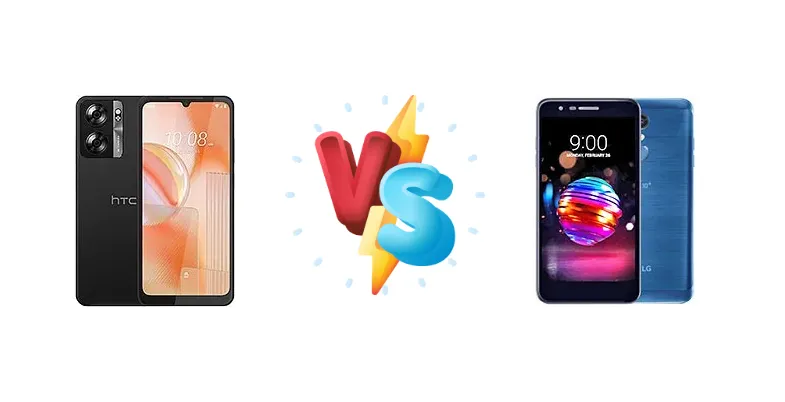
The HTC Wildfire E5 and LG K10 (2018) represent a segment of the smartphone market focused on affordability. Both devices target users prioritizing essential functionality over cutting-edge features. However, despite similar price points, significant differences in their underlying hardware – specifically the chipsets – dictate their real-world performance and suitability for different users.
🏆 Quick Verdict
For the average user seeking a basic smartphone experience, the HTC Wildfire E5 is the slightly better choice. Its Unisoc SC9863A, featuring newer Cortex-A55 cores, offers a modest performance advantage and potentially better efficiency compared to the LG K10 (2018)'s older Mediatek MT6750, despite both being manufactured on a 28nm process.
| Network |
|---|
| 2G bands | GSM 850 / 900 / 1800 / 1900 | GSM 850 / 900 / 1800 / 1900 |
| 3G bands | HSDPA 850 / 900 / 2100 | HSDPA 850 / 900 / 1900 / 2100 |
| 4G bands | LTE | 1, 3, 5, 7, 8, 20 |
| Speed | HSPA, LTE | HSPA 42.2/5.76 Mbps, LTE (2CA) Cat6 300/50 Mbps |
| Technology | GSM / HSPA / LTE | GSM / HSPA / LTE |
| Launch |
|---|
| Announced | 2025, June 18 | 2018, February. Released 2018, June |
| Status | Available. Released 2025, July 04 | Discontinued |
| Body |
|---|
| Build | Glass front, plastic back, plastic frame | Glass front, plastic back, plastic frame |
| Dimensions | - | 148.7 x 75.3 x 8.7 mm (5.85 x 2.96 x 0.34 in) |
| SIM | Nano-SIM + Nano-SIM | · Nano-SIM· Nano-SIM + Nano-SIM |
| Weight | - | 162 g (5.71 oz) |
| Display |
|---|
| Resolution | 720 x 1600 pixels, 20:9 ratio (~260 ppi density) | 720 x 1280 pixels, 16:9 ratio (~277 ppi density) |
| Size | 6.75 inches, 110.0 cm2 | 5.3 inches, 77.4 cm2 (~69.2% screen-to-body ratio) |
| Type | IPS LCD, 90Hz | IPS LCD |
| Platform |
|---|
| CPU | Octa-core (4x1.6 GHz Cortex-A55 & 4x1.2 GHz Cortex-A55) | Octa-core (4x1.5 GHz Cortex-A53 & 4x1.0 GHz Cortex-A53) |
| Chipset | Unisoc SC9863A (28 nm) | Mediatek MT6750 (28 nm) |
| GPU | IMG8322 | Mali-T860MP2 |
| OS | Android 14 | Android 7.1.2 (Nougat) |
| Memory |
|---|
| Card slot | microSDXC | microSDXC (dedicated slot) |
| Internal | 64GB 4GB RAM | 16GB 2GB RAM, 32GB 3GB RAM |
| | - | eMMC 5.1 |
| Main Camera |
|---|
| Dual | 16 MP, (wide)
VGA | - |
| Features | LED flash | LED flash, HDR |
| Single | - | 13 MP or 8 MP, PDAF |
| Video | 1080p@30fps | 1080p@30fps |
| Selfie camera |
|---|
| Single | 5 MP, (wide) | 8 MP or 5 MP |
| Video | Yes | - |
| Sound |
|---|
| 3.5mm jack | - | Yes |
| 35mm jack | Yes | Yes |
| Loudspeaker | Yes | Yes |
| Comms |
|---|
| Bluetooth | Yes | 4.2, A2DP, LE |
| NFC | No | Yes |
| Positioning | GPS | GPS, GLONASS |
| Radio | Unspecified | FM radio, RDS, recording |
| USB | USB Type-C 2.0 | microUSB 2.0 |
| WLAN | Yes | Wi-Fi 802.11 b/g/n, Wi-Fi Direct |
| Features |
|---|
| Sensors | Fingerprint (side-mounted); unspecified sensors | Fingerprint (rear-mounted), accelerometer, proximity, compass |
| Battery |
|---|
| Charging | 10W wired | - |
| Type | 5000 mAh | Li-Ion 3000 mAh, non-removable |
| Misc |
|---|
| Colors | Black | Aurora Black, Moroccan Blue, Terra Gold |
| Price | About 80 EUR | About 150 EUR |
HTC Wildfire E5
- Newer CPU architecture (Cortex-A55) for improved efficiency.
- Potentially smoother performance in everyday tasks.
- Likely to receive more software updates (depending on HTC's support).
- Limited brand recognition compared to LG.
- 10W charging is slow.
LG K10 (2018)
- Established brand reputation (LG).
- Potentially more refined software experience (depending on region).
- Wider availability in some markets.
- Older CPU architecture (Cortex-A53) resulting in lower efficiency.
- May receive fewer software updates.
- 10W charging is slow.
Display Comparison
Neither HTC nor LG provided detailed display specifications for these models. Given their market positioning, both likely utilize IPS LCD panels with 720p resolutions. The absence of information regarding peak brightness or color gamut suggests neither device prioritizes display quality. Bezels are expected to be substantial on both, reflecting their budget nature. The user experience will likely be similar in terms of visual fidelity.
Camera Comparison
Detailed camera specifications are scarce. Both phones likely feature a primary camera around 8-13MP, accompanied by lower-resolution sensors for depth sensing or macro photography. The LG K10 (2018) may have a slightly more refined image processing pipeline due to LG’s historical camera expertise, but the difference will be minimal. The 2MP macro cameras often found on phones in this segment are largely ineffective and should not be a deciding factor. Expect adequate performance in good lighting conditions, but struggles in low light.
Performance
The core difference lies in the chipsets. The HTC Wildfire E5’s Unisoc SC9863A utilizes four Cortex-A55 cores clocked at 1.6 GHz and another four at 1.2 GHz. The LG K10 (2018) employs the Mediatek MT6750 with four Cortex-A53 cores at 1.5 GHz and four at 1.0 GHz. While both are octa-core, the Cortex-A55 architecture is more efficient and offers improved performance per clock cycle compared to the older Cortex-A53. This translates to potentially snappier app loading and smoother multitasking on the Wildfire E5. Both chipsets are built on a 28nm process, meaning thermal management will be similar, but the A55’s efficiency could lead to slightly less heat generation under sustained load. Neither device is suited for demanding gaming.
Battery Life
Battery capacity is not specified for either device. However, given their similar form factors and target markets, they likely house batteries in the 2500-3000 mAh range. Both support 10W wired charging, which is slow by modern standards. Expect approximately 2.5-3.5 hours to fully charge from 0-100%. Real-world battery life will depend heavily on usage patterns, but both should comfortably last a full day with moderate use – primarily calls, messaging, and light browsing.
Buying Guide
Buy the HTC Wildfire E5 if you need a device primarily for calls, messaging, and light social media use, and appreciate the potential for slightly smoother performance with newer software updates. Buy the LG K10 (2018) if you prefer a potentially more established software ecosystem (depending on regional updates) and are comfortable with a chipset architecture that, while capable, is now several generations old.
Frequently Asked Questions
❓ Will the Unisoc SC9863A in the HTC Wildfire E5 struggle with popular apps like WhatsApp and Facebook?
While not a powerhouse, the Unisoc SC9863A with its Cortex-A55 cores is generally sufficient for running common social media apps like WhatsApp and Facebook. Expect some loading times and occasional lag when multitasking, but the core functionality should be usable. The newer architecture provides a slight edge over the LG K10's older chipset.
❓ Is the LG K10 (2018) still receiving Android updates?
Android update support for the LG K10 (2018) is limited and varies by region. It likely received its last major update to Android 8.0 Oreo or 8.1. Security patches may also be infrequent or unavailable. The HTC Wildfire E5, depending on HTC’s commitment, may receive more frequent updates, though it’s also unlikely to receive major Android version upgrades.
❓ Can either of these phones handle basic mobile gaming?
Both the HTC Wildfire E5 and LG K10 (2018) can handle very basic mobile games like Candy Crush or simple puzzle games. However, they will struggle with more demanding titles like PUBG Mobile or Call of Duty Mobile, even at the lowest settings. Expect low frame rates and significant lag.