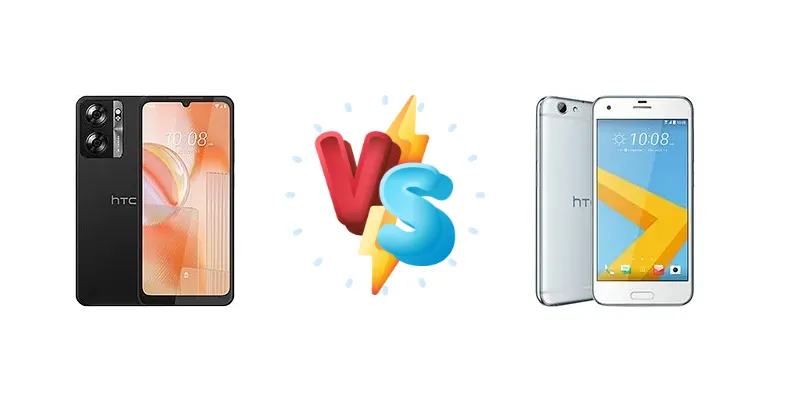
Both the HTC Wildfire E5 and the HTC One A9s represent HTC's attempts to capture the budget smartphone market. Released in different years, they offer similar price points but diverge significantly in their internal hardware. This comparison dissects the key differences between the Unisoc SC9863A-powered Wildfire E5 and the MediaTek Helio P10-equipped One A9s, focusing on performance, efficiency, and user experience.
🏆 Quick Verdict
For the average user prioritizing basic smartphone functionality, the HTC One A9s is the slightly better choice. While both phones share 10W charging and a similar price bracket, the Helio P10’s Cortex-A53 cores, clocked higher than the Wildfire E5’s Cortex-A55, provide a noticeable performance advantage in everyday tasks and light multitasking.
| Network |
|---|
| 2G bands | GSM 850 / 900 / 1800 / 1900 | GSM 850 / 900 / 1800 / 1900 |
| 3G bands | HSDPA 850 / 900 / 2100 | HSDPA 850 / 900 / 1900 / 2100 |
| 4G bands | LTE | 1, 2, 3, 4, 5, 7, 8, 12, 17, 28, 38, 40 |
| Speed | HSPA, LTE | HSPA 42.2/5.76 Mbps, LTE (2CA) Cat6 300/50 Mbps |
| Technology | GSM / HSPA / LTE | GSM / HSPA / LTE |
| Launch |
|---|
| Announced | 2025, June 18 | 2016, September. Released 2016, November |
| Status | Available. Released 2025, July 04 | Discontinued |
| Body |
|---|
| Build | Glass front, plastic back, plastic frame | - |
| Dimensions | - | 146.5 x 71.5 x 8 mm (5.77 x 2.81 x 0.31 in) |
| SIM | Nano-SIM + Nano-SIM | Nano-SIM |
| Weight | - | 149.8 g (5.29 oz) |
| Display |
|---|
| Protection | - | Corning Gorilla Glass (unspecified version) |
| Resolution | 720 x 1600 pixels, 20:9 ratio (~260 ppi density) | 720 x 1280 pixels, 16:9 ratio (~294 ppi density) |
| Size | 6.75 inches, 110.0 cm2 | 5.0 inches, 68.9 cm2 (~65.8% screen-to-body ratio) |
| Type | IPS LCD, 90Hz | Super LCD |
| Platform |
|---|
| CPU | Octa-core (4x1.6 GHz Cortex-A55 & 4x1.2 GHz Cortex-A55) | Octa-core (4x1.8 GHz Cortex-A53 & 4x1.0 GHz Cortex-A53) |
| Chipset | Unisoc SC9863A (28 nm) | Mediatek MT6755 Helio P10 (28 nm) |
| GPU | IMG8322 | Mali-T860MP2 |
| OS | Android 14 | Android 6.0 (Marshmallow), Sense UI |
| Memory |
|---|
| Card slot | microSDXC | microSDXC (dedicated slot) |
| Internal | 64GB 4GB RAM | 16GB 2GB RAM, 32GB 3GB RAM |
| | - | eMMC 5.1 |
| Main Camera |
|---|
| Dual | 16 MP, (wide)
VGA | - |
| Features | LED flash | LED flash, panorama, HDR |
| Single | - | 13 MP, f/2.2, 28mm (wide), 1.12µm, AF |
| Video | 1080p@30fps | 1080p@30fps |
| Selfie camera |
|---|
| Single | 5 MP, (wide) | 5 MP, f/2.8, 34mm (standard), 1/5.0", 1.12µm |
| Video | Yes | - |
| Sound |
|---|
| 3.5mm jack | - | Yes |
| 35mm jack | Yes | Yes |
| Loudspeaker | Yes | Yes |
| Comms |
|---|
| Bluetooth | Yes | 4.2, A2DP |
| NFC | No | Yes (payments only) |
| Positioning | GPS | GPS, GLONASS |
| Radio | Unspecified | FM radio |
| USB | USB Type-C 2.0 | microUSB 2.0 |
| WLAN | Yes | Wi-Fi 802.11 a/b/g/n |
| Features |
|---|
| Sensors | Fingerprint (side-mounted); unspecified sensors | Fingerprint (front-mounted), accelerometer, proximity, compass |
| Battery |
|---|
| Charging | 10W wired | 10W wired |
| Stand-by | - | Up to 432 h (3G) |
| Talk time | - | Up to 13 h (3G) |
| Type | 5000 mAh | Li-Ion 2300 mAh, non-removable |
| Misc |
|---|
| Colors | Black | Black, Silver, Gold |
| Models | - | One A9s |
| Price | About 80 EUR | About 150 EUR |
HTC Wildfire E5
- Potentially better battery life under light usage due to efficient cores.
- Unisoc chipset may receive longer software support.
- Lower price point (potentially).
- Slower CPU performance compared to the One A9s.
- Likely less responsive user experience.
- Limited gaming capabilities.
HTC One A9s
- Faster CPU performance for smoother multitasking.
- More responsive user experience.
- Slightly better image processing (potentially).
- Potentially shorter battery life under heavy loads.
- Older chipset architecture.
- Software updates may be limited.
Display Comparison
Neither HTC provides detailed display specifications. Given their market positioning, both likely utilize IPS LCD panels with 720p resolutions. The absence of information regarding peak brightness or color gamut suggests neither phone excels in display quality. Bezels are expected to be substantial on both devices, typical of budget smartphones. Color accuracy is likely to be standard for this price range, prioritizing power efficiency over fidelity.
Camera Comparison
Detailed camera specifications are scarce for both devices. It’s safe to assume both feature a primary rear camera, likely around 8-13MP, and a front-facing camera for selfies. The presence of a 2MP macro lens on either device is largely marketing fluff, offering minimal practical benefit due to the low resolution and lack of optical image stabilization (OIS). Image processing will likely be basic on both, relying on software algorithms to enhance photos, but don't expect flagship-level results. The A9s *might* have a slight edge due to MediaTek’s image signal processor (ISP) being marginally more advanced.
Performance
The core difference lies in the chipsets. The HTC One A9s’ MediaTek Helio P10 features an octa-core configuration with four Cortex-A53 cores clocked at 1.8 GHz and four at 1.0 GHz. The Wildfire E5 utilizes the Unisoc SC9863A, also octa-core, but with four Cortex-A55 cores at 1.6 GHz and four at 1.2 GHz. While both are 28nm chips, the Cortex-A53 architecture in the Helio P10 generally offers better single-core performance than the A55, resulting in snappier app launches and smoother multitasking. The higher clock speeds on the A9s further contribute to this advantage. However, the A55 cores in the Wildfire E5 are more power-efficient, potentially leading to slightly better battery life under light loads.
Battery Life
Both phones are equipped with 10W wired charging, indicating a similar charging experience – expect over 3 hours for a full charge. Battery capacity is not specified, but given the hardware and target market, both likely house batteries in the 2500-3000 mAh range. The Unisoc SC9863A’s more efficient Cortex-A55 cores in the Wildfire E5 could translate to slightly longer battery life during light usage, such as browsing or messaging. However, the Helio P10’s performance advantage means it will drain the battery faster under heavier loads.
Buying Guide
Buy the HTC Wildfire E5 if you need a very basic smartphone for essential communication and light app usage, and prioritize potential long-term software support from Unisoc. Buy the HTC One A9s if you prefer a slightly more responsive experience for social media, web browsing, and occasional gaming, and are comfortable with the potential for older software versions.
Frequently Asked Questions
❓ Will the Helio P10 in the One A9s struggle with modern apps?
The Helio P10 is an older chipset, and while it can handle basic apps like social media and messaging, it will likely struggle with demanding applications or graphically intensive games. Expect slowdowns and potential crashes when multitasking with several apps open.
❓ Is the Unisoc SC9863A a reliable chipset for long-term use?
Unisoc has been steadily improving its chipsets, and the SC9863A is generally considered a reliable option for entry-level smartphones. However, it lacks the brand recognition and optimization of Qualcomm or MediaTek, so long-term software support and performance consistency may be less predictable.
❓ Can either of these phones handle popular games like PUBG Mobile?
Both phones will struggle to run PUBG Mobile smoothly, even at the lowest settings. The Helio P10 in the One A9s will offer a slightly better experience, but expect significant frame rate drops and lag. These phones are not designed for gaming.
❓ What about software updates for these devices?
Software update support is a significant concern for both devices. Given their age and budget positioning, it's unlikely either phone will receive major Android version updates. Security patches may be infrequent or non-existent. The Wildfire E5 *might* benefit from continued support from Unisoc, but this is not guaranteed.