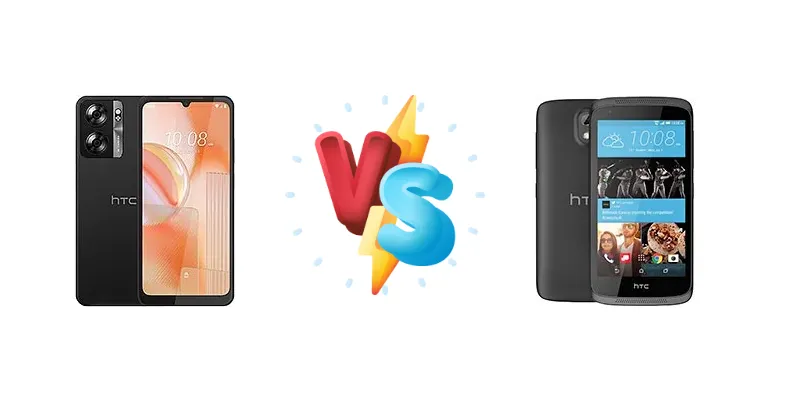
The HTC Wildfire E5 and Desire 526 represent HTC's attempts to capture the ultra-budget smartphone market. Released in different eras, they both target users prioritizing affordability over cutting-edge features. This comparison dissects their core differences, focusing on the significant chipset disparity and its impact on real-world performance.
🏆 Quick Verdict
For the average user seeking a functional, albeit basic, smartphone experience, the HTC Wildfire E5 emerges as the better choice. Its Unisoc SC9863A chipset, with its octa-core configuration, provides a noticeable performance advantage over the quad-core Snapdragon 210 in the Desire 526, making it more responsive for everyday tasks.
| Network |
|---|
| 2G bands | GSM 850 / 900 / 1800 / 1900 | GSM 850 / 900 / 1800 / 1900 |
| 3G bands | HSDPA 850 / 900 / 2100 | HSDPA 850 / 1900 - USA |
| 4G bands | LTE | 2, 4, 13 - USA |
| Speed | HSPA, LTE | HSPA, LTE |
| Technology | GSM / HSPA / LTE | GSM / HSPA / LTE |
| Launch |
|---|
| Announced | 2025, June 18 | 2015, July. Released 2015, August |
| Status | Available. Released 2025, July 04 | Discontinued |
| Body |
|---|
| Build | Glass front, plastic back, plastic frame | - |
| Dimensions | - | 140 x 70 x 9.9 mm (5.51 x 2.76 x 0.39 in) |
| SIM | Nano-SIM + Nano-SIM | Nano-SIM |
| Weight | - | 156 g (5.50 oz) |
| Display |
|---|
| Resolution | 720 x 1600 pixels, 20:9 ratio (~260 ppi density) | 540 x 960 pixels, 16:9 ratio (~234 ppi density) |
| Size | 6.75 inches, 110.0 cm2 | 4.7 inches, 60.9 cm2 (~62.1% screen-to-body ratio) |
| Type | IPS LCD, 90Hz | IPS LCD |
| Platform |
|---|
| CPU | Octa-core (4x1.6 GHz Cortex-A55 & 4x1.2 GHz Cortex-A55) | Quad-core 1.1 GHz Cortex-A7 |
| Chipset | Unisoc SC9863A (28 nm) | Qualcomm MSM8909 Snapdragon 210 (28 nm) |
| GPU | IMG8322 | Adreno 304 |
| OS | Android 14 | Android 5.1 (Lollipop), Sense 7 UI |
| Memory |
|---|
| Card slot | microSDXC | microSDXC (dedicated slot) |
| Internal | 64GB 4GB RAM | 8GB 1.5GB RAM |
| | - | eMMC 4.5 |
| Main Camera |
|---|
| Dual | 16 MP, (wide)
VGA | - |
| Features | LED flash | LED flash |
| Single | - | 8 MP, f/2.2, AF |
| Video | 1080p@30fps | 720p@30fps |
| Selfie camera |
|---|
| Single | 5 MP, (wide) | 2 MP |
| Video | Yes | 720p |
| Sound |
|---|
| 3.5mm jack | - | Yes |
| 35mm jack | Yes | Yes |
| Loudspeaker | Yes | Yes |
| Comms |
|---|
| Bluetooth | Yes | 4.1, A2DP |
| NFC | No | No |
| Positioning | GPS | GPS |
| Radio | Unspecified | FM radio |
| USB | USB Type-C 2.0 | microUSB 2.0 |
| WLAN | Yes | Wi-Fi 802.11 b/g/n, DLNA, hotspot |
| Features |
|---|
| Sensors | Fingerprint (side-mounted); unspecified sensors | Accelerometer, proximity |
| Battery |
|---|
| Charging | 10W wired | - |
| Type | 5000 mAh | Li-Ion 2000 mAh, removable |
| Misc |
|---|
| Colors | Black | Black |
| Models | - | HTCD100LVWPP |
| Price | About 80 EUR | About 110 EUR |
HTC Wildfire E5
- More powerful octa-core processor
- More efficient CPU architecture (Cortex-A55)
- Potentially better multitasking performance
- Limited brand support and software updates
- Likely basic camera performance
HTC Desire 526
- Potentially lower price point
- Qualcomm chipset (potentially better software compatibility)
- Simple and straightforward user experience
- Significantly weaker processor
- Outdated CPU architecture (Cortex-A7)
- Struggles with multitasking and demanding apps
Display Comparison
Neither device boasts a standout display. Given both are 28nm devices targeting the lowest price brackets, display specifications are likely similar – likely 720p resolution and IPS LCD panels. However, detailed specs are unavailable. The focus here isn't on visual fidelity, but on basic usability. Expect similar viewing angles and color reproduction, adequate for basic tasks but not ideal for media consumption.
Camera Comparison
Camera details are sparse for both devices. It's safe to assume both feature basic camera setups geared towards casual snapshots. Without specific sensor sizes or aperture information, a direct comparison is difficult. However, given the overall positioning of these phones, image quality will be limited, particularly in low-light conditions. Expect similar levels of detail and dynamic range, with neither device excelling in photography.
Performance
The core difference lies in the chipsets. The HTC Wildfire E5’s Unisoc SC9863A is an octa-core processor featuring four Cortex-A55 cores clocked at 1.6 GHz and four at 1.2 GHz. This contrasts sharply with the Desire 526’s Qualcomm MSM8909 Snapdragon 210, a quad-core processor with Cortex-A7 cores clocked at 1.1 GHz. The Cortex-A55 architecture in the Wildfire E5 is more efficient and offers better performance per watt than the older Cortex-A7. The higher core count further enhances multitasking capabilities. While both are 28nm, the architectural improvements in the Unisoc chip translate to a more responsive user experience, especially when running multiple apps or browsing the web. The Snapdragon 210 will likely struggle with even moderately demanding applications.
Battery Life
Both devices feature 10W wired charging. Battery capacity is not specified, but given the target market, it's likely around 2500-3000 mAh for both. The more efficient Unisoc SC9863A in the Wildfire E5 *may* translate to slightly better battery life, as it requires less power to perform the same tasks as the Snapdragon 210. However, the difference will likely be marginal, and both phones will require daily charging with moderate use.
Buying Guide
Buy the HTC Wildfire E5 if you need a smartphone capable of handling more than just the most basic apps and require a slightly smoother multitasking experience. It's suitable for users who occasionally browse the web, use social media, or engage in light messaging. Buy the HTC Desire 526 if your primary needs are limited to phone calls, text messaging, and very light app usage, and you prioritize a potentially lower price point, understanding its performance limitations.
Frequently Asked Questions
❓ Will the HTC Desire 526 struggle with modern social media apps like Facebook and Instagram?
Yes, the Snapdragon 210's limited processing power and older architecture will likely result in slow loading times, laggy scrolling, and potential crashes when using demanding social media apps. The Wildfire E5 will offer a significantly smoother experience.
❓ Is the Unisoc SC9863A in the Wildfire E5 capable of running popular mobile games?
While the Wildfire E5 can run some less demanding mobile games, don't expect a high-performance gaming experience. The chipset is not designed for graphically intensive titles. Expect low frame rates and potentially long loading times. The Snapdragon 210 will struggle even more with gaming.
❓ Which phone is more likely to receive software updates?
Neither phone is likely to receive significant software updates. Both are entry-level devices from a period where HTC's software support was already limited. Expect minimal security patches, if any.
❓ Does either phone support 4G LTE connectivity?
While not explicitly stated, both devices likely support 4G LTE, as it was becoming standard during their respective release periods. However, the specific LTE bands supported may vary, so compatibility with your carrier should be verified.