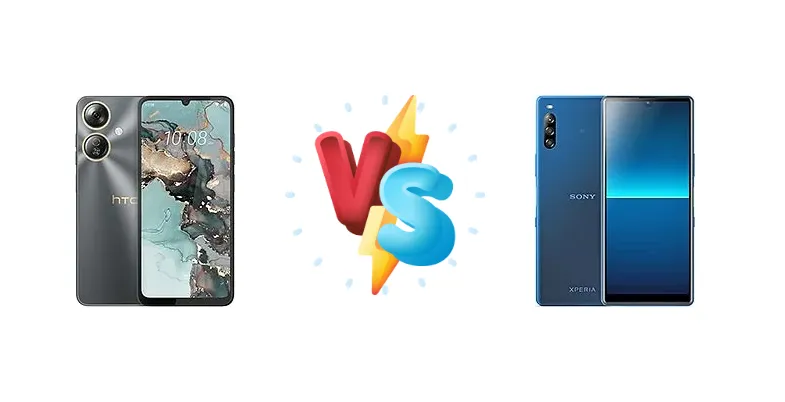
The HTC Wildfire E5 Plus and Sony Xperia L4 represent distinct approaches to the ultra-budget smartphone market. The Wildfire E5 Plus leverages the newer Unisoc T606 chipset, while the Xperia L4 relies on the established Mediatek Helio P22. This comparison dives deep into their specifications to determine which device offers the best experience for users prioritizing affordability.
🏆 Quick Verdict
For the average user seeking a slightly more responsive experience, the HTC Wildfire E5 Plus emerges as the better choice. Its Unisoc T606 chipset, featuring Cortex-A75 cores, provides a noticeable performance edge over the Xperia L4’s all-Cortex-A53 configuration, despite both being fabricated on a 12nm process.
| Network |
|---|
| 2G bands | GSM 850 / 900 / 1800 / 1900 | GSM 850 / 900 / 1800 / 1900 |
| 3G bands | HSDPA 850 / 900 / 2100 | HSDPA 850 / 900 / 1900 / 2100 |
| 4G bands | 1, 3, 5, 7, 8, 20, 38, 40, 41 | 1, 2, 3, 5, 7, 8, 20, 40 |
| Speed | HSPA, LTE | HSPA 42.2/5.76 Mbps, LTE (2CA) Cat6 300/50 Mbps |
| Technology | GSM / HSPA / LTE | GSM / HSPA / LTE |
| Launch |
|---|
| Announced | 2025, February 15 | 2020, February 20. Released 2020, April 28 |
| Status | Available. Released 2025, March 11 | Discontinued |
| Body |
|---|
| Build | Glass front, plastic back, plastic frame | Glass front, plastic back, plastic frame |
| Dimensions | 168.4 x 77.9 x 9.5 mm (6.63 x 3.07 x 0.37 in) | 159 x 71 x 8.7 mm (6.26 x 2.80 x 0.34 in) |
| SIM | Nano-SIM + Nano-SIM | · Nano-SIM· Nano-SIM + Nano-SIM |
| Weight | 218 g (7.69 oz) | 178 g (6.28 oz) |
| Display |
|---|
| Resolution | 720 x 1600 pixels, 20:9 ratio (~260 ppi density) | 720 x 1680 pixels, 21:9 ratio (~295 ppi density) |
| Size | 6.75 inches, 110.0 cm2 (~83.9% screen-to-body ratio) | 6.2 inches, 89.8 cm2 (~79.5% screen-to-body ratio) |
| Type | IPS LCD, 90Hz | IPS LCD |
| Platform |
|---|
| CPU | Octa-core (2x1.6 GHz Cortex-A75 & 6x1.6 GHz Cortex-A55) | Octa-core 2.0 GHz Cortex-A53 |
| Chipset | Unisoc T606 (12 nm) | Mediatek MT6762 Helio P22 (12 nm) |
| GPU | Mali-G57 MP1 | PowerVR GE8320 |
| OS | Android 14 | Android 9.0 (Pie) |
| Memory |
|---|
| Card slot | microSDXC (uses shared SIM slot) | microSDXC (uses shared SIM slot) |
| Internal | 128GB 6GB RAM | 64GB 3GB RAM |
| | - | eMMC 5.1 |
| Main Camera |
|---|
| Dual | 50 MP, f/1.8, (wide), AF
2 MP, f/2.4 | - |
| Features | LED flash | LED flash, HDR, panorama |
| Triple | - | 13 MP, f/2.0, 26mm (wide), 1/3.0", PDAF
5 MP, f/2.2, 17mm (ultrawide), 1/5.0", 1.12µm
Auxiliary lens |
| Video | 1080p@30fps | 1080p@30fps |
| Selfie camera |
|---|
| Single | 16 MP, f/2.2, (wide) | 8 MP, f/2.0, 27mm (wide), 1/4.0", 1.12µm |
| Video | Yes | 1080p@30fps |
| Sound |
|---|
| 3.5mm jack | - | Yes |
| 35mm jack | Yes | Yes |
| Loudspeaker | Yes | Yes |
| Comms |
|---|
| Bluetooth | 5.0, A2DP, LE | 5.0, A2DP, LE |
| NFC | No | Yes |
| Positioning | GPS, GLONASS, GALILEO | GPS, GLONASS |
| Radio | Unspecified | FM radio |
| USB | USB Type-C 2.0 | USB Type-C 2.0 |
| WLAN | Wi-Fi 802.11 a/b/g/n/ac, dual-band | Wi-Fi 802.11 a/b/g/n, dual-band, Wi-Fi Direct |
| Features |
|---|
| Sensors | Fingerprint (side-mounted), accelerometer, proximity, compass | Fingerprint (side-mounted), accelerometer, proximity, compass |
| Battery |
|---|
| Charging | - | USB Power Delivery |
| Type | 5000 mAh | Li-Ion 3580 mAh |
| Misc |
|---|
| Colors | Gray, Blue | Black, Blue |
| Models | - | XQ-AD52, XQ-AD51 |
| Price | About 90 EUR | About 200 EUR |
HTC Wildfire E5 Plus
- More modern CPU architecture (Cortex-A75 cores)
- Potentially faster application loading and multitasking
- Likely better power efficiency with Unisoc T606
- Likely slower charging due to lack of USB Power Delivery
- Less established brand reputation than Sony
Sony Xperia L4
- USB Power Delivery for faster charging
- Sony’s brand recognition and software experience
- Potentially better color calibration on the display
- Older CPU architecture (all Cortex-A53 cores)
- Slower overall performance compared to the Wildfire E5 Plus
- May exhibit more throttling under sustained load
Display Comparison
Neither device boasts a standout display. Both are likely to feature LCD panels, common in this price bracket. The absence of detailed display specifications (resolution, brightness) necessitates relying on brand tendencies. Sony typically offers slightly better color calibration, but the Wildfire E5 Plus’s larger screen size (assumed, based on typical Wildfire models) could provide a more immersive viewing experience. Bezels are expected to be substantial on both devices, reflecting their budget positioning.
Camera Comparison
Camera performance is likely to be similar, with both devices targeting basic photography needs. The absence of detailed sensor information suggests both will feature modest sensors. The Xperia L4’s potential for Sony’s image processing algorithms could offer slightly more refined results, but the Wildfire E5 Plus’s chipset might provide faster image processing speeds. Expect limited low-light performance and a reliance on software enhancements. Any macro or depth sensors are likely to be low resolution and offer minimal benefit.
Performance
The core difference lies in the chipsets. The HTC Wildfire E5 Plus’s Unisoc T606 utilizes a heterogeneous core configuration – two Cortex-A75 cores clocked at 1.6 GHz paired with six Cortex-A55 cores, also at 1.6 GHz. This architecture provides a significant boost in single-core performance compared to the Sony Xperia L4’s Mediatek Helio P22, which features eight Cortex-A53 cores clocked at 2.0 GHz. While the Helio P22’s higher clock speed might seem advantageous, the A75 cores in the T606 offer superior Instructions Per Clock (IPC), translating to faster application loading and smoother multitasking. The Unisoc chip’s newer design also suggests potential optimizations for power efficiency. Both likely pair with 3GB or 4GB of RAM, further emphasizing the chipset as the primary performance differentiator.
Battery Life
Battery capacity is not specified for either device, but both are likely to house batteries in the 4000-5000 mAh range, typical for this segment. The Sony Xperia L4’s inclusion of USB Power Delivery is a key advantage, allowing for faster charging with compatible chargers. The Wildfire E5 Plus will likely rely on standard micro-USB charging, resulting in slower charging times. While the T606’s potential power efficiency could contribute to slightly longer battery life, the L4’s faster charging capability provides a more convenient user experience.
Buying Guide
Buy the HTC Wildfire E5 Plus if you need a phone capable of handling everyday tasks with a bit more fluidity and appreciate a chipset with a more modern CPU architecture. Buy the Sony Xperia L4 if you prioritize USB Power Delivery for faster charging compatibility and value the Sony brand’s software experience, even if it comes with a performance trade-off.
Frequently Asked Questions
❓ Will the Mediatek Helio P22 in the Xperia L4 struggle with modern mobile games?
Yes, the Helio P22 is a relatively older chipset and will likely struggle with demanding games. Expect low frame rates and the need to lower graphics settings significantly, even for less intensive titles. The Unisoc T606 in the Wildfire E5 Plus offers a more capable gaming experience, though still limited by the budget nature of both devices.
❓ Does the Unisoc T606 chipset in the Wildfire E5 Plus support VoLTE and Wi-Fi calling?
VoLTE and Wi-Fi calling support depend on carrier compatibility and software implementation. While the Unisoc T606 is technically capable of supporting these features, it's crucial to verify compatibility with your specific mobile carrier before purchasing the HTC Wildfire E5 Plus.
❓ How much faster is charging on the Sony Xperia L4 with USB Power Delivery compared to the HTC Wildfire E5 Plus?
The Xperia L4, with USB Power Delivery, can potentially charge at up to 18W with a compatible charger. The Wildfire E5 Plus, using standard micro-USB, will likely be limited to 5W or 10W charging. This translates to a significantly faster 0-100% charge time on the Xperia L4, potentially cutting charging time in half.