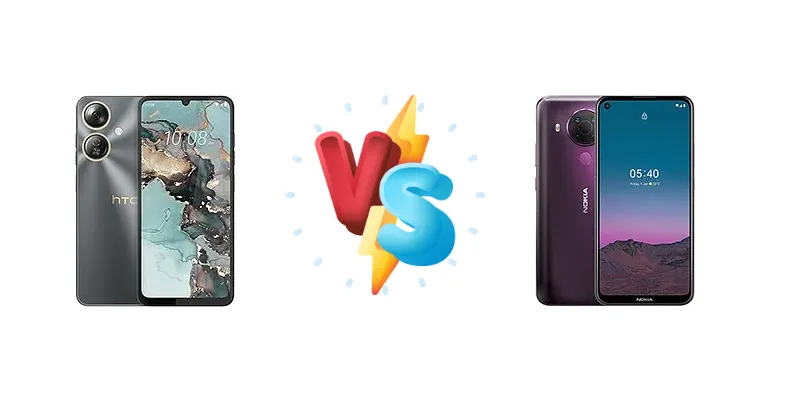
The HTC Wildfire E5 Plus and Nokia 5.4 represent two distinct approaches to the budget smartphone market. The Wildfire E5 Plus leverages the efficiency of Unisoc’s T606 chipset, while the Nokia 5.4 relies on Qualcomm’s Snapdragon 662. This comparison dives deep into the architectural differences and real-world implications of these chipsets, helping you determine which phone best suits your needs.
🏆 Quick Verdict
For the average user prioritizing consistent performance and a more established software experience, the Nokia 5.4 emerges as the better choice. The Snapdragon 662, built on an 11nm process, offers a noticeable performance advantage over the Unisoc T606, despite the slower charging speed. However, the Wildfire E5 Plus may appeal to those seeking a potentially more power-efficient device.
| Network |
|---|
| 2G bands | GSM 850 / 900 / 1800 / 1900 | GSM 850 / 900 / 1800 / 1900 |
| 3G bands | HSDPA 850 / 900 / 2100 | HSDPA 850 / 900 / 1900 / 2100 - International |
| 4G bands | 1, 3, 5, 7, 8, 20, 38, 40, 41 | 1, 3, 5, 7, 8, 20, 28, 38, 40, 41 - International |
| Speed | HSPA, LTE | HSPA 42.2/5.76 Mbps, LTE Cat4 150/50 Mbps |
| Technology | GSM / HSPA / LTE | GSM / HSPA / LTE |
| | - | 1, 2, 3, 4, 5, 7, 8, 12, 13, 17, 28, 66 - NA, LATAM |
| Launch |
|---|
| Announced | 2025, February 15 | 2020, December 15. Released 2020, December 25 |
| Status | Available. Released 2025, March 11 | Discontinued |
| Body |
|---|
| Build | Glass front, plastic back, plastic frame | - |
| Dimensions | 168.4 x 77.9 x 9.5 mm (6.63 x 3.07 x 0.37 in) | 161 x 76 x 8.7 mm (6.34 x 2.99 x 0.34 in) |
| SIM | Nano-SIM + Nano-SIM | · Nano-SIM· Nano-SIM + Nano-SIM |
| Weight | 218 g (7.69 oz) | 181 g (6.38 oz) |
| Display |
|---|
| Resolution | 720 x 1600 pixels, 20:9 ratio (~260 ppi density) | 720 x 1560 pixels, 19.5:9 ratio (~269 ppi density) |
| Size | 6.75 inches, 110.0 cm2 (~83.9% screen-to-body ratio) | 6.39 inches, 100.2 cm2 (~81.9% screen-to-body ratio) |
| Type | IPS LCD, 90Hz | IPS LCD, 400 nits (typ) |
| Platform |
|---|
| CPU | Octa-core (2x1.6 GHz Cortex-A75 & 6x1.6 GHz Cortex-A55) | Octa-core (4x2.0 GHz Kryo 260 Gold & 4x1.8 GHz Kryo 260 Silver) |
| Chipset | Unisoc T606 (12 nm) | Qualcomm SM6115 Snapdragon 662 (11 nm) |
| GPU | Mali-G57 MP1 | Adreno 610 |
| OS | Android 14 | Android 10, upgradable to Android 12 |
| Memory |
|---|
| Card slot | microSDXC (uses shared SIM slot) | microSDXC (dedicated slot) |
| Internal | 128GB 6GB RAM | 64GB 4GB RAM, 64GB 6GB RAM, 128GB 4GB RAM |
| Main Camera |
|---|
| Dual | 50 MP, f/1.8, (wide), AF
2 MP, f/2.4 | - |
| Features | LED flash | LED flash, HDR, panorama |
| Quad | - | 48 MP, f/1.8, (wide), PDAF
5 MP, 13mm (ultrawide)
2 MP (macro)
Auxiliary lens |
| Video | 1080p@30fps | 1080p@30fps |
| Selfie camera |
|---|
| Single | 16 MP, f/2.2, (wide) | 16 MP, f/2.0, (wide) |
| Video | Yes | 1080p@30fps |
| Sound |
|---|
| 3.5mm jack | - | Yes |
| 35mm jack | Yes | Yes |
| Loudspeaker | Yes | Yes |
| Comms |
|---|
| Bluetooth | 5.0, A2DP, LE | 4.2, A2DP, aptX Adaptive |
| NFC | No | Yes (market/region dependent) |
| Positioning | GPS, GLONASS, GALILEO | GPS, GLONASS, GALILEO, BDS |
| Radio | Unspecified | FM radio |
| USB | USB Type-C 2.0 | USB Type-C 2.0, OTG |
| WLAN | Wi-Fi 802.11 a/b/g/n/ac, dual-band | Wi-Fi 802.11 b/g/n |
| Features |
|---|
| Sensors | Fingerprint (side-mounted), accelerometer, proximity, compass | Fingerprint (rear-mounted), accelerometer, gyro, proximity |
| Battery |
|---|
| Charging | - | 10W wired |
| Type | 5000 mAh | Li-Po 4000 mAh |
| Misc |
|---|
| Colors | Gray, Blue | Polar Night, Dusk |
| Models | - | TA-1333, TA-1340, TA-1337, TA-1328, TA-1325 |
| Price | About 90 EUR | About 90 EUR |
| SAR | - | 0.68 W/kg (head) 1.02 W/kg (body) |
| SAR EU | - | 0.99 W/kg (head) 0.96 W/kg (body) |
HTC Wildfire E5 Plus
- Potentially better battery efficiency due to 12nm process.
- May be more affordable depending on regional pricing.
- Unisoc chipset offers a different architecture for those seeking alternatives to Qualcomm.
- Less powerful CPU and GPU compared to the Snapdragon 662.
- Likely slower app loading times and multitasking.
- Software support and updates may be less frequent.
Nokia 5.4
- More powerful Snapdragon 662 chipset for smoother performance.
- Qualcomm’s ISP offers better image processing capabilities.
- More established software ecosystem and potentially better update support.
- Slower 10W charging.
- May experience slightly shorter battery life under heavy load.
- Potentially higher price point.
Display Comparison
Neither device boasts a standout display. Details regarding panel type (IPS, AMOLED) and resolution are missing, suggesting both likely utilize standard LCD panels common in this price bracket. The key difference lies under the hood: processing power impacts UI smoothness. While both will likely offer adequate viewing angles, the Snapdragon 662 in the Nokia 5.4 will contribute to a more fluid experience when scrolling and navigating the interface.
Camera Comparison
Without detailed sensor information, a direct camera comparison is difficult. However, it’s safe to assume both phones feature budget-oriented camera systems. The Nokia 5.4 likely benefits from Qualcomm’s image signal processor (ISP) within the Snapdragon 662, which generally delivers better image processing and noise reduction compared to Unisoc’s ISP. The absence of Optical Image Stabilization (OIS) on either device suggests image quality will be heavily reliant on software processing, giving the Nokia 5.4 a slight edge due to Qualcomm’s expertise.
Performance
The core of the difference lies in the chipsets. The Nokia 5.4’s Snapdragon 662 (11nm) features a Kryo 260 CPU with a split core configuration – 4x2.0 GHz Cortex-A75 (Gold) for performance and 4x1.8 GHz Cortex-A55 (Silver) for efficiency. This contrasts with the HTC Wildfire E5 Plus’s Unisoc T606 (12nm) which uses 2x1.6 GHz Cortex-A75 and 6x1.6 GHz Cortex-A55 cores. The Snapdragon 662’s higher clock speeds on its performance cores, combined with Qualcomm’s optimized architecture, provide a tangible advantage in demanding tasks and multitasking. The 11nm process node also contributes to better power efficiency at peak performance compared to the Unisoc’s 12nm node.
Battery Life
Battery capacity details are missing for both devices, making a direct mAh comparison impossible. However, the Nokia 5.4 is limited to 10W wired charging, while the HTC Wildfire E5 Plus’s charging speed is unknown. The slower charging on the Nokia 5.4 means longer times to reach a full charge, potentially impacting usability for users who frequently need to top up their battery. The Unisoc T606’s 12nm process *could* offer slightly better standby power consumption, but the Snapdragon 662’s performance advantage may offset this during active use.
Buying Guide
Buy the HTC Wildfire E5 Plus if you prioritize potential battery longevity and are comfortable with a less-refined software experience. Its Unisoc T606 chipset, while less powerful, is built on a 12nm process which *could* translate to better efficiency. Buy the Nokia 5.4 if you value smoother multitasking, a more responsive user interface, and the reliability of Qualcomm’s Snapdragon platform, even if it means slightly shorter battery life and slower 10W charging.
Frequently Asked Questions
❓ Will the Snapdragon 662 in the Nokia 5.4 struggle with demanding games like PUBG Mobile?
While the Snapdragon 662 isn't a gaming powerhouse, it's capable of running PUBG Mobile at medium settings with acceptable frame rates. Expect some occasional stuttering during intense firefights. The HTC Wildfire E5 Plus with the Unisoc T606 will likely require even lower settings and may experience more frequent performance drops.
❓ How does the software experience differ between the HTC Wildfire E5 Plus and Nokia 5.4?
The Nokia 5.4 runs a near-stock version of Android One, guaranteeing faster updates and a cleaner user interface. HTC’s software on the Wildfire E5 Plus is likely to be more heavily customized, potentially including bloatware and slower update cycles. This difference significantly impacts long-term usability and security.
❓ Is the 10W charging on the Nokia 5.4 a significant drawback?
Yes, 10W charging is considerably slower than the charging speeds offered by many competitors. Expect a full charge to take over 3 hours. This is a notable inconvenience for users who rely on quick top-ups throughout the day. The HTC Wildfire E5 Plus's charging speed is unknown, but even a slightly faster rate would be preferable.