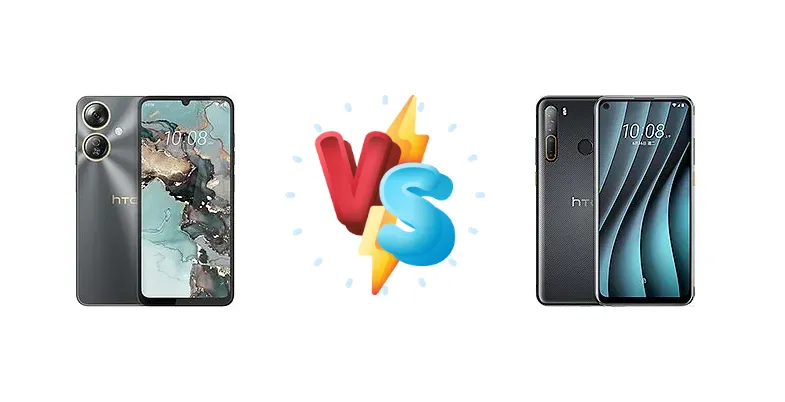
HTC's budget offerings, the Wildfire E5 Plus and Desire 20 Pro, represent attempts to capture the value-conscious smartphone user. While both aim for affordability, they diverge significantly in their core hardware, particularly the chipset. This comparison dissects these differences to determine which device delivers the best experience for your money.
🏆 Quick Verdict
For most users, the HTC Desire 20 Pro is the better choice. Its Snapdragon 665, fabricated on an 11nm process, offers a noticeable performance advantage over the Wildfire E5 Plus’s Unisoc T606. The inclusion of Quick Charge 3.0 further sweetens the deal, despite a similar battery capacity.
| Network |
|---|
| 2G bands | GSM 850 / 900 / 1800 / 1900 | GSM 850 / 900 / 1800 / 1900 |
| 3G bands | HSDPA 850 / 900 / 2100 | HSDPA 850 / 900 / 1900 / 2100 |
| 4G bands | 1, 3, 5, 7, 8, 20, 38, 40, 41 | 1, 2, 3, 5, 7, 8, 20, 28, 38, 39, 40, 41 |
| EDGE | - | No |
| GPRS | - | No |
| Speed | HSPA, LTE | HSPA 42.2/5.76 Mbps, LTE (2CA) Cat13 400/150 Mbps |
| Technology | GSM / HSPA / LTE | GSM / HSPA / LTE |
| Launch |
|---|
| Announced | 2025, February 15 | 2020, June 16. Released 2020, July 18 |
| Status | Available. Released 2025, March 11 | Discontinued |
| Body |
|---|
| Build | Glass front, plastic back, plastic frame | - |
| Dimensions | 168.4 x 77.9 x 9.5 mm (6.63 x 3.07 x 0.37 in) | 162 x 77 x 9.4 mm (6.38 x 3.03 x 0.37 in) |
| SIM | Nano-SIM + Nano-SIM | Nano-SIM + Nano-SIM |
| Weight | 218 g (7.69 oz) | 201 g (7.09 oz) |
| Display |
|---|
| Resolution | 720 x 1600 pixels, 20:9 ratio (~260 ppi density) | 1080 x 2340 pixels, 19.5:9 ratio (~396 ppi density) |
| Size | 6.75 inches, 110.0 cm2 (~83.9% screen-to-body ratio) | 6.5 inches, 103.7 cm2 (~83.1% screen-to-body ratio) |
| Type | IPS LCD, 90Hz | IPS LCD |
| Platform |
|---|
| CPU | Octa-core (2x1.6 GHz Cortex-A75 & 6x1.6 GHz Cortex-A55) | Octa-core (4x2.0 GHz Kryo 260 Gold & 4x1.8 GHz Kryo 260 Silver) |
| Chipset | Unisoc T606 (12 nm) | Qualcomm SM6125 Snapdragon 665 (11 nm) |
| GPU | Mali-G57 MP1 | Adreno 610 |
| OS | Android 14 | Android 10 |
| Memory |
|---|
| Call records | - | 20 dialed, 20 received, 20 missed calls |
| Card slot | microSDXC (uses shared SIM slot) | microSDXC |
| Internal | 128GB 6GB RAM | 128GB 6GB RAM |
| Phonebook | - | 1000 entries |
| Main Camera |
|---|
| Dual | 50 MP, f/1.8, (wide), AF
2 MP, f/2.4 | - |
| Features | LED flash | Dual-LED flash, HDR, panorama |
| Quad | - | 48 MP, f/1.8, 26mm (wide), 1/2.0", 0.8µm, PDAF
8 MP, f/2.2, 118˚ (ultrawide), 1/4.0", 1.12µm
2 MP (macro)
Auxiliary lens |
| Video | 1080p@30fps | 4K@30fps, 1080p@30fps |
| Selfie camera |
|---|
| Features | - | HDR |
| Single | 16 MP, f/2.2, (wide) | 25 MP, f/2.0, (wide) |
| Video | Yes | 1080p@30fps |
| Sound |
|---|
| 3.5mm jack | - | Yes |
| 35mm jack | Yes | Yes |
| Loudspeaker | Yes | Yes |
| Comms |
|---|
| Bluetooth | 5.0, A2DP, LE | 5.0, A2DP, LE |
| NFC | No | Yes |
| Positioning | GPS, GLONASS, GALILEO | GPS, GLONASS, GALILEO, BDS |
| Radio | Unspecified | FM radio |
| USB | USB Type-C 2.0 | USB Type-C 2.0, OTG |
| WLAN | Wi-Fi 802.11 a/b/g/n/ac, dual-band | Wi-Fi 802.11 a/b/g/n/ac, dual-band, Wi-Fi Direct |
| Features |
|---|
| Games | - | Yes |
| Java | - | Yes |
| Messaging | - | SMS |
| Sensors | Fingerprint (side-mounted), accelerometer, proximity, compass | Fingerprint (rear-mounted), accelerometer, gyro, proximity, compass |
| Battery |
|---|
| Charging | - | 15W wired, QC3 |
| Stand-by | - | Up to 570 h |
| Talk time | - | Up to 8 h 40 min |
| Type | 5000 mAh | Li-Po 5000 mAh |
| Misc |
|---|
| Colors | Gray, Blue | Smoky Black, Pretty Blue, Crystal Green |
| Price | About 90 EUR | About 660 EUR |
| SAR EU | - | 0.56 W/kg (head) |
HTC Wildfire E5 Plus
- Potentially longer battery life due to less powerful chipset.
- Simpler user experience for basic tasks.
- Likely more affordable price point.
- Noticeably slower performance in demanding apps.
- Lacks Quick Charge support for slower charging speeds.
- Inferior image processing capabilities.
HTC Desire 20 Pro
- Faster and more responsive performance with Snapdragon 665.
- Quick Charge 3.0 support for rapid charging.
- Better image processing and potentially superior camera quality.
- May have slightly shorter battery life under heavy load.
- Potentially higher price compared to the Wildfire E5 Plus.
- May experience more heat during prolonged gaming.
Display Comparison
Neither HTC provides detailed display specifications beyond resolution. However, given their price points, both likely utilize IPS LCD panels. The real difference lies in the underlying processing power driving the display. A more powerful chipset, like the Snapdragon 665 in the Desire 20 Pro, can contribute to smoother animations and faster app loading, indirectly improving the perceived display experience. Bezels are expected to be substantial on both devices, typical of this market segment.
Camera Comparison
Detailed camera specs are lacking for both devices. However, it’s safe to assume both feature a multi-camera setup with a primary sensor and potentially depth or macro lenses. The image signal processor (ISP) within the Snapdragon 665 is generally more advanced than that found in the Unisoc T606, leading to better image processing, dynamic range, and low-light performance. While megapixel counts may be similar, the Desire 20 Pro will likely produce more visually appealing photos due to superior software and hardware capabilities. Focusing on the primary sensor's quality is crucial, as auxiliary lenses are often of limited utility.
Performance
The core distinction between these phones is the chipset. The Desire 20 Pro’s Qualcomm Snapdragon 665 (11nm) boasts a more refined architecture – 4x2.0 GHz Kryo 260 Gold and 4x1.8 GHz Kryo 260 Silver – compared to the Wildfire E5 Plus’s Unisoc T606 (12nm). The 11nm fabrication process of the Snapdragon 665 generally translates to better power efficiency and thermal management. While both are octa-core CPUs, the Snapdragon’s Kryo cores offer a performance edge, particularly in sustained workloads. This means the Desire 20 Pro will handle multitasking and moderately demanding apps more effectively. The Unisoc T606, while capable for basic tasks, will likely exhibit more noticeable slowdowns under pressure.
Battery Life
Both devices likely feature similar battery capacities, typical for budget smartphones. However, the Desire 20 Pro’s support for 15W wired charging with Quick Charge 3.0 is a significant advantage. Quick Charge allows for significantly faster charging speeds compared to standard charging, reducing downtime. While the Wildfire E5 Plus may achieve a full charge eventually, the Desire 20 Pro will replenish its battery much quicker, offering greater convenience for users on the go. The more efficient Snapdragon 665 may also contribute to slightly better battery life during typical usage.
Buying Guide
Buy the HTC Wildfire E5 Plus if your primary needs are basic communication, light social media use, and extended battery life with minimal gaming. It’s ideal for first-time smartphone users or those seeking a simple, reliable device. Buy the HTC Desire 20 Pro if you prioritize smoother multitasking, occasional gaming, and faster charging. It’s a better fit for users who demand a more responsive experience and appreciate the convenience of Quick Charge.
Frequently Asked Questions
❓ Will the HTC Desire 20 Pro handle popular games like PUBG Mobile smoothly?
The Snapdragon 665 in the Desire 20 Pro can run PUBG Mobile, but likely at medium graphics settings to maintain a stable frame rate. Expect some occasional frame drops during intense action. The Wildfire E5 Plus’s Unisoc T606 will struggle with PUBG, even on the lowest settings.
❓ Does the HTC Wildfire E5 Plus support software updates beyond the initial Android version?
Given HTC's recent track record and the Wildfire E5 Plus's budget positioning, significant software updates are unlikely. Expect limited security patches at best. The Desire 20 Pro may receive slightly more support, but long-term software updates should not be a primary purchase consideration for either device.
❓ Is the difference in chipset fabrication (12nm vs 11nm) significant in real-world usage?
While seemingly small, the move from 12nm to 11nm generally results in improved power efficiency and reduced heat generation. This translates to slightly longer battery life and less thermal throttling under sustained load, giving the Snapdragon 665 in the Desire 20 Pro a tangible advantage.