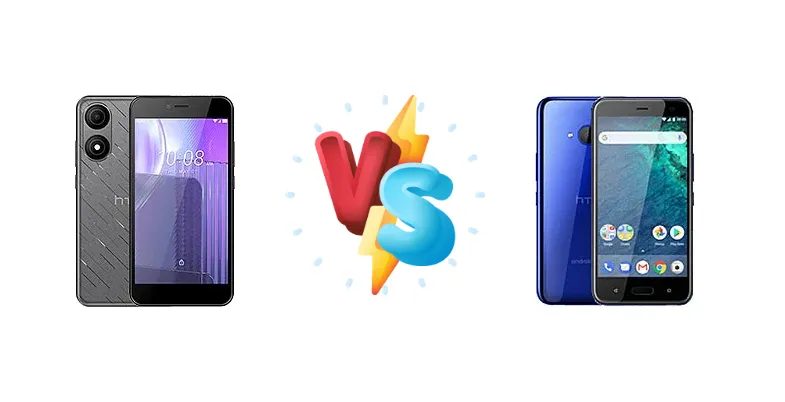
The HTC U11 Life and Wildfire E5 Life represent different eras of HTC's smartphone strategy. The U11 Life, released in 2017, aimed for a premium mid-range experience, while the Wildfire E5 Life is a more recent, ultra-budget offering. This comparison dissects their key differences to determine which device best suits your needs and budget.
🏆 Quick Verdict
For most users, the HTC U11 Life is the superior choice. Its Qualcomm Snapdragon 630 chipset delivers significantly better performance than the Unisoc SC9832E in the Wildfire E5 Life, making it more capable for multitasking and demanding applications. While both boast similar battery endurance ratings, the U11 Life's overall processing power provides a smoother user experience.
| Network |
|---|
| 2G bands | GSM 850 / 900 / 1800 / 1900 | GSM 850 / 900 / 1800 / 1900 - SIM 1 & SIM 2 (dual-SIM model only) |
| 3G bands | HSDPA 900 / 2100 | HSDPA 850 / 900 / 1700(AWS) / 1900 / 2100 |
| 4G bands | LTE | 1, 2, 3, 4, 5, 7, 12, 13, 17, 20, 28, 66 |
| Speed | HSPA, LTE | HSPA 42.2/5.76 Mbps, LTE (3CA) Cat11 600/75 Mbps |
| Technology | GSM / HSPA / LTE | GSM / HSPA / LTE |
| Launch |
|---|
| Announced | 2025, Q3 | 2017, November. Released 2017, December |
| Status | Available. Released 2025, Q3 | Discontinued |
| Body |
|---|
| Build | Glass front, plastic back, plastic frame | Glass front (Gorilla Glass 3), plastic back, plastic frame |
| Dimensions | 155.6 x 77.8 x 10.2 mm (6.13 x 3.06 x 0.40 in) | 149.1 x 72.9 x 8.1 mm (5.87 x 2.87 x 0.32 in) |
| SIM | Nano-SIM + Nano-SIM | · Nano-SIM· Nano-SIM + Nano-SIM |
| Weight | 188 g (6.63 oz) | 142 g (5.01 oz) |
| | - | IP67 dust/water resistant (up to 1m for 30 mins) |
| Display |
|---|
| Protection | - | Corning Gorilla Glass 3 |
| Resolution | 540 x 960 pixels, 16:9 ratio (~200 ppi density) | 1080 x 1920 pixels, 16:9 ratio (~424 ppi density) |
| Size | 5.5 inches, 83.4 cm2 (~68.9% screen-to-body ratio) | 5.2 inches, 74.5 cm2 (~68.6% screen-to-body ratio) |
| Type | TFT LCD | Super LCD |
| Platform |
|---|
| CPU | Quad-core 1.3 GHz Cortex-A53 | Octa-core 2.2 GHz Cortex-A53 |
| Chipset | Unisoc SC9832E (28 nm) | Qualcomm SDM630 Snapdragon 630 (14 nm) |
| GPU | Mali-T820 MP1 | Adreno 508 |
| OS | Android 14 (Go edition) | Android 8.0 (Oreo), upgradable to Android 9.0 (Pie), Android One |
| Memory |
|---|
| Card slot | Unspecified | microSDXC (dedicated slot) - single-SIM modelmicroSDXC (uses shared SIM slot) - dual-SIM model |
| Internal | 32GB 3GB RAM | 32GB 3GB RAM, 64GB 4GB RAM |
| Main Camera |
|---|
| Features | LED flash | LED flash, HDR, panorama |
| Single | 5 MP | 16 MP, f/2.0, PDAF |
| Video | 540p | 4K@30fps, 1080p@30fps |
| Selfie camera |
|---|
| Features | - | HDR, panorama |
| Single | 2 MP | 16 MP, f/2.0, 27mm (wide), 1/3.06", 1.0µm |
| Video | Yes | 1080p@30fps |
| Sound |
|---|
| 3.5mm jack | - | No |
| 35mm jack | Yes | No |
| Loudspeaker | Yes | Yes |
| | - | 24-bit/192kHz audio
|
| Comms |
|---|
| Bluetooth | Yes | 5.0, A2DP, LE |
| NFC | No | Yes |
| Positioning | GPS | GPS, GLONASS, BDS |
| Radio | Unspecified | No |
| USB | USB Type-C | USB Type-C 2.0 |
| WLAN | Yes | Wi-Fi 802.11 a/b/g/n/ac, dual-band, Wi-Fi Direct |
| Features |
|---|
| Sensors | No | Fingerprint (front-mounted), accelerometer, gyro, proximity, compass |
| Battery |
|---|
| Stand-by | - | Up to 670 h (3G) |
| Talk time | - | Up to 17 h (3G) |
| Type | Li-Ion 3000 mAh | Li-Ion 2600 mAh, non-removable |
| Misc |
|---|
| Colors | Gray | Brilliant Black, Sapphire Blue, Ice White |
| Models | - | U11 life |
| Price | About 30 EUR | About 210 EUR |
| Tests |
|---|
| Battery life | - | Endurance rating 73h |
| Camera | - |
Photo / Video |
| Display | - |
Contrast ratio: 1529:1 (nominal), 3.108 (sunlight) |
| Loudspeaker | - |
Voice 70dB / Noise 75dB / Ring 88dB |
| Performance | - |
GeekBench: 4140 (v4.4)
GFXBench: 5.3fps (ES 3.1 onscreen) |
HTC Wildfire E5 Life
- Ultra-affordable price point
- Acceptable battery endurance
- Suitable for basic smartphone tasks
- Weak processor performance
- Limited multitasking capabilities
- Display specifications largely unknown
HTC U11 Life
- Significantly faster processor
- Better thermal management
- Potentially superior camera image processing
- Older device, potentially limited software updates
- May be harder to find new
- Higher price than Wildfire E5 Life
Display Comparison
Both devices share a similar contrast ratio of 1529:1 (nominal) and 3.108 (sunlight), suggesting comparable outdoor visibility. However, detailed display specifications like resolution and panel type are missing for the Wildfire E5 Life. The U11 Life's display, while not cutting-edge, benefits from the more powerful image processing capabilities of the Snapdragon 630, potentially resulting in more accurate color reproduction. Without further data on the Wildfire E5 Life's panel, it's difficult to assess its color accuracy or viewing angles.
Camera Comparison
Both phones are listed as having 'Photo / Video' capabilities, but specific details are absent. Given the U11 Life’s more powerful chipset, its image signal processor (ISP) will likely deliver superior image quality, faster processing, and potentially better low-light performance. The absence of sensor size or aperture information makes a precise comparison impossible, but the U11 Life’s overall processing power gives it a clear advantage in computational photography.
Performance
The performance gap is the most significant differentiator. The HTC U11 Life’s Qualcomm Snapdragon 630, built on a 14nm process, features an octa-core Cortex-A53 CPU clocked at 2.2 GHz. This contrasts sharply with the Wildfire E5 Life’s Unisoc SC9832E, a quad-core 1.3 GHz Cortex-A53 processor fabricated on a larger 28nm node. The 14nm process of the Snapdragon 630 is more efficient, leading to better thermal management and sustained performance. The U11 Life will handle multitasking, app switching, and moderately demanding games with greater ease, while the Wildfire E5 Life will likely struggle with resource-intensive tasks.
Battery Life
Interestingly, both devices share an endurance rating of 73 hours. This suggests similar battery optimization and usage patterns were considered during testing. However, the Snapdragon 630’s greater power efficiency could translate to slightly longer real-world usage on the U11 Life, despite the lack of a specified mAh difference. Charging speeds are unknown for both devices, making it difficult to assess the convenience of topping up the battery.
Buying Guide
Buy the HTC Wildfire E5 Life if you prioritize extreme affordability and only need a phone for basic tasks like calls, texts, and light social media. It's a suitable option for first-time smartphone users or as a reliable backup device. Buy the HTC U11 Life if you value performance, smoother multitasking, and a more responsive user experience, even if it means spending a bit more. It's ideal for users who enjoy occasional gaming, streaming, or using more demanding apps.
Frequently Asked Questions
❓ Is the HTC U11 Life still receiving software updates?
As a 2017 device, the U11 Life is unlikely to receive major Android version updates. However, it may still receive occasional security patches. Check HTC's official support website for the latest information.
❓ Can the HTC Wildfire E5 Life handle popular games like PUBG Mobile?
The Unisoc SC9832E processor in the Wildfire E5 Life is unlikely to provide a smooth gaming experience with demanding titles like PUBG Mobile. You may experience significant lag and frame rate drops, even on low settings.
❓ What version of Android does each phone run?
The HTC U11 Life launched with Android 8.0 Oreo. The Wildfire E5 Life runs Android Go Edition, a lightweight version of Android designed for devices with limited resources.
❓ Does the HTC U11 Life have a headphone jack?
Yes, the HTC U11 Life includes a 3.5mm headphone jack, offering compatibility with a wide range of wired headphones and audio devices.