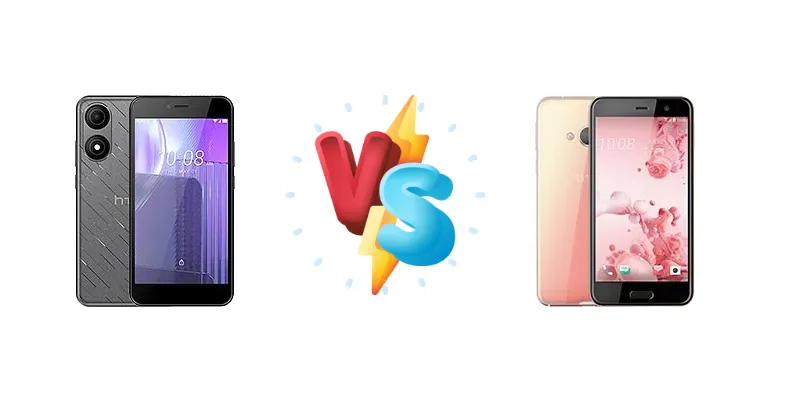
The HTC U Play and Wildfire E5 Life represent different approaches to the budget smartphone market. The U Play, released in 2017, aimed for a more premium experience at a mid-range price, while the Wildfire E5 Life is a more recent entry focused on essential functionality and affordability. This comparison dissects their core components to determine which device offers the best value in 2024.
🏆 Quick Verdict
For the average user in 2024, the HTC U Play is the better choice. While both phones utilize a 28nm process, the U Play’s Mediatek Helio P10, with its octa-core configuration, delivers significantly more processing power than the Wildfire E5 Life’s quad-core Unisoc SC9832E, resulting in a smoother user experience, especially for multitasking and app loading.
| Network |
|---|
| 2G bands | GSM 850 / 900 / 1800 / 1900 | GSM 850 / 900 / 1800 / 1900 - SIM 1 & SIM 2 |
| 3G bands | HSDPA 900 / 2100 | HSDPA 850 / 900 / 1900 / 2100 |
| 4G bands | LTE | 1, 3, 5, 7, 8, 20, 28, 38, 40 |
| Speed | HSPA, LTE | HSPA 42.2/5.76 Mbps, LTE (2CA) Cat6 300/50 Mbps |
| Technology | GSM / HSPA / LTE | GSM / HSPA / LTE |
| Launch |
|---|
| Announced | 2025, Q3 | 2017, January. Released 2017, February |
| Status | Available. Released 2025, Q3 | Discontinued |
| Body |
|---|
| Build | Glass front, plastic back, plastic frame | Glass front (Gorilla Glass), plastic back, plastic frame |
| Dimensions | 155.6 x 77.8 x 10.2 mm (6.13 x 3.06 x 0.40 in) | 146 x 72.9 x 8 mm (5.75 x 2.87 x 0.31 in) |
| SIM | Nano-SIM + Nano-SIM | Nano-SIM + Nano-SIM |
| Weight | 188 g (6.63 oz) | 145 g (5.11 oz) |
| Display |
|---|
| Protection | - | Corning Gorilla Glass (unspecified version) |
| Resolution | 540 x 960 pixels, 16:9 ratio (~200 ppi density) | 1080 x 1920 pixels, 16:9 ratio (~428 ppi density) |
| Size | 5.5 inches, 83.4 cm2 (~68.9% screen-to-body ratio) | 5.2 inches, 73.2 cm2 (~68.7% screen-to-body ratio) |
| Type | TFT LCD | Super LCD |
| Platform |
|---|
| CPU | Quad-core 1.3 GHz Cortex-A53 | Octa-core (4x2.0 GHz Cortex-A53 & 4x1.1 GHz Cortex-A53) |
| Chipset | Unisoc SC9832E (28 nm) | Mediatek MT6755 Helio P10 (28 nm) |
| GPU | Mali-T820 MP1 | Mali-T860MP2 |
| OS | Android 14 (Go edition) | Android 6.0 (Marshmallow) |
| Memory |
|---|
| Card slot | Unspecified | microSDXC (uses shared SIM slot) |
| Internal | 32GB 3GB RAM | 32GB 3GB RAM, 64GB 4GB RAM |
| | - | eMMC 5.1 |
| Main Camera |
|---|
| Features | LED flash | Dual-LED dual-tone flash, panorama |
| Single | 5 MP | 16 MP, f/2.0, 28mm (wide), 1/3.1", 1.0µm, PDAF, OIS |
| Video | 540p | 1080p@30fps |
| Selfie camera |
|---|
| Features | - | HDR |
| Single | 2 MP | 16 MP, f/2.0, 27mm (wide), 1/3.06", 1.0µm |
| Video | Yes | 1080p@30fps |
| Sound |
|---|
| 3.5mm jack | - | No |
| 35mm jack | Yes | No |
| Loudspeaker | Yes | Yes |
| Comms |
|---|
| Bluetooth | Yes | 4.2, A2DP, LE |
| NFC | No | Yes |
| Positioning | GPS | GPS, GLONASS |
| Radio | Unspecified | No |
| USB | USB Type-C | USB Type-C 2.0 |
| WLAN | Yes | Wi-Fi 802.11 a/b/g/n/ac, dual-band, Wi-Fi Direct, DLNA |
| Features |
|---|
| Sensors | No | Fingerprint (front-mounted), accelerometer, gyro, proximity, compass |
| Battery |
|---|
| Charging | - | 10W wired |
| Stand-by | - | Up to 427 h (3G) |
| Talk time | - | Up to 15 h (3G) |
| Type | Li-Ion 3000 mAh | Li-Ion 2500 mAh, non-removable |
| Misc |
|---|
| Colors | Gray | Brilliant Black, Cosmetic Pink, Ice White, Sapphire Blue |
| Models | - | U Play, U-2u, 2PZM3 |
| Price | About 30 EUR | About 150 EUR |
HTC Wildfire E5 Life
- Extremely affordable price point
- Potentially runs Android Go Edition for optimized performance
- Simple and easy-to-use interface
- Significantly weaker processor performance
- Likely lower quality display
- Unknown charging speed
HTC U Play
- More powerful octa-core processor
- 10W wired charging
- Potentially better camera quality
- Older model, potentially limited software support
- Slower charging compared to modern standards
- Higher initial price (at launch)
Display Comparison
Neither HTC provides detailed display specifications in the provided data. However, given the U Play’s original positioning, it likely features a higher resolution panel than the Wildfire E5 Life. Both devices, being older models, likely utilize IPS LCD technology. The U Play’s slightly higher price point at launch suggests a potentially better color accuracy and viewing angles, though this is speculative. The Wildfire E5 Life, targeting a lower price bracket, likely prioritizes cost savings over display quality.
Camera Comparison
Without detailed camera specifications, a direct comparison is difficult. However, it’s reasonable to assume the U Play, being a slightly more premium device, features a more capable primary camera sensor. The Wildfire E5 Life likely relies on a simpler camera setup to minimize costs. The presence of a 2MP macro camera on the E5 Life is likely a marketing feature with limited real-world benefit due to the small sensor size and lack of optical image stabilization (OIS). Image processing capabilities on the U Play, given its more powerful processor, are also likely superior.
Performance
The core difference lies in the chipsets. The HTC U Play’s Mediatek Helio P10 is an octa-core processor (4x2.0 GHz Cortex-A53 & 4x1.1 GHz Cortex-A53), offering a significant advantage over the Wildfire E5 Life’s Unisoc SC9832E quad-core 1.3 GHz Cortex-A53. The Helio P10’s big.LITTLE architecture allows it to dynamically allocate tasks to the appropriate cores, improving efficiency and responsiveness. The U Play will demonstrably outperform the E5 Life in CPU-intensive tasks like web browsing, app loading, and multitasking. While both are built on a 28nm process, the architectural advantage of the Helio P10 is substantial.
Battery Life
Battery capacity isn’t specified for either device. However, the HTC U Play includes 10W wired charging, while the Wildfire E5 Life’s charging speed is unknown. The 10W charging on the U Play, while slow by modern standards, provides a defined charging time. The Wildfire E5 Life may offer slower charging, potentially offsetting any advantage gained from a larger battery capacity. Real-world battery life will depend heavily on usage patterns, but the U Play’s more efficient processor could contribute to longer runtimes under moderate load.
Buying Guide
Buy the HTC Wildfire E5 Life if you prioritize extreme affordability and a simple, streamlined Android experience – potentially with Android Go Edition. It’s ideal for users who primarily need a phone for basic communication and light tasks. Buy the HTC U Play if you prefer a more responsive device capable of handling more demanding applications and multitasking, even if it means accepting a slightly older model and slower charging speeds. It’s better suited for users who want a more versatile smartphone experience.
Frequently Asked Questions
❓ Is the Unisoc SC9832E processor in the Wildfire E5 Life sufficient for running popular apps like WhatsApp and Facebook?
Yes, the Unisoc SC9832E can handle basic applications like WhatsApp and Facebook. However, expect slower loading times and potential lag when multitasking or using more demanding features within these apps. It's best suited for light usage.
❓ Does the HTC U Play’s Helio P10 chip overheat during prolonged use, such as video streaming or gaming?
The Helio P10 is known to generate some heat under sustained load. While it’s unlikely to cause critical overheating, you may experience thermal throttling, which reduces performance to prevent damage. Short gaming sessions and moderate video streaming should be manageable, but extended use may lead to noticeable slowdowns.
❓ What Android version do these phones likely run, and will they receive future updates?
The HTC U Play originally launched with Android 6.0 Marshmallow and received updates to Android 8.0 Oreo. The Wildfire E5 Life likely runs a more recent version of Android, potentially Android 11 or 12, and may even be optimized for Android Go Edition. However, given their age and budget nature, significant future updates are unlikely for either device.
❓ Is the 10W charging on the HTC U Play slow compared to modern smartphones?
Yes, 10W charging is considerably slower than the 25W, 45W, or even 65W charging found on many modern smartphones. Expect a full charge to take several hours. However, it's a defined charging speed, unlike the unknown charging capabilities of the Wildfire E5 Life.