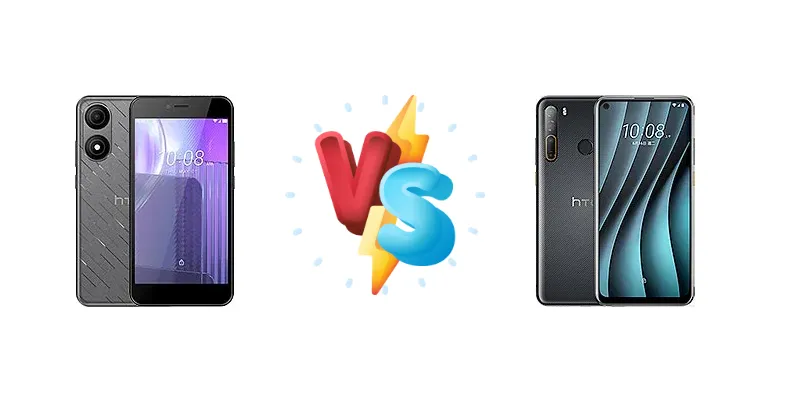
HTC's budget offerings, the Desire 20 Pro and Wildfire E5 Life, represent attempts to capture the value-conscious consumer. While both aim for affordability, they diverge significantly in their internal hardware. This comparison dissects the core differences – specifically the chipset – to determine which phone delivers the best experience for everyday tasks and beyond.
🏆 Quick Verdict
For most users, the HTC Desire 20 Pro is the superior choice. Its Qualcomm Snapdragon 665 chipset, built on an 11nm process, provides a substantial performance advantage over the Wildfire E5 Life’s Unisoc SC9832E, translating to smoother multitasking and a more responsive user interface. While the E5 Life may offer slightly better battery life due to its less powerful processor, the Desire 20 Pro’s Quick Charge 3.0 support mitigates this.
| Network |
|---|
| 2G bands | GSM 850 / 900 / 1800 / 1900 | GSM 850 / 900 / 1800 / 1900 |
| 3G bands | HSDPA 900 / 2100 | HSDPA 850 / 900 / 1900 / 2100 |
| 4G bands | LTE | 1, 2, 3, 5, 7, 8, 20, 28, 38, 39, 40, 41 |
| EDGE | - | No |
| GPRS | - | No |
| Speed | HSPA, LTE | HSPA 42.2/5.76 Mbps, LTE (2CA) Cat13 400/150 Mbps |
| Technology | GSM / HSPA / LTE | GSM / HSPA / LTE |
| Launch |
|---|
| Announced | 2025, Q3 | 2020, June 16. Released 2020, July 18 |
| Status | Available. Released 2025, Q3 | Discontinued |
| Body |
|---|
| Build | Glass front, plastic back, plastic frame | - |
| Dimensions | 155.6 x 77.8 x 10.2 mm (6.13 x 3.06 x 0.40 in) | 162 x 77 x 9.4 mm (6.38 x 3.03 x 0.37 in) |
| SIM | Nano-SIM + Nano-SIM | Nano-SIM + Nano-SIM |
| Weight | 188 g (6.63 oz) | 201 g (7.09 oz) |
| Display |
|---|
| Resolution | 540 x 960 pixels, 16:9 ratio (~200 ppi density) | 1080 x 2340 pixels, 19.5:9 ratio (~396 ppi density) |
| Size | 5.5 inches, 83.4 cm2 (~68.9% screen-to-body ratio) | 6.5 inches, 103.7 cm2 (~83.1% screen-to-body ratio) |
| Type | TFT LCD | IPS LCD |
| Platform |
|---|
| CPU | Quad-core 1.3 GHz Cortex-A53 | Octa-core (4x2.0 GHz Kryo 260 Gold & 4x1.8 GHz Kryo 260 Silver) |
| Chipset | Unisoc SC9832E (28 nm) | Qualcomm SM6125 Snapdragon 665 (11 nm) |
| GPU | Mali-T820 MP1 | Adreno 610 |
| OS | Android 14 (Go edition) | Android 10 |
| Memory |
|---|
| Call records | - | 20 dialed, 20 received, 20 missed calls |
| Card slot | Unspecified | microSDXC |
| Internal | 32GB 3GB RAM | 128GB 6GB RAM |
| Phonebook | - | 1000 entries |
| Main Camera |
|---|
| Features | LED flash | Dual-LED flash, HDR, panorama |
| Quad | - | 48 MP, f/1.8, 26mm (wide), 1/2.0", 0.8µm, PDAF
8 MP, f/2.2, 118˚ (ultrawide), 1/4.0", 1.12µm
2 MP (macro)
Auxiliary lens |
| Single | 5 MP | - |
| Video | 540p | 4K@30fps, 1080p@30fps |
| Selfie camera |
|---|
| Features | - | HDR |
| Single | 2 MP | 25 MP, f/2.0, (wide) |
| Video | Yes | 1080p@30fps |
| Sound |
|---|
| 3.5mm jack | - | Yes |
| 35mm jack | Yes | Yes |
| Loudspeaker | Yes | Yes |
| Comms |
|---|
| Bluetooth | Yes | 5.0, A2DP, LE |
| NFC | No | Yes |
| Positioning | GPS | GPS, GLONASS, GALILEO, BDS |
| Radio | Unspecified | FM radio |
| USB | USB Type-C | USB Type-C 2.0, OTG |
| WLAN | Yes | Wi-Fi 802.11 a/b/g/n/ac, dual-band, Wi-Fi Direct |
| Features |
|---|
| Games | - | Yes |
| Java | - | Yes |
| Messaging | - | SMS |
| Sensors | No | Fingerprint (rear-mounted), accelerometer, gyro, proximity, compass |
| Battery |
|---|
| Charging | - | 15W wired, QC3 |
| Stand-by | - | Up to 570 h |
| Talk time | - | Up to 8 h 40 min |
| Type | Li-Ion 3000 mAh | Li-Po 5000 mAh |
| Misc |
|---|
| Colors | Gray | Smoky Black, Pretty Blue, Crystal Green |
| Price | About 30 EUR | About 660 EUR |
| SAR EU | - | 0.56 W/kg (head) |
HTC Wildfire E5 Life
- Potentially longer battery life due to less powerful chipset
- Lower price point (likely)
- Sufficient for basic communication tasks
- Significantly slower performance compared to the Desire 20 Pro
- Struggles with multitasking and demanding apps
- Likely inferior camera performance
HTC Desire 20 Pro
- Faster and more responsive performance thanks to the Snapdragon 665
- Quick Charge 3.0 support for faster charging
- Better suited for social media, streaming, and casual gaming
- Potentially shorter battery life compared to the Wildfire E5 Life
- Likely a higher price point
- May not be a significant upgrade for users with very basic needs
Display Comparison
Neither HTC provides detailed display specifications in the provided data. However, given their market positioning, it’s reasonable to assume both utilize LCD panels. The lack of information regarding resolution, brightness, or refresh rate suggests neither phone prioritizes display quality. The Desire 20 Pro, being slightly higher-tier, *may* benefit from better color calibration, but this is speculative. Bezels are likely to be substantial on both devices, typical of this price bracket.
Camera Comparison
Without detailed camera specs, a direct comparison is difficult. However, it’s safe to assume both phones feature basic camera setups geared towards casual photography. The Desire 20 Pro, positioned as a slightly more premium device, likely has a more capable main sensor. The presence of Quick Charge 3.0 suggests a more robust power management system, potentially enabling better image processing capabilities. The Wildfire E5 Life’s camera will likely suffice for basic snapshots in good lighting conditions, but will struggle in low-light scenarios. The inclusion of a 2MP macro lens on either device is largely a marketing gimmick and unlikely to deliver significant improvements in image quality.
Performance
The core difference lies in the chipsets. The HTC Desire 20 Pro’s Qualcomm Snapdragon 665, an octa-core processor fabricated on an 11nm process, significantly outperforms the Wildfire E5 Life’s Unisoc SC9832E. The Snapdragon 665’s architecture – four Kryo 260 Gold cores at 2.0 GHz and four Kryo 260 Silver cores at 1.8 GHz – allows for efficient task allocation. The Unisoc SC9832E, with its quad-core 1.3 GHz Cortex-A53 cores and 28nm process, will struggle with demanding applications and multitasking. This translates to slower app loading times and potential lag when switching between apps on the Wildfire E5 Life. The 11nm process of the Snapdragon 665 also contributes to better thermal efficiency, reducing the likelihood of performance throttling under sustained load.
Battery Life
The Unisoc SC9832E’s lower power consumption in the Wildfire E5 Life *could* result in slightly longer battery life during typical usage. However, the Desire 20 Pro’s 15W wired charging with Quick Charge 3.0 support is a significant advantage. Quick Charge 3.0 allows for faster charging speeds, minimizing downtime. While the exact battery capacities are unknown, the convenience of faster charging on the Desire 20 Pro likely outweighs any potential battery life advantage held by the Wildfire E5 Life.
Buying Guide
Buy the HTC Wildfire E5 Life if you prioritize absolute minimal cost and need a phone primarily for basic communication – calls, texts, and light web browsing. Its Unisoc chipset is sufficient for these tasks. Buy the HTC Desire 20 Pro if you value a smoother, more capable experience, especially if you plan to use the phone for social media, streaming video, or casual gaming. The Snapdragon 665 offers a noticeable performance uplift that justifies the potential price difference.
Frequently Asked Questions
❓ Will the Unisoc SC9832E in the Wildfire E5 Life struggle with popular apps like Facebook or WhatsApp?
While the Wildfire E5 Life can run these apps, expect slower loading times and occasional lag, especially when multitasking. The Unisoc SC9832E is a basic processor and isn't optimized for demanding applications. Frequent use of these apps may lead to a frustrating user experience.
❓ Does the HTC Desire 20 Pro support playing PUBG Mobile, and if so, at what settings?
The Snapdragon 665 in the Desire 20 Pro *can* run PUBG Mobile, but not at the highest settings. Expect to play at low to medium graphics settings with a moderate frame rate. Higher settings will likely result in significant lag and stuttering. It's a playable experience, but not ideal for competitive gaming.
❓ How much faster is the charging on the Desire 20 Pro with Quick Charge 3.0 compared to a standard 5W charger?
Quick Charge 3.0 on the Desire 20 Pro can significantly reduce charging times. While a standard 5W charger might take 3-4 hours to fully charge the battery, Quick Charge 3.0 can potentially achieve a full charge in around 1.5-2 hours, depending on the battery capacity and charger used.