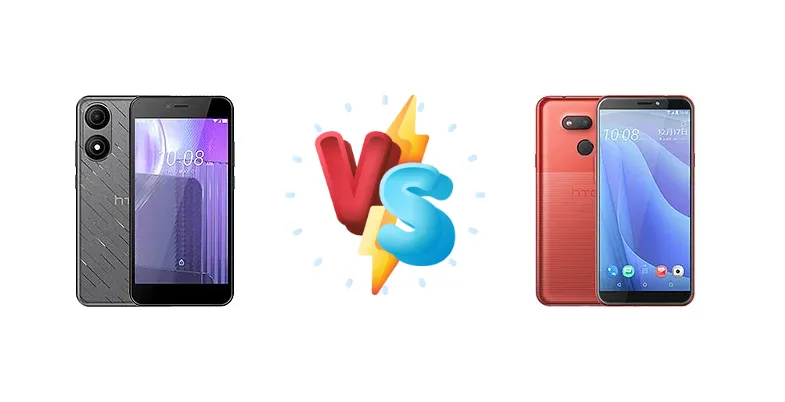
Both the HTC Desire 12s and Wildfire E5 Life represent HTC's attempts to capture the ultra-budget smartphone market. While both devices share a similar price point and target first-time smartphone users, they diverge significantly in their core hardware, specifically the chipset. This comparison will dissect the differences between the Qualcomm Snapdragon 435 and Unisoc SC9832E to determine which phone delivers a more responsive and enjoyable user experience.
🏆 Quick Verdict
For the average user prioritizing smoother multitasking and a more future-proof experience, the HTC Desire 12s is the better choice. Its octa-core Snapdragon 435 offers a noticeable performance advantage over the quad-core Unisoc SC9832E in the Wildfire E5 Life, making it more capable of handling everyday tasks and light gaming.
| Network |
|---|
| 2G bands | GSM 850 / 900 / 1800 / 1900 | GSM 850 / 900 / 1800 / 1900 |
| 3G bands | HSDPA 900 / 2100 | HSDPA 850 / 900 / 1900 / 2100 |
| 4G bands | LTE | 1, 3, 5, 7, 8, 20, 28, 38, 40, 41 |
| Speed | HSPA, LTE | HSPA 42.2/5.76 Mbps, LTE (2CA) Cat6 300/50 Mbps |
| Technology | GSM / HSPA / LTE | GSM / HSPA / LTE |
| Launch |
|---|
| Announced | 2025, Q3 | 2018, December. Released 2018, December |
| Status | Available. Released 2025, Q3 | Discontinued |
| Body |
|---|
| Build | Glass front, plastic back, plastic frame | - |
| Dimensions | 155.6 x 77.8 x 10.2 mm (6.13 x 3.06 x 0.40 in) | 154.2 x 72.7 x 8.3 mm (6.07 x 2.86 x 0.33 in) |
| SIM | Nano-SIM + Nano-SIM | Nano-SIM + Nano-SIM |
| Weight | 188 g (6.63 oz) | 150 g (5.29 oz) |
| Display |
|---|
| Resolution | 540 x 960 pixels, 16:9 ratio (~200 ppi density) | 720 x 1440 pixels, 18:9 ratio (~282 ppi density) |
| Size | 5.5 inches, 83.4 cm2 (~68.9% screen-to-body ratio) | 5.7 inches, 83.8 cm2 (~74.8% screen-to-body ratio) |
| Type | TFT LCD | IPS LCD |
| Platform |
|---|
| CPU | Quad-core 1.3 GHz Cortex-A53 | Octa-core 1.4 GHz Cortex-A53 |
| Chipset | Unisoc SC9832E (28 nm) | Qualcomm MSM8940 Snapdragon 435 (28 nm) |
| GPU | Mali-T820 MP1 | Adreno 505 |
| OS | Android 14 (Go edition) | Android 8.1 (Oreo) |
| Memory |
|---|
| Card slot | Unspecified | microSDXC (dedicated slot) |
| Internal | 32GB 3GB RAM | 32GB 3GB RAM, 64GB 4GB RAM |
| | - | eMMC 5.1 |
| Main Camera |
|---|
| Features | LED flash | LED flash, HDR, panorama |
| Single | 5 MP | 13 MP, f/2.0, PDAF |
| Video | 540p | 1080p@30fps |
| Selfie camera |
|---|
| Features | - | LED flash |
| Single | 2 MP | 13 MP, f/2.2 |
| Video | Yes | 1080p@30fps |
| Sound |
|---|
| 3.5mm jack | - | Yes |
| 35mm jack | Yes | Yes |
| Loudspeaker | Yes | Yes |
| Comms |
|---|
| Bluetooth | Yes | 4.2, A2DP, LE |
| NFC | No | Yes |
| Positioning | GPS | GPS, GLONASS |
| Radio | Unspecified | FM radio |
| USB | USB Type-C | microUSB 2.0 |
| WLAN | Yes | Wi-Fi 802.11 b/g/n, Wi-Fi Direct |
| Features |
|---|
| Sensors | No | Fingerprint (rear-mounted), accelerometer, proximity, compass |
| Battery |
|---|
| Type | Li-Ion 3000 mAh | Li-Ion 3075 mAh, non-removable |
| Misc |
|---|
| Colors | Gray | Black, Silver, Red |
| Price | About 30 EUR | About 200 EUR |
HTC Wildfire E5 Life
- Potentially lower price point
- Simpler user experience (potentially Android Go)
- May offer slightly longer battery life due to lower processing demands
- Significantly slower performance
- Struggles with multitasking
- Less responsive user interface
HTC Desire 12s
- Faster and smoother performance
- Better multitasking capabilities
- More responsive user interface
- Potentially better camera image processing
- Likely a slightly higher price
- May have slightly shorter battery life under heavy load
Display Comparison
Neither HTC provides detailed display specifications beyond size and resolution. Given the target market, both likely utilize IPS LCD panels. However, the performance difference between the chipsets suggests the Desire 12s *may* have a slightly more responsive touch experience due to the increased processing power dedicated to display handling. The 28nm fabrication process of both chipsets doesn't suggest significant power efficiency gains in display operation.
Camera Comparison
Detailed camera specifications are unavailable. However, given the price bracket, both phones likely feature basic camera setups. The processing power of the Snapdragon 435 in the Desire 12s *could* translate to slightly better image processing, particularly in low-light conditions, due to its superior ISP (Image Signal Processor). It's reasonable to assume the Desire 12s will offer faster image capture and potentially better dynamic range, though neither phone is expected to compete with higher-end camera phones.
Performance
The core difference lies in the chipset. The HTC Desire 12s boasts the Qualcomm MSM8940 Snapdragon 435, an octa-core processor clocked at 1.4 GHz, utilizing Cortex-A53 cores. Conversely, the Wildfire E5 Life is powered by the Unisoc SC9832E, a quad-core processor clocked at 1.3 GHz, also using Cortex-A53 cores. The Snapdragon 435’s octa-core configuration provides a significant advantage in multi-threaded tasks, resulting in faster app loading times and smoother multitasking. While both are built on a 28nm process, Qualcomm’s architecture generally offers better sustained performance and thermal management. The Unisoc chip, while adequate for basic tasks, will likely struggle with more demanding applications.
Battery Life
Battery capacity details are missing for both devices. However, the more efficient Snapdragon 435 in the Desire 12s, despite its higher clock speed, could potentially offset a slightly smaller battery capacity compared to the Wildfire E5 Life. The 28nm fabrication process is a common denominator, meaning neither chipset is particularly power-hungry. Real-world battery life will heavily depend on usage patterns, but the Desire 12s’s more efficient processor gives it a potential edge.
Buying Guide
Buy the HTC Wildfire E5 Life if you need a basic smartphone for essential communication – calls, texts, and light app usage – and prioritize simplicity, potentially benefiting from Android Go Edition's optimized experience. Buy the HTC Desire 12s if you prefer a more responsive device capable of handling multiple apps simultaneously, occasional gaming, and generally offering a smoother user experience, even if it comes at a slightly higher price.
Frequently Asked Questions
❓ Will the Unisoc SC9832E in the Wildfire E5 Life struggle with popular apps like Facebook or WhatsApp?
While the Unisoc SC9832E can run these apps, you may experience noticeable lag when switching between them or loading content. The quad-core processor and limited RAM will be strained by these applications, especially with multiple tabs or features open simultaneously.
❓ Is the Snapdragon 435 in the Desire 12s capable of playing modern mobile games?
The Snapdragon 435 can handle less demanding mobile games at lower settings. However, graphically intensive titles will likely require significant compromises in graphics quality and frame rates to achieve playable performance. Don't expect a smooth experience with the latest AAA mobile games.
❓ Does either phone support fast charging?
Neither HTC officially advertises fast charging support for these models. Expect standard 5W charging speeds, meaning a full charge will take several hours.
❓ Which phone is more likely to receive software updates?
Given HTC's recent track record, neither phone is likely to receive frequent or long-term software updates. However, the Desire 12s, being based on a more mainstream Qualcomm platform, *might* have a slightly better chance of receiving security patches.