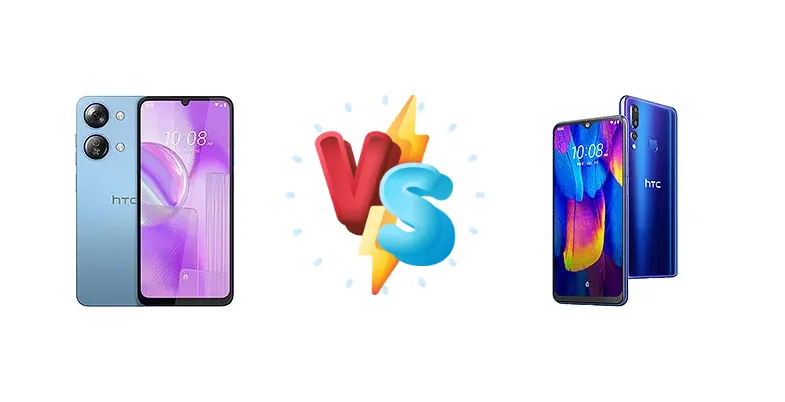
The HTC Wildfire series represents a commitment to accessible Android smartphones. Both the E4 Plus and the X aim for the budget-conscious consumer, but they diverge in their core processing power. This comparison dissects the key differences between the Unisoc T606-powered E4 Plus and the Mediatek Helio P22-equipped X, focusing on how these chipset choices impact real-world performance and user experience.
🏆 Quick Verdict
For most users, the HTC Wildfire E4 Plus offers a more compelling experience. While both phones share the same slow 10W charging, the Unisoc T606’s Cortex-A75 cores provide a noticeable performance uplift over the Helio P22’s all-Cortex-A53 configuration, making it better suited for multitasking and moderately demanding apps.
| Network |
|---|
| 2G bands | GSM 850 / 900 / 1800 / 1900 | GSM 850 / 900 / 1800 / 1900 |
| 3G bands | HSDPA 850 / 900 / 2100 | HSDPA 900 / 2100 |
| 4G bands | LTE | 1, 3, 5, 8, 40, 41 |
| Speed | HSPA, LTE | HSPA, LTE |
| Technology | GSM / HSPA / LTE | GSM / HSPA / LTE |
| Launch |
|---|
| Announced | 2025, June 20 | 2019, August 14. Released 2019, August 22 |
| Status | Available. Released 2025, June 20 | Discontinued |
| Body |
|---|
| Build | Glass front, plastic back, plastic frame | - |
| Dimensions | - | 156.7 x 74.9 x 8 mm (6.17 x 2.95 x 0.31 in) |
| SIM | Nano-SIM + Nano-SIM | Nano-SIM + Nano-SIM |
| Weight | - | 160 g (5.64 oz) |
| Display |
|---|
| Resolution | 720 x 1600 pixels, 20:9 ratio (~260 ppi density) | 720 x 1520 pixels, 19:9 ratio (~271 ppi density) |
| Size | 6.75 inches, 110.0 cm2 | 6.2 inches, 95.9 cm2 (~81.7% screen-to-body ratio) |
| Type | IPS LCD, 90Hz | IPS LCD |
| Platform |
|---|
| CPU | Octa-core (2x1.6 GHz Cortex-A75 & 6x1.6 GHz Cortex-A55) | Octa-core 2.0 GHz Cortex-A53 |
| Chipset | Unisoc T606 (12 nm) | Mediatek MT6762 Helio P22 (12 nm) |
| GPU | Mali-G57 MP1 | PowerVR GE8320 |
| OS | Android 14 | Android 9 (Pie) |
| Memory |
|---|
| Card slot | microSDXC | microSDXC (uses shared SIM slot) |
| Internal | 128GB 4GB RAM | 32GB 3GB RAM, 128GB 4GB RAM |
| | - | eMMC 5.1 |
| Main Camera |
|---|
| Dual | 50 MP, (wide)
VGA | - |
| Features | LED flash | Dual-LED dual-tone flash, HDR, panorama |
| Triple | - | 12 MP, (wide), 1/2.8", 1.25µm, PDAF
8 MP, (telephoto), 2x optical zoom
Auxiliary lens |
| Video | 1080p@30fps | 1080p@30fps |
| Selfie camera |
|---|
| Single | 8 MP, (wide) | 8 MP |
| Video | Yes | 1080p@30fps |
| Sound |
|---|
| 3.5mm jack | - | Yes |
| 35mm jack | Yes | Yes |
| Loudspeaker | Yes | Yes |
| Comms |
|---|
| Bluetooth | Yes | 4.1, A2DP, LE |
| NFC | No | No |
| Positioning | GPS, GLONASS, GALILEO | GPS, GLONASS, BDS |
| Radio | Unspecified | FM radio |
| USB | USB Type-C 2.0 | USB Type-C 2.0, OTG |
| WLAN | Yes | Wi-Fi 802.11 a/b/g/n/ac, dual-band, Wi-Fi Direct |
| Features |
|---|
| Sensors | Fingerprint (side-mounted); unspecified sensors | Fingerprint (rear-mounted), accelerometer, gyro, proximity |
| Battery |
|---|
| Charging | 10W wired | 10W wired |
| Type | 5000 mAh | Li-Po 3300 mAh, non-removable |
| Misc |
|---|
| Colors | Black, Light Blue | Sapphire Blue |
| Price | About 100 EUR | About 150 EUR |
HTC Wildfire E4 Plus
- More modern chipset architecture (Unisoc T606)
- Better single-core performance for smoother UI
- Potentially better power efficiency
- Slow 10W charging
- Limited camera capabilities (likely)
HTC Wildfire X
- Potentially lower price point
- Simple and straightforward user experience
- Acceptable for very basic tasks
- Outdated chipset (Helio P22)
- Slower overall performance
- Slow 10W charging
Display Comparison
Neither HTC provides detailed display specifications beyond resolution. However, given their market positioning, both likely utilize IPS LCD panels. The real difference lies in the processing power driving them. A smoother UI on the E4 Plus will translate to a more pleasant visual experience, even if the panels themselves are similar. Bezels are expected to be substantial on both devices, typical of this price bracket.
Camera Comparison
Both phones likely feature basic camera setups, and detailed sensor information is scarce. It’s safe to assume both include a primary camera and potentially depth or macro sensors of limited utility. Image processing will be heavily reliant on software optimization, and neither phone is expected to excel in low-light conditions. The chipset’s ISP (Image Signal Processor) plays a role, and the T606’s more modern architecture *could* offer slightly better image processing capabilities, but the difference will likely be minimal. Focusing on the primary sensor resolution (if available) is more important than speculating about software enhancements.
Performance
The core distinction between these phones is the chipset. The Unisoc T606 in the E4 Plus features a heterogeneous core arrangement – two Cortex-A75 cores clocked at 1.6 GHz paired with six Cortex-A55 cores, also at 1.6 GHz. This contrasts with the Helio P22’s eight Cortex-A53 cores running at a higher 2.0 GHz. While the P22’s clock speed is higher, the A75 cores in the T606 offer significantly better single-core performance, crucial for responsive app launches and general UI fluidity. The T606’s architecture is more modern, leading to better efficiency and sustained performance. Users will notice this difference in multitasking and app loading times.
Battery Life
Both the Wildfire E4 Plus and X are equipped with 10W wired charging, a significant limitation in today’s market. Battery capacity isn’t specified, but given their similar size and target market, they likely fall in the 4000-5000 mAh range. The Unisoc T606’s improved efficiency *could* translate to slightly better battery life on the E4 Plus, offsetting any potential capacity differences. However, the slow charging speed means topping up the battery will take a considerable amount of time on both devices.
Buying Guide
Buy the HTC Wildfire E4 Plus if you prioritize smoother app switching and a slightly more responsive user interface, even if it's still a budget experience. This phone is best for users who occasionally browse social media, use messaging apps, and need a reliable device for basic tasks. Buy the HTC Wildfire X if you are looking for the absolute lowest price point and your usage is extremely light – primarily calls, texts, and very basic app usage. The X is a viable option for first-time smartphone users or as a simple backup device.
Frequently Asked Questions
❓ Will the Unisoc T606 in the E4 Plus handle popular social media apps like Facebook and Instagram without significant lag?
Yes, the Unisoc T606’s Cortex-A75 cores provide enough processing power to run social media apps smoothly. While it won’t offer a flagship-level experience, you should expect acceptable performance for browsing feeds, posting updates, and viewing stories. The Helio P22 in the X may struggle with these tasks when multiple apps are open.
❓ Is the 10W charging speed on either phone a major drawback for daily use?
Absolutely. 10W charging is significantly slower than the charging speeds offered by most modern smartphones. Expect to spend several hours fully charging either device. It’s best to charge these phones overnight to ensure they’re ready for the next day. Consider this a major compromise for the budget price point.
❓ Can the HTC Wildfire E4 Plus handle light gaming, such as casual puzzle games or older titles?
The E4 Plus can handle light gaming, but don’t expect to play demanding 3D games at high settings. The Unisoc T606’s integrated GPU is capable of running less intensive games, but frame rates may be inconsistent. The Helio P22 in the X will struggle even more with gaming.