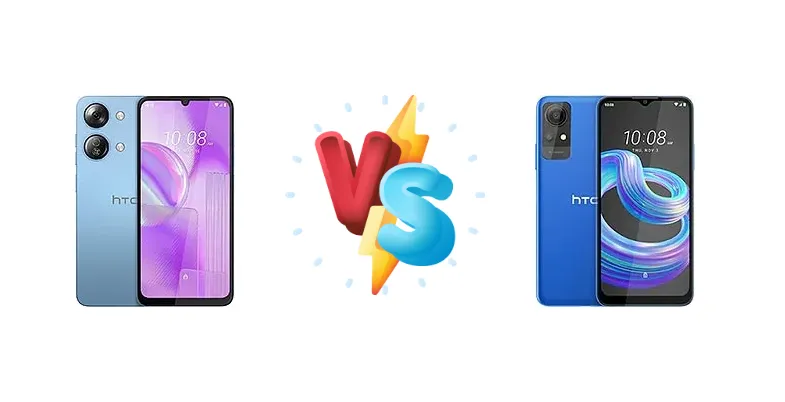
HTC's Wildfire series continues to offer affordable Android options, but the E4 Plus and E3 Lite represent distinct approaches within that budget segment. The E4 Plus aims for a slight performance boost, while the E3 Lite focuses on maintaining a lower price point. This comparison dissects the key differences to determine which device delivers the best value for your money.
🏆 Quick Verdict
For most users, the HTC Wildfire E4 Plus is the better choice. Its Unisoc T606 chipset, built on a more modern 12nm process, provides a noticeable performance advantage over the E3 Lite’s older 28nm SC9863A. While both offer similar 10W charging, the E4 Plus’s improved CPU architecture translates to a smoother overall experience.
| Network |
|---|
| 2G bands | GSM 850 / 900 / 1800 / 1900 | GSM 850 / 900 / 1800 / 1900 |
| 3G bands | HSDPA 850 / 900 / 2100 | HSDPA 850 / 900 / 2100 |
| 4G bands | LTE | 1, 3, 5, 7, 8, 20, 34, 38, 40, 41 |
| Speed | HSPA, LTE | HSPA, LTE |
| Technology | GSM / HSPA / LTE | GSM / HSPA / LTE |
| Launch |
|---|
| Announced | 2025, June 20 | 2023, April 10 |
| Status | Available. Released 2025, June 20 | Available. Released 2023, April 10 |
| Body |
|---|
| Build | Glass front, plastic back, plastic frame | Glass front, plastic back, plastic frame |
| Dimensions | - | 164.8 x 76.5 x 9.2 mm (6.49 x 3.01 x 0.36 in) |
| SIM | Nano-SIM + Nano-SIM | Nano-SIM + Nano-SIM |
| Weight | - | 218 g (7.69 oz) |
| Display |
|---|
| Resolution | 720 x 1600 pixels, 20:9 ratio (~260 ppi density) | 720 x 1600 pixels, 20:9 ratio (~269 ppi density) |
| Size | 6.75 inches, 110.0 cm2 | 6.52 inches, 102.6 cm2 (~81.4% screen-to-body ratio) |
| Type | IPS LCD, 90Hz | IPS LCD |
| Platform |
|---|
| CPU | Octa-core (2x1.6 GHz Cortex-A75 & 6x1.6 GHz Cortex-A55) | Octa-core (4x1.6 GHz Cortex-A55 & 4x1.2 GHz Cortex-A55) |
| Chipset | Unisoc T606 (12 nm) | Unisoc SC9863A (28 nm) |
| GPU | Mali-G57 MP1 | IMG8322 |
| OS | Android 14 | Android 12 |
| Memory |
|---|
| Card slot | microSDXC | microSDXC |
| Internal | 128GB 4GB RAM | 32GB 3GB RAM, 64GB 4GB RAM |
| | - | eMMC 5.1 |
| Main Camera |
|---|
| Dual | 50 MP, (wide)
VGA | 13 MP, f/2.2, (wide), AF
Auxiliary lens |
| Features | LED flash | LED flash |
| Video | 1080p@30fps | 1080p@30fps |
| Selfie camera |
|---|
| Single | 8 MP, (wide) | 5 MP, f/2.0 |
| Video | Yes | 720p |
| Sound |
|---|
| 3.5mm jack | - | Yes |
| 35mm jack | Yes | Yes |
| Loudspeaker | Yes | Yes |
| Comms |
|---|
| Bluetooth | Yes | 4.2, A2DP |
| NFC | No | No |
| Positioning | GPS, GLONASS, GALILEO | GPS, GLONASS, GALILEO |
| Radio | Unspecified | Unspecified |
| USB | USB Type-C 2.0 | USB Type-C 2.0 |
| WLAN | Yes | Wi-Fi 802.11 a/b/g/n |
| Features |
|---|
| Sensors | Fingerprint (side-mounted); unspecified sensors | Fingerprint (side-mounted), accelerometer, proximity |
| Battery |
|---|
| Charging | 10W wired | 10W wired |
| Type | 5000 mAh | Li-Po 5000 mAh |
| Misc |
|---|
| Colors | Black, Light Blue | Black, Blue |
| Price | About 100 EUR | - |
HTC Wildfire E4 Plus
- More powerful Unisoc T606 chipset
- More efficient 12nm process
- Better CPU architecture for smoother performance
- Likely higher price point than the E3 Lite
- 10W charging is relatively slow
HTC Wildfire E3 lite
- Lower price point
- Functional for basic tasks
- 10W charging is standard for the segment
- Significantly weaker Unisoc SC9863A chipset
- Less efficient 28nm process
- Noticeably slower performance
Display Comparison
Neither HTC provides detailed display specifications beyond resolution. However, given the price points, both likely utilize LCD panels. The difference in processing power suggests the E4 Plus *could* handle slightly more complex display rendering, but this is unlikely to be a significant visual difference. Bezels are expected to be substantial on both devices, typical of this market segment. Color accuracy is likely to be standard for budget phones, prioritizing power efficiency over color fidelity.
Camera Comparison
Detailed camera specs are unavailable, but both phones likely feature basic camera setups geared towards casual photography. Given the market segment, expect a primary sensor on both, potentially accompanied by a depth or macro sensor (though the usefulness of a 2MP macro lens is limited). The E4 Plus’s more powerful processor *could* enable slightly better image processing, resulting in marginally improved image quality, particularly in low-light conditions. However, the sensor size and lens aperture will be the primary determinants of image quality, and without that data, it’s difficult to definitively say which phone has the better camera.
Performance
The core difference lies in the chipsets. The HTC Wildfire E4 Plus features the Unisoc T606, a 12nm octa-core processor with a heterogeneous architecture – 2x Cortex-A75 cores for performance and 6x Cortex-A55 cores for efficiency. This contrasts sharply with the E3 Lite’s Unisoc SC9863A, a 28nm chip with 4x Cortex-A55 cores at 1.6GHz and 4x at 1.2GHz. The 12nm process of the T606 is significantly more efficient, leading to less heat generation and potentially better sustained performance. The inclusion of Cortex-A75 cores in the E4 Plus provides a substantial boost in single-core performance, crucial for app launch times and general responsiveness. The E3 Lite’s all-A55 configuration will feel noticeably slower in demanding scenarios.
Battery Life
Both devices are equipped with 10W wired charging, indicating a similar charging experience – expect around 2.5-3.5 hours for a full charge. While battery capacity isn’t specified, the more efficient Unisoc T606 in the E4 Plus will likely translate to slightly longer battery life under typical usage. The 28nm SC9863A in the E3 Lite will consume more power, reducing overall runtime, especially during processor-intensive tasks.
Buying Guide
Buy the HTC Wildfire E4 Plus if you prioritize responsiveness for everyday tasks like browsing, social media, and light gaming. The more efficient chipset will also contribute to slightly better battery life under moderate use. Buy the HTC Wildfire E3 Lite if your primary concern is absolute affordability and you only need a phone for basic communication – calls, texts, and very light app usage. It’s a functional device for those on the tightest of budgets.
Frequently Asked Questions
❓ Will the HTC Wildfire E4 Plus handle popular social media apps like Facebook and Instagram smoothly?
Yes, the Unisoc T606 chipset in the E4 Plus is sufficiently powerful to run social media apps without significant lag. The Cortex-A75 cores provide a performance boost that the E3 Lite’s SC9863A lacks, resulting in a more responsive experience when scrolling through feeds and loading content.
❓ Is the HTC Wildfire E3 Lite suitable for playing mobile games?
The HTC Wildfire E3 Lite is only suitable for very light gaming. The Unisoc SC9863A chipset struggles with demanding games, and you’ll likely experience significant frame rate drops and lag. It’s best suited for simple puzzle games or older titles.
❓ Does either phone support fast charging beyond the 10W standard?
No, both the HTC Wildfire E4 Plus and E3 Lite are limited to 10W wired charging. This is typical for phones in this price range, and you shouldn’t expect significantly faster charging speeds.
❓ What kind of storage options are available on these devices?
While specific storage configurations vary by region, both the E4 Plus and E3 Lite typically come with 32GB or 64GB of internal storage. Both also support microSD card expansion, allowing you to increase storage capacity if needed.