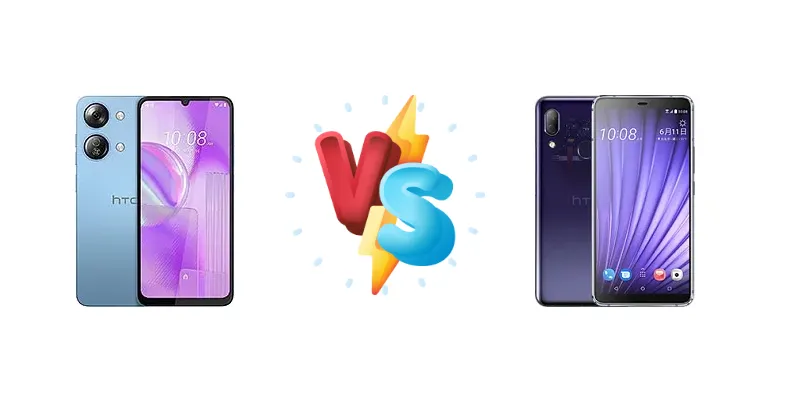
The HTC U19e and Wildfire E4 Plus represent different approaches to the budget smartphone market. The U19e, released earlier, leverages Qualcomm’s Snapdragon 710, while the Wildfire E4 Plus opts for the more recent Unisoc T606. This comparison dives deep into the architectural differences and real-world implications of these choices, helping you determine which device best suits your needs.
🏆 Quick Verdict
For most users, the HTC U19e is the superior choice. Its Snapdragon 710, built on a 10nm process, delivers noticeably better performance and supports 18W Quick Charge 4.0 for faster refueling. While the Wildfire E4 Plus offers a newer chipset, the Unisoc T606’s performance doesn’t match the U19e’s efficiency or power.
| Network |
|---|
| 2G bands | GSM 850 / 900 / 1800 / 1900 | GSM 850 / 900 / 1800 / 1900 |
| 3G bands | HSDPA 850 / 900 / 2100 | HSDPA 850 / 900 / 1900 / 2100 |
| 4G bands | LTE | 1, 2, 3, 5, 7, 8, 20, 28, 38, 39, 40, 41 |
| Speed | HSPA, LTE | HSPA 42.2/5.76 Mbps, LTE (3CA) Cat15 800/150 Mbps |
| Technology | GSM / HSPA / LTE | GSM / HSPA / LTE |
| Launch |
|---|
| Announced | 2025, June 20 | 2019, June 11. Released 2019, June 11 |
| Status | Available. Released 2025, June 20 | Discontinued |
| Body |
|---|
| Build | Glass front, plastic back, plastic frame | Glass front (Gorilla Glass), glass back, aluminum frame |
| Dimensions | - | 156.6 x 75.9 x 8 mm (6.17 x 2.99 x 0.31 in) |
| SIM | Nano-SIM + Nano-SIM | Nano-SIM + Nano-SIM |
| Weight | - | 180 g (6.35 oz) |
| Display |
|---|
| Protection | - | Corning Gorilla Glass (unspecified) |
| Resolution | 720 x 1600 pixels, 20:9 ratio (~260 ppi density) | 1080 x 2160 pixels, 18:9 ratio (~402 ppi density) |
| Size | 6.75 inches, 110.0 cm2 | 6.0 inches, 92.9 cm2 (~78.2% screen-to-body ratio) |
| Type | IPS LCD, 90Hz | OLED, HDR10 |
| Platform |
|---|
| CPU | Octa-core (2x1.6 GHz Cortex-A75 & 6x1.6 GHz Cortex-A55) | Octa-core (2x2.2 GHz Kryo 360 Gold & 6x1.7 GHz Kryo 360 Silver) |
| Chipset | Unisoc T606 (12 nm) | Qualcomm SDM710 Snapdragon 710 (10 nm) |
| GPU | Mali-G57 MP1 | Adreno 616 |
| OS | Android 14 | Android 9.0 (Pie), HTC Sense |
| Memory |
|---|
| Card slot | microSDXC | microSDXC (uses shared SIM slot) |
| Internal | 128GB 4GB RAM | 128GB 6GB RAM |
| Main Camera |
|---|
| Dual | 50 MP, (wide)
VGA | 12 MP, f/1.8, 26mm (wide), PDAF
20 MP, f/2.6, 52mm (telephoto), 2x optical zoom |
| Features | LED flash | Dual-LED dual-tone flash, Auto HDR, panorama |
| Video | 1080p@30fps | 4K@30fps |
| Selfie camera |
|---|
| Dual | - | 24 MP, f/2.0, 26mm (wide), 1/2.8", 0.9µm
2 MP, f/2.2 (depth sensor) |
| Features | - | Auto HDR |
| Single | 8 MP, (wide) | - |
| Video | Yes | 1080p@30fps |
| Sound |
|---|
| 3.5mm jack | - | No |
| 35mm jack | Yes | No |
| Loudspeaker | Yes | Yes, with stereo speakers |
| | - | 24-bit/192kHz audio
|
| Comms |
|---|
| Bluetooth | Yes | 5.0, A2DP, LE |
| NFC | No | Yes |
| Positioning | GPS, GLONASS, GALILEO | GPS, GLONASS |
| Radio | Unspecified | FM radio |
| USB | USB Type-C 2.0 | USB Type-C 3.1 |
| WLAN | Yes | Wi-Fi 802.11 a/b/g/n/ac, dual-band, Wi-Fi Direct |
| Features |
|---|
| Sensors | Fingerprint (side-mounted); unspecified sensors | Iris scanner, fingerprint (rear-mounted), accelerometer, gyro, proximity, compass |
| Battery |
|---|
| Charging | 10W wired | 18W wired, QC4 |
| Type | 5000 mAh | Li-Ion 3930 mAh, non-removable |
| Misc |
|---|
| Colors | Black, Light Blue | Extraordinary Purple, Modest Green |
| Price | About 100 EUR | About 420 EUR |
HTC Wildfire E4 Plus
- More affordable price point
- Potentially longer battery life due to power-efficient chipset
- Newer chipset architecture (Unisoc T606)
- Significantly lower performance compared to Snapdragon 710
- Slower 10W charging
- Likely less refined camera image processing
HTC U19e
- Faster and more responsive performance (Snapdragon 710)
- 18W Quick Charge 4.0 for faster charging
- Potentially better camera image quality
- Higher price compared to Wildfire E4 Plus
- Older chipset generation
- May have slightly shorter battery life under heavy load
Display Comparison
Neither HTC provides detailed display specifications beyond resolution. However, given the market positioning, both likely utilize IPS LCD panels. The U19e’s slightly higher price suggests a potentially better-quality panel with improved color accuracy. The absence of high refresh rates on either device indicates a focus on power efficiency rather than visual fluidity. Bezels are expected to be relatively substantial on both, typical of their price brackets.
Camera Comparison
Detailed camera specs are unavailable, but both phones likely feature a multi-camera setup geared towards basic photography. The U19e’s slightly higher market positioning suggests a potentially larger main sensor and more sophisticated image processing. The presence of Quick Charge 4.0 on the U19e implies a more advanced ISP (Image Signal Processor) within the Snapdragon 710, potentially leading to better image quality and faster processing times. The Wildfire E4 Plus likely relies on Unisoc’s image processing capabilities, which are generally less refined than Qualcomm’s.
Performance
The core difference lies in the chipsets. The Qualcomm Snapdragon 710 (10nm) in the U19e features 2x 2.2 GHz Kryo 360 Gold cores and 6x 1.7 GHz Kryo 360 Silver cores. This contrasts with the Unisoc T606 (12nm) in the Wildfire E4 Plus, which has 2x 1.6 GHz Cortex-A75 cores and 6x 1.6 GHz Cortex-A55 cores. The 10nm process of the Snapdragon 710 offers superior transistor density and thermal efficiency, translating to sustained performance under load. While the Cortex-A75 cores in the T606 are individually more powerful than the A55 cores, the Snapdragon 710’s architecture and process node provide a clear advantage in overall system performance and multitasking.
Battery Life
Battery capacity is not specified for either device. However, the U19e’s 18W wired charging with Quick Charge 4.0 support is a significant advantage. This allows for much faster charging times compared to the Wildfire E4 Plus’s 10W wired charging. While a larger battery capacity on the Wildfire E4 Plus could offset the slower charging, the Snapdragon 710’s power efficiency means the U19e can likely achieve comparable or even better battery life with a smaller battery, coupled with faster top-ups when needed.
Buying Guide
Buy the HTC Wildfire E4 Plus if you prioritize a very basic, affordable smartphone for essential tasks like calls, messaging, and light social media use, and battery life is paramount. Buy the HTC U19e if you need a more responsive experience for multitasking, occasional gaming, and appreciate faster charging speeds, even if it means a slightly higher price point.
Frequently Asked Questions
❓ Will the Unisoc T606 in the Wildfire E4 Plus struggle with demanding apps like PUBG Mobile?
Yes, the Unisoc T606 is a budget-focused chipset. While it can handle basic gaming, demanding titles like PUBG Mobile will likely require significantly reduced graphics settings and may still experience noticeable lag or frame drops. The Snapdragon 710 in the U19e offers a much smoother gaming experience.
❓ Does the HTC U19e support VoLTE and Wi-Fi calling, and are these features reliable?
The HTC U19e, being a slightly higher-tier device, is more likely to support VoLTE and Wi-Fi calling. However, reliability depends on your carrier. It's crucial to check with your mobile provider to confirm compatibility before purchasing, as support can vary by region and network.
❓ How much faster is the charging on the HTC U19e compared to the Wildfire E4 Plus in real-world use?
The 18W Quick Charge 4.0 on the U19e can potentially charge the phone from 0-100% in around 90-120 minutes, depending on battery capacity. The Wildfire E4 Plus’s 10W charging will likely take over 3 hours to achieve a full charge, making the U19e significantly more convenient for users who need to quickly top up their battery.