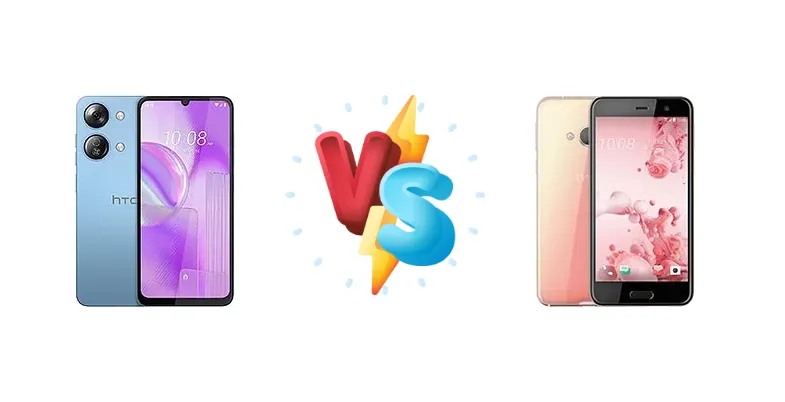
The HTC Wildfire E4 Plus and the HTC U Play represent different eras of HTC's smartphone strategy. The U Play, released in 2017, aimed for a mid-range experience with a focus on design, while the Wildfire E4 Plus, a more recent offering, prioritizes affordability and essential functionality. This comparison dissects their core components to determine which device delivers the best experience for today's user.
🏆 Quick Verdict
For the average user in 2024, the HTC Wildfire E4 Plus is the better choice. While both phones share the same slow 10W charging, the Wildfire E4 Plus’s Unisoc T606 chipset, built on a more modern 12nm process, offers a noticeable efficiency advantage over the U Play’s older 28nm Helio P10, translating to better battery life and potentially smoother performance in everyday tasks.
| Network |
|---|
| 2G bands | GSM 850 / 900 / 1800 / 1900 | GSM 850 / 900 / 1800 / 1900 - SIM 1 & SIM 2 |
| 3G bands | HSDPA 850 / 900 / 2100 | HSDPA 850 / 900 / 1900 / 2100 |
| 4G bands | LTE | 1, 3, 5, 7, 8, 20, 28, 38, 40 |
| Speed | HSPA, LTE | HSPA 42.2/5.76 Mbps, LTE (2CA) Cat6 300/50 Mbps |
| Technology | GSM / HSPA / LTE | GSM / HSPA / LTE |
| Launch |
|---|
| Announced | 2025, June 20 | 2017, January. Released 2017, February |
| Status | Available. Released 2025, June 20 | Discontinued |
| Body |
|---|
| Build | Glass front, plastic back, plastic frame | Glass front (Gorilla Glass), plastic back, plastic frame |
| Dimensions | - | 146 x 72.9 x 8 mm (5.75 x 2.87 x 0.31 in) |
| SIM | Nano-SIM + Nano-SIM | Nano-SIM + Nano-SIM |
| Weight | - | 145 g (5.11 oz) |
| Display |
|---|
| Protection | - | Corning Gorilla Glass (unspecified version) |
| Resolution | 720 x 1600 pixels, 20:9 ratio (~260 ppi density) | 1080 x 1920 pixels, 16:9 ratio (~428 ppi density) |
| Size | 6.75 inches, 110.0 cm2 | 5.2 inches, 73.2 cm2 (~68.7% screen-to-body ratio) |
| Type | IPS LCD, 90Hz | Super LCD |
| Platform |
|---|
| CPU | Octa-core (2x1.6 GHz Cortex-A75 & 6x1.6 GHz Cortex-A55) | Octa-core (4x2.0 GHz Cortex-A53 & 4x1.1 GHz Cortex-A53) |
| Chipset | Unisoc T606 (12 nm) | Mediatek MT6755 Helio P10 (28 nm) |
| GPU | Mali-G57 MP1 | Mali-T860MP2 |
| OS | Android 14 | Android 6.0 (Marshmallow) |
| Memory |
|---|
| Card slot | microSDXC | microSDXC (uses shared SIM slot) |
| Internal | 128GB 4GB RAM | 32GB 3GB RAM, 64GB 4GB RAM |
| | - | eMMC 5.1 |
| Main Camera |
|---|
| Dual | 50 MP, (wide)
VGA | - |
| Features | LED flash | Dual-LED dual-tone flash, panorama |
| Single | - | 16 MP, f/2.0, 28mm (wide), 1/3.1", 1.0µm, PDAF, OIS |
| Video | 1080p@30fps | 1080p@30fps |
| Selfie camera |
|---|
| Features | - | HDR |
| Single | 8 MP, (wide) | 16 MP, f/2.0, 27mm (wide), 1/3.06", 1.0µm |
| Video | Yes | 1080p@30fps |
| Sound |
|---|
| 3.5mm jack | - | No |
| 35mm jack | Yes | No |
| Loudspeaker | Yes | Yes |
| Comms |
|---|
| Bluetooth | Yes | 4.2, A2DP, LE |
| NFC | No | Yes |
| Positioning | GPS, GLONASS, GALILEO | GPS, GLONASS |
| Radio | Unspecified | No |
| USB | USB Type-C 2.0 | USB Type-C 2.0 |
| WLAN | Yes | Wi-Fi 802.11 a/b/g/n/ac, dual-band, Wi-Fi Direct, DLNA |
| Features |
|---|
| Sensors | Fingerprint (side-mounted); unspecified sensors | Fingerprint (front-mounted), accelerometer, gyro, proximity, compass |
| Battery |
|---|
| Charging | 10W wired | 10W wired |
| Stand-by | - | Up to 427 h (3G) |
| Talk time | - | Up to 15 h (3G) |
| Type | 5000 mAh | Li-Ion 2500 mAh, non-removable |
| Misc |
|---|
| Colors | Black, Light Blue | Brilliant Black, Cosmetic Pink, Ice White, Sapphire Blue |
| Models | - | U Play, U-2u, 2PZM3 |
| Price | About 100 EUR | About 150 EUR |
HTC Wildfire E4 Plus
- More efficient Unisoc T606 chipset
- Modern CPU architecture (Cortex-A75/A55)
- Potentially better battery life
- Likely improved display technology
- Limited 10W charging
- Basic camera system (details unknown)
HTC U Play
- Slightly higher CPU clock speed (on paper)
- Potentially more premium design (from 2017)
- May be available at a lower price point (due to age)
- Inefficient 28nm Helio P10 chipset
- Older CPU architecture (Cortex-A53)
- Shorter battery life
- Likely lower display quality
Display Comparison
Neither HTC provides display specifications beyond resolution in their marketing materials. However, given their market positioning, both likely utilize IPS LCD panels. The U Play’s age suggests a lower peak brightness and potentially wider bezels compared to the Wildfire E4 Plus. The older manufacturing process of the U Play likely results in lower color accuracy and contrast ratios. The Wildfire E4 Plus, being a newer device, benefits from advancements in display technology, even within the budget segment.
Camera Comparison
Both phones likely feature basic camera setups. Detailed camera specs are scarce, but the U Play’s age suggests a less sophisticated image signal processor (ISP). The Wildfire E4 Plus, despite its budget status, benefits from newer image processing algorithms and potentially better low-light performance due to advancements in sensor technology. It's reasonable to assume both phones include a primary camera and a depth sensor, but detailed analysis is hampered by the lack of specific sensor information. Focusing on megapixel counts alone would be misleading; the image processing pipeline is more critical at this price point.
Performance
The core difference lies in the chipsets. The Unisoc T606 in the Wildfire E4 Plus, fabricated on a 12nm process, features a more modern CPU architecture – Cortex-A75 and A55 cores – compared to the Helio P10’s older Cortex-A53 cores. While the Helio P10 boasts a slightly higher peak CPU clock speed (2.0 GHz vs 1.6 GHz), the architectural improvements and smaller node size of the T606 provide a significant advantage in sustained performance and power efficiency. The Helio P10’s 28nm process is notoriously power-hungry, impacting battery life. The T606’s octa-core configuration, while sharing the same core count, is more balanced, with performance cores handling demanding tasks and efficiency cores managing background processes.
Battery Life
Battery capacity is not specified for either device. However, the Unisoc T606’s superior power efficiency in the Wildfire E4 Plus will translate to longer battery life despite potentially having a similar capacity to the U Play. Both phones are limited to 10W wired charging, meaning a full charge will take a considerable amount of time – likely exceeding 3 hours. The U Play’s older, less efficient chipset will require more frequent charging cycles, making the Wildfire E4 Plus the more practical choice for all-day use.
Buying Guide
Buy the HTC Wildfire E4 Plus if you need a phone for basic communication, social media, and light tasks, prioritizing battery life and a more modern chipset architecture. Buy the HTC U Play if you prefer a slightly more premium design aesthetic from 2017 and are willing to accept a less efficient processor and potentially shorter battery life. Both are firmly in the entry-level segment, but the Wildfire E4 Plus represents a more sensible purchase in the current market.
Frequently Asked Questions
❓ Will the Helio P10 in the HTC U Play struggle with modern apps?
Yes, the Helio P10, being a 2017-era chipset, will likely exhibit noticeable lag and slowdowns when running newer, more demanding applications. The older Cortex-A53 cores and the inefficient 28nm process simply aren't optimized for the software of 2024. The Wildfire E4 Plus’s Unisoc T606 will provide a smoother experience, even if it isn’t a powerhouse.
❓ Is the 10W charging on either phone acceptable for daily use?
No, 10W charging is quite slow by today’s standards. Expect a full charge to take over 3 hours on both the Wildfire E4 Plus and the U Play. This is a significant drawback for users who need quick top-ups throughout the day. However, the Wildfire E4 Plus’s more efficient chipset means you’ll likely need to charge it less frequently.
❓ Can either of these phones handle basic mobile gaming?
Both phones can handle *basic* mobile gaming, but don't expect high frame rates or detailed graphics. The Helio P10 will likely struggle with more demanding titles, while the Unisoc T606 in the Wildfire E4 Plus will offer a slightly better experience, but still requires lowered settings for optimal performance. Neither is a gaming phone.