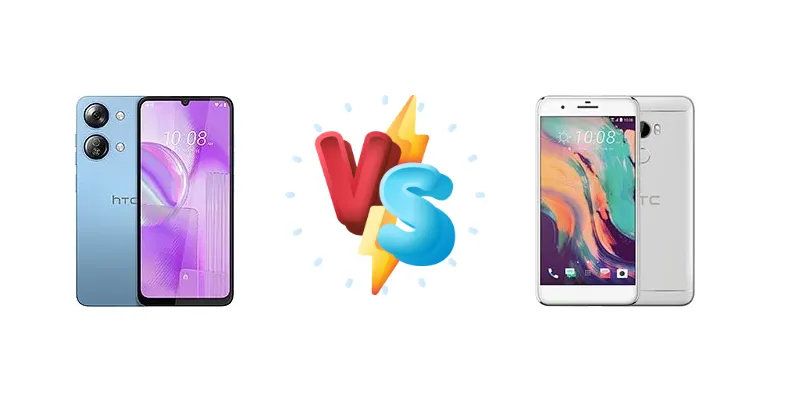
The HTC Wildfire E4 Plus and the HTC One X10 represent different eras of HTC's budget smartphone strategy. The E4 Plus, released later, leverages a more modern, power-efficient chipset, while the One X10 relies on the older, but still capable, MediaTek Helio P10. This comparison dissects the key differences to determine which device offers the best value in today's market.
🏆 Quick Verdict
For the average user in 2024, the HTC Wildfire E4 Plus is the better choice. Its Unisoc T606 chipset, built on a 12nm process, provides a more efficient experience than the One X10’s 28nm Helio P10, translating to better battery life and potentially less heat. While neither phone is a performance powerhouse, the E4 Plus offers a more contemporary foundation.
| Network |
|---|
| 2G bands | GSM 850 / 900 / 1800 / 1900 | GSM 850 / 900 / 1800 / 1900 - SIM 1 & SIM 2 (dual-SIM model only) |
| 3G bands | HSDPA 850 / 900 / 2100 | HSDPA 850 / 900 / 1900 / 2100 |
| 4G bands | LTE | 1, 3, 5, 7, 8, 20, 28, 38, 40 |
| Speed | HSPA, LTE | HSPA 42.2/5.76 Mbps, LTE (2CA) Cat6 300/50 Mbps |
| Technology | GSM / HSPA / LTE | GSM / HSPA / LTE |
| Launch |
|---|
| Announced | 2025, June 20 | 2017, April. Released 2017, July |
| Status | Available. Released 2025, June 20 | Discontinued |
| Body |
|---|
| Build | Glass front, plastic back, plastic frame | - |
| Dimensions | - | 152.9 x 75.6 x 8.2 mm (6.02 x 2.98 x 0.32 in) |
| SIM | Nano-SIM + Nano-SIM | · Nano-SIM· Nano-SIM + Nano-SIM |
| Weight | - | 175 g (6.17 oz) |
| Display |
|---|
| Protection | - | Corning Gorilla Glass (unspecified version) |
| Resolution | 720 x 1600 pixels, 20:9 ratio (~260 ppi density) | 1080 x 1920 pixels, 16:9 ratio (~401 ppi density) |
| Size | 6.75 inches, 110.0 cm2 | 5.5 inches, 83.4 cm2 (~72.1% screen-to-body ratio) |
| Type | IPS LCD, 90Hz | Super LCD |
| Platform |
|---|
| CPU | Octa-core (2x1.6 GHz Cortex-A75 & 6x1.6 GHz Cortex-A55) | Octa-core (4x1.8 GHz Cortex-A53 & 4x1.0 GHz Cortex-A53) |
| Chipset | Unisoc T606 (12 nm) | Mediatek MT6755 Helio P10 (28 nm) |
| GPU | Mali-G57 MP1 | Mali-T860MP2 |
| OS | Android 14 | Android OS |
| Memory |
|---|
| Card slot | microSDXC | microSDXC |
| Internal | 128GB 4GB RAM | 32GB 3GB RAM |
| | - | eMMC 5.1 |
| Main Camera |
|---|
| Dual | 50 MP, (wide)
VGA | - |
| Features | LED flash | Dual-LED dual-tone flash, HDR, panorama |
| Single | - | 16 MP, f/2.0, 26mm (wide), AF |
| Video | 1080p@30fps | 1080p@30fps |
| Selfie camera |
|---|
| Single | 8 MP, (wide) | 8 MP, f/2.2, 23mm (wide), 1/4.0", 1.12µm |
| Video | Yes | 1080p@30fps |
| Sound |
|---|
| 3.5mm jack | - | Yes |
| 35mm jack | Yes | Yes |
| Loudspeaker | Yes | Yes |
| Comms |
|---|
| Bluetooth | Yes | 4.2, A2DP |
| NFC | No | No |
| Positioning | GPS, GLONASS, GALILEO | GPS, GLONASS |
| Radio | Unspecified | FM radio |
| USB | USB Type-C 2.0 | microUSB 2.0 |
| WLAN | Yes | Wi-Fi 802.11 a/b/g/n, Wi-Fi Direct, DLNA, hotspot |
| Features |
|---|
| Sensors | Fingerprint (side-mounted); unspecified sensors | Fingerprint (rear-mounted), accelerometer, gyro, proximity, compass |
| Battery |
|---|
| Charging | 10W wired | - |
| Stand-by | - | Up to 744 h (3G) |
| Talk time | - | Up to 25 h 30 min (3G) |
| Type | 5000 mAh | Li-Ion 4000 mAh, non-removable |
| Misc |
|---|
| Colors | Black, Light Blue | Black, Silver |
| Models | - | One X10, 2PXH3 |
| Price | About 100 EUR | About 200 EUR |
HTC Wildfire E4 Plus
- More efficient Unisoc T606 chipset
- Likely better battery life
- Potentially smoother multitasking
- 10W charging is slow
- Limited detailed specifications available
HTC One X10
- Potentially larger form factor (unconfirmed)
- May be available at a lower price point
- Established MediaTek chipset
- Less efficient 28nm Helio P10 chipset
- Likely shorter battery life
- Older architecture and potentially limited software support
Display Comparison
Detailed display specifications are unavailable for either device. However, given their market positioning, both likely feature LCD panels with 720p+ resolutions. The key difference lies in the underlying technology and efficiency. The older One X10, with its 28nm chipset, likely has less power available to drive a brighter or higher-refresh-rate display. The E4 Plus, benefiting from the 12nm Unisoc T606, *could* potentially offer a slightly better viewing experience, though this is speculative without further data.
Camera Comparison
Camera details are sparse for both devices. It's safe to assume both feature basic camera setups geared towards casual photography. Without sensor size or aperture information, a direct comparison is difficult. However, the newer chipset in the E4 Plus *may* offer slightly improved image signal processing (ISP) capabilities, potentially leading to better image quality in favorable lighting conditions. The presence of a 2MP macro lens on either device is largely a marketing gimmick and shouldn't be a deciding factor.
Performance
The Unisoc T606 in the Wildfire E4 Plus and the MediaTek Helio P10 in the One X10 represent a significant architectural leap. The T606 utilizes a combination of Cortex-A75 and A55 cores, offering a more modern and efficient CPU design compared to the Helio P10’s all-Cortex-A53 configuration. While the Helio P10 has eight cores, the A53 architecture is less efficient per clock cycle. The 12nm fabrication process of the T606 further enhances efficiency, meaning the E4 Plus will likely handle sustained workloads with less thermal throttling. This translates to a smoother experience during multitasking and light gaming for the E4 Plus.
Battery Life
Battery capacity is not specified for either device. However, the Unisoc T606’s 12nm process gives the Wildfire E4 Plus a distinct advantage in battery life. The Helio P10’s 28nm process is significantly less efficient, meaning it consumes more power for the same tasks. The E4 Plus also features 10W wired charging, which, while slow, is a standard offering in this price segment. The One X10’s charging speed is unknown, but likely similar. The E4 Plus will likely achieve a longer runtime on a single charge due to its more efficient chipset.
Buying Guide
Buy the HTC Wildfire E4 Plus if you prioritize battery life, a more modern software experience (even if still Android Go), and a device that won't struggle as much with everyday tasks. Buy the HTC One X10 if you find a significantly discounted unit and are comfortable with an older chipset and potentially limited software updates. The X10 might appeal to users who prefer a slightly larger form factor, though this isn't confirmed by available specs.
Frequently Asked Questions
❓ Will the HTC One X10 struggle with modern apps like Facebook or WhatsApp?
The Helio P10, while capable for its time, is showing its age. Running demanding apps like Facebook or WhatsApp on the One X10 may result in noticeable lag or slowdowns, especially with multiple apps open simultaneously. The Wildfire E4 Plus, with its newer Unisoc T606, will handle these tasks more smoothly.
❓ Is the 10W charging on the Wildfire E4 Plus a significant drawback?
10W charging is relatively slow by today's standards, taking several hours to fully charge the device. However, given the likely smaller battery capacity and the E4 Plus’s efficient chipset, this may not be a major inconvenience for most users. It’s best suited for overnight charging.
❓ Can either of these phones handle basic mobile gaming?
Both phones can handle basic mobile gaming, but don't expect high frame rates or demanding graphics settings. The Unisoc T606 in the Wildfire E4 Plus will provide a slightly better gaming experience due to its more modern architecture and potentially better thermal management, reducing the likelihood of performance throttling.