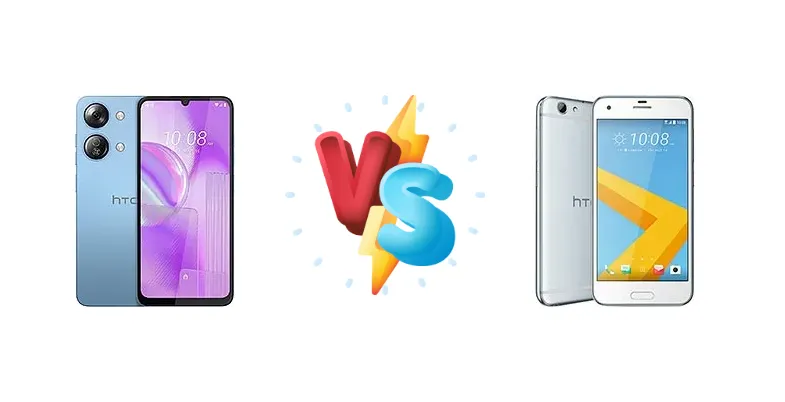
The HTC Wildfire E4 Plus and One A9s represent HTC's attempts to capture the budget smartphone market, but they approach it with different hardware philosophies. The E4 Plus leverages a newer, albeit entry-level, Unisoc chipset, while the A9s relies on the older Mediatek Helio P10. This comparison dissects these differences to determine which device offers the best value for users prioritizing affordability.
🏆 Quick Verdict
For the average user seeking a functional, if basic, smartphone experience, the HTC Wildfire E4 Plus emerges as the better choice. Its Unisoc T606 chipset, built on a more modern 12nm process, offers a noticeable performance advantage over the A9s’s 28nm Helio P10, despite similar core counts, and translates to a smoother user experience.
| Network |
|---|
| 2G bands | GSM 850 / 900 / 1800 / 1900 | GSM 850 / 900 / 1800 / 1900 |
| 3G bands | HSDPA 850 / 900 / 2100 | HSDPA 850 / 900 / 1900 / 2100 |
| 4G bands | LTE | 1, 2, 3, 4, 5, 7, 8, 12, 17, 28, 38, 40 |
| Speed | HSPA, LTE | HSPA 42.2/5.76 Mbps, LTE (2CA) Cat6 300/50 Mbps |
| Technology | GSM / HSPA / LTE | GSM / HSPA / LTE |
| Launch |
|---|
| Announced | 2025, June 20 | 2016, September. Released 2016, November |
| Status | Available. Released 2025, June 20 | Discontinued |
| Body |
|---|
| Build | Glass front, plastic back, plastic frame | - |
| Dimensions | - | 146.5 x 71.5 x 8 mm (5.77 x 2.81 x 0.31 in) |
| SIM | Nano-SIM + Nano-SIM | Nano-SIM |
| Weight | - | 149.8 g (5.29 oz) |
| Display |
|---|
| Protection | - | Corning Gorilla Glass (unspecified version) |
| Resolution | 720 x 1600 pixels, 20:9 ratio (~260 ppi density) | 720 x 1280 pixels, 16:9 ratio (~294 ppi density) |
| Size | 6.75 inches, 110.0 cm2 | 5.0 inches, 68.9 cm2 (~65.8% screen-to-body ratio) |
| Type | IPS LCD, 90Hz | Super LCD |
| Platform |
|---|
| CPU | Octa-core (2x1.6 GHz Cortex-A75 & 6x1.6 GHz Cortex-A55) | Octa-core (4x1.8 GHz Cortex-A53 & 4x1.0 GHz Cortex-A53) |
| Chipset | Unisoc T606 (12 nm) | Mediatek MT6755 Helio P10 (28 nm) |
| GPU | Mali-G57 MP1 | Mali-T860MP2 |
| OS | Android 14 | Android 6.0 (Marshmallow), Sense UI |
| Memory |
|---|
| Card slot | microSDXC | microSDXC (dedicated slot) |
| Internal | 128GB 4GB RAM | 16GB 2GB RAM, 32GB 3GB RAM |
| | - | eMMC 5.1 |
| Main Camera |
|---|
| Dual | 50 MP, (wide)
VGA | - |
| Features | LED flash | LED flash, panorama, HDR |
| Single | - | 13 MP, f/2.2, 28mm (wide), 1.12µm, AF |
| Video | 1080p@30fps | 1080p@30fps |
| Selfie camera |
|---|
| Single | 8 MP, (wide) | 5 MP, f/2.8, 34mm (standard), 1/5.0", 1.12µm |
| Video | Yes | - |
| Sound |
|---|
| 3.5mm jack | - | Yes |
| 35mm jack | Yes | Yes |
| Loudspeaker | Yes | Yes |
| Comms |
|---|
| Bluetooth | Yes | 4.2, A2DP |
| NFC | No | Yes (payments only) |
| Positioning | GPS, GLONASS, GALILEO | GPS, GLONASS |
| Radio | Unspecified | FM radio |
| USB | USB Type-C 2.0 | microUSB 2.0 |
| WLAN | Yes | Wi-Fi 802.11 a/b/g/n |
| Features |
|---|
| Sensors | Fingerprint (side-mounted); unspecified sensors | Fingerprint (front-mounted), accelerometer, proximity, compass |
| Battery |
|---|
| Charging | 10W wired | 10W wired |
| Stand-by | - | Up to 432 h (3G) |
| Talk time | - | Up to 13 h (3G) |
| Type | 5000 mAh | Li-Ion 2300 mAh, non-removable |
| Misc |
|---|
| Colors | Black, Light Blue | Black, Silver, Gold |
| Models | - | One A9s |
| Price | About 100 EUR | About 150 EUR |
HTC Wildfire E4 Plus
- More modern and efficient Unisoc T606 chipset
- Potentially better battery life due to chipset efficiency
- Smoother user experience compared to the A9s
- 10W charging is slow
- Long-term software support is uncertain
HTC One A9s
- Potentially wider availability of accessories
- Slightly larger existing user base
- May be available at an even lower price point
- Older and less efficient Mediatek Helio P10 chipset
- Noticeably slower performance
- Higher power consumption leading to shorter battery life
Display Comparison
Neither device boasts a standout display. Details regarding panel type (IPS, TFT) and resolution are missing, but both are likely 720p given their market segment. The key difference lies in the underlying processing power driving the display; the Unisoc T606 in the E4 Plus has a more capable GPU, potentially leading to smoother scrolling and animations. Bezels are expected to be substantial on both, reflecting their budget nature. Color accuracy is unlikely to be a priority on either device.
Camera Comparison
Camera performance on both devices is expected to be basic. Details regarding sensor size and image processing are unavailable, but the inclusion of a 2MP macro lens on either device is largely a marketing gimmick. The primary camera’s quality will be the determining factor, and the E4 Plus’s more modern ISP (Image Signal Processor) within the Unisoc T606 chipset *may* offer slightly better image processing capabilities, particularly in low-light conditions. However, expectations should remain tempered; these are not camera-focused devices.
Performance
The Unisoc T606 in the Wildfire E4 Plus represents a significant architectural leap over the Mediatek Helio P10 in the One A9s. While both are octa-core CPUs, the T606 utilizes a more modern core design – Cortex-A75 and A55 – compared to the A9s’s older Cortex-A53 cores. The 12nm fabrication process of the T606 also provides a substantial efficiency advantage over the Helio P10’s 28nm process, resulting in better thermal management and potentially sustained performance. This translates to faster app loading times and a more responsive user interface on the E4 Plus. The A9s, while capable for basic tasks, will likely exhibit noticeable lag with multitasking or demanding applications.
Battery Life
Both the HTC Wildfire E4 Plus and One A9s feature 10W wired charging, indicating a similar charging experience – slow by modern standards. Battery capacity details are missing, but the more efficient Unisoc T606 in the E4 Plus will likely translate to better battery life, even with a similar capacity battery. The 28nm Helio P10 is known for its power consumption, meaning the A9s will likely require more frequent charging.
Buying Guide
Buy the HTC Wildfire E4 Plus if you need a phone for essential tasks like calling, messaging, and light social media browsing, and appreciate a slightly more responsive interface. Its newer chipset provides a better foundation for future Android updates (though support remains a concern). Buy the HTC One A9s if you specifically require a device with a potentially wider range of aftermarket accessories due to its slightly older release and larger user base, but be prepared for a less fluid experience and potentially shorter software support lifespan.
Frequently Asked Questions
❓ Is the Unisoc T606 chipset in the Wildfire E4 Plus capable of running popular apps like WhatsApp and Facebook smoothly?
Yes, the Unisoc T606 is sufficiently powerful to run common applications like WhatsApp and Facebook without significant lag. Its Cortex-A75 cores provide a noticeable performance boost over the older cores found in the Helio P10, ensuring a smoother experience for everyday tasks.
❓ Does the HTC One A9s suffer from significant overheating during prolonged use, such as during video playback?
The Mediatek Helio P10, built on a 28nm process, is known to generate more heat than newer chipsets. While it won't likely reach critical temperatures, the One A9s may experience noticeable warming during extended use, potentially leading to performance throttling.
❓ Given the 10W charging on both devices, how long will it take to fully charge the battery from 0%?
With 10W charging, expect a full charge to take approximately 3-4 hours. This is a relatively slow charging speed compared to modern smartphones, but it's typical for devices in this price range. Neither phone supports fast charging technologies.
❓ Will either of these phones receive Android updates beyond their current versions?
Software support for both devices is a significant concern. HTC's track record with updates for budget phones is poor. It's unlikely either device will receive major Android version updates, and security patches may be infrequent or non-existent.