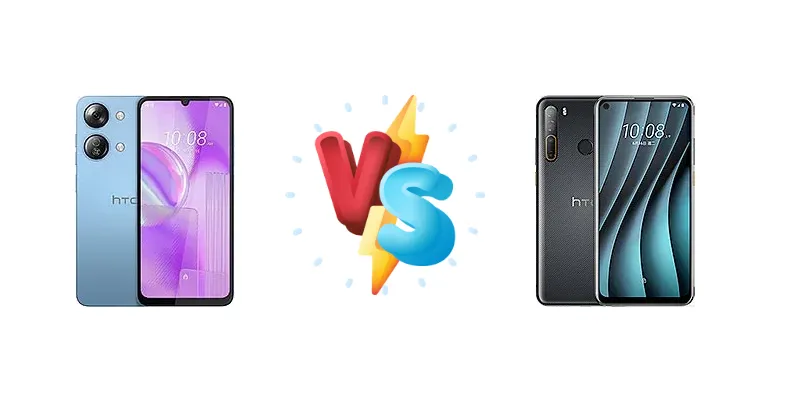
HTC continues to offer affordable options in the smartphone market, but navigating their lineup can be tricky. The Desire 20 Pro and Wildfire E4 Plus represent two distinct approaches to budget-friendly devices. The Desire 20 Pro, released earlier, leverages Qualcomm’s Snapdragon 665, while the newer Wildfire E4 Plus opts for Unisoc’s T606. This comparison dives deep into the hardware differences to determine which phone delivers the best experience for your money.
🏆 Quick Verdict
For most users, the HTC Desire 20 Pro is the better choice. While the Wildfire E4 Plus is newer, the Snapdragon 665 offers a noticeable performance advantage and faster 15W Quick Charge 3.0 support, making it more suitable for everyday tasks and light gaming. The slightly older chipset provides a smoother experience overall.
| Network |
|---|
| 2G bands | GSM 850 / 900 / 1800 / 1900 | GSM 850 / 900 / 1800 / 1900 |
| 3G bands | HSDPA 850 / 900 / 2100 | HSDPA 850 / 900 / 1900 / 2100 |
| 4G bands | LTE | 1, 2, 3, 5, 7, 8, 20, 28, 38, 39, 40, 41 |
| EDGE | - | No |
| GPRS | - | No |
| Speed | HSPA, LTE | HSPA 42.2/5.76 Mbps, LTE (2CA) Cat13 400/150 Mbps |
| Technology | GSM / HSPA / LTE | GSM / HSPA / LTE |
| Launch |
|---|
| Announced | 2025, June 20 | 2020, June 16. Released 2020, July 18 |
| Status | Available. Released 2025, June 20 | Discontinued |
| Body |
|---|
| Build | Glass front, plastic back, plastic frame | - |
| Dimensions | - | 162 x 77 x 9.4 mm (6.38 x 3.03 x 0.37 in) |
| SIM | Nano-SIM + Nano-SIM | Nano-SIM + Nano-SIM |
| Weight | - | 201 g (7.09 oz) |
| Display |
|---|
| Resolution | 720 x 1600 pixels, 20:9 ratio (~260 ppi density) | 1080 x 2340 pixels, 19.5:9 ratio (~396 ppi density) |
| Size | 6.75 inches, 110.0 cm2 | 6.5 inches, 103.7 cm2 (~83.1% screen-to-body ratio) |
| Type | IPS LCD, 90Hz | IPS LCD |
| Platform |
|---|
| CPU | Octa-core (2x1.6 GHz Cortex-A75 & 6x1.6 GHz Cortex-A55) | Octa-core (4x2.0 GHz Kryo 260 Gold & 4x1.8 GHz Kryo 260 Silver) |
| Chipset | Unisoc T606 (12 nm) | Qualcomm SM6125 Snapdragon 665 (11 nm) |
| GPU | Mali-G57 MP1 | Adreno 610 |
| OS | Android 14 | Android 10 |
| Memory |
|---|
| Call records | - | 20 dialed, 20 received, 20 missed calls |
| Card slot | microSDXC | microSDXC |
| Internal | 128GB 4GB RAM | 128GB 6GB RAM |
| Phonebook | - | 1000 entries |
| Main Camera |
|---|
| Dual | 50 MP, (wide)
VGA | - |
| Features | LED flash | Dual-LED flash, HDR, panorama |
| Quad | - | 48 MP, f/1.8, 26mm (wide), 1/2.0", 0.8µm, PDAF
8 MP, f/2.2, 118˚ (ultrawide), 1/4.0", 1.12µm
2 MP (macro)
Auxiliary lens |
| Video | 1080p@30fps | 4K@30fps, 1080p@30fps |
| Selfie camera |
|---|
| Features | - | HDR |
| Single | 8 MP, (wide) | 25 MP, f/2.0, (wide) |
| Video | Yes | 1080p@30fps |
| Sound |
|---|
| 3.5mm jack | - | Yes |
| 35mm jack | Yes | Yes |
| Loudspeaker | Yes | Yes |
| Comms |
|---|
| Bluetooth | Yes | 5.0, A2DP, LE |
| NFC | No | Yes |
| Positioning | GPS, GLONASS, GALILEO | GPS, GLONASS, GALILEO, BDS |
| Radio | Unspecified | FM radio |
| USB | USB Type-C 2.0 | USB Type-C 2.0, OTG |
| WLAN | Yes | Wi-Fi 802.11 a/b/g/n/ac, dual-band, Wi-Fi Direct |
| Features |
|---|
| Games | - | Yes |
| Java | - | Yes |
| Messaging | - | SMS |
| Sensors | Fingerprint (side-mounted); unspecified sensors | Fingerprint (rear-mounted), accelerometer, gyro, proximity, compass |
| Battery |
|---|
| Charging | 10W wired | 15W wired, QC3 |
| Stand-by | - | Up to 570 h |
| Talk time | - | Up to 8 h 40 min |
| Type | 5000 mAh | Li-Po 5000 mAh |
| Misc |
|---|
| Colors | Black, Light Blue | Smoky Black, Pretty Blue, Crystal Green |
| Price | About 100 EUR | About 660 EUR |
| SAR EU | - | 0.56 W/kg (head) |
HTC Wildfire E4 Plus
- Newer device with potential for longer software support
- May be more readily available in certain markets
- Potentially lower price point (depending on retailer)
- Unisoc T606 chipset offers lower performance
- Slower 10W charging
- Likely lower resolution display
HTC Desire 20 Pro
- More powerful Snapdragon 665 chipset
- Faster 15W Quick Charge 3.0 charging
- Likely sharper display with higher resolution
- Older device, potentially shorter software support lifespan
- May be harder to find in stock
- Potentially slightly higher price
Display Comparison
Neither HTC provides detailed display specifications beyond size. However, the choice of chipsets hints at display capabilities. The Snapdragon 665 typically pairs with displays targeting 1080p resolution, while the Unisoc T606 is more commonly found on 720p panels. This suggests the Desire 20 Pro likely offers a sharper image. Both devices likely utilize IPS LCD technology, common in this price bracket, and lack high refresh rates. Bezels are expected to be substantial on both, reflecting their budget positioning.
Camera Comparison
Detailed camera specs are unavailable, but the chipset choice provides clues. The Snapdragon 665 typically supports more advanced image signal processors (ISPs) than the Unisoc T606. This means the Desire 20 Pro is likely to produce better image quality, especially in low-light conditions. While both phones likely feature a multi-camera setup, the image processing capabilities of the Snapdragon 665 will give it an edge in dynamic range and detail. Expect both to include a standard wide lens and potentially a depth sensor, but avoid expectations for exceptional camera performance.
Performance
The core difference lies in the chipsets. The Qualcomm Snapdragon 665 (11nm) in the Desire 20 Pro features a Kryo 260 CPU configuration with 4x2.0 GHz performance cores and 4x1.8 GHz efficiency cores. This contrasts with the Unisoc T606 (12nm) in the Wildfire E4 Plus, which uses a combination of 2x1.6 GHz Cortex-A75 and 6x1.6 GHz Cortex-A55 cores. The Snapdragon 665’s more efficient 11nm process and superior core architecture translate to better overall performance, particularly in demanding applications. While both are octa-core, the Snapdragon’s architecture is optimized for sustained performance. The Desire 20 Pro will handle multitasking and app loading more smoothly.
Battery Life
Battery capacity is not specified for either device. However, the charging speeds are a clear differentiator. The Desire 20 Pro supports 15W wired charging with Quick Charge 3.0 compatibility, allowing for significantly faster charging times compared to the Wildfire E4 Plus’s 10W charging. While a larger battery capacity on the Wildfire E4 Plus could partially offset this, the faster charging of the Desire 20 Pro is a significant convenience factor. Users who frequently find themselves needing to top up their battery will greatly benefit from the Desire 20 Pro’s faster charging.
Buying Guide
Buy the HTC Wildfire E4 Plus if your primary need is a very basic smartphone for essential communication – calls, texts, and light social media – and you prioritize a newer device. Buy the HTC Desire 20 Pro if you prefer a more responsive experience for multitasking, streaming, and occasional gaming, and value faster charging speeds. The Desire 20 Pro is the better option for anyone who doesn't want to constantly wait for their phone to catch up.
Frequently Asked Questions
❓ Is the Unisoc T606 in the Wildfire E4 Plus sufficient for playing games like PUBG Mobile?
While the Unisoc T606 can *run* PUBG Mobile, expect to play at lower graphics settings and potentially experience frame drops. The Snapdragon 665 in the Desire 20 Pro will provide a smoother and more consistent gaming experience, allowing for higher settings and more stable frame rates.
❓ Does the HTC Desire 20 Pro support software updates beyond Android 10?
Software update support for both devices is limited. The Desire 20 Pro launched with Android 10, and while some minor updates may have been released, major Android version upgrades are unlikely. The Wildfire E4 Plus, being newer, *might* receive a slightly longer support window, but don't expect significant updates.
❓ How much faster is the 15W charging on the Desire 20 Pro compared to the 10W charging on the Wildfire E4 Plus?
The 15W charging with Quick Charge 3.0 on the Desire 20 Pro can reduce charging times by approximately 30-50% compared to the 10W charging on the Wildfire E4 Plus. This means a full charge could take around 2-3 hours on the Wildfire E4 Plus, while the Desire 20 Pro could achieve a full charge in 1.5-2 hours.