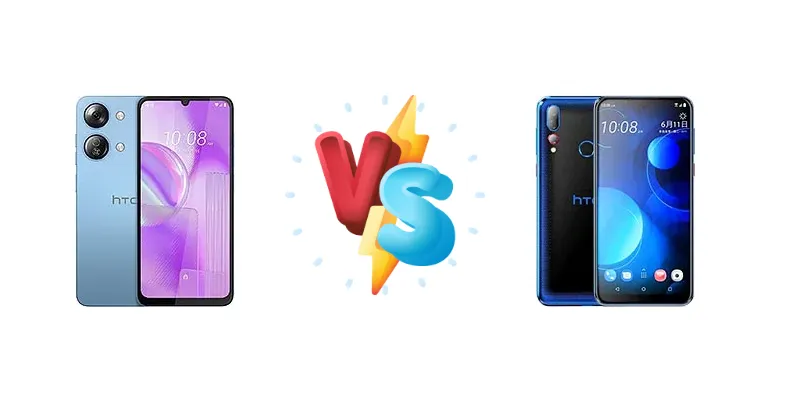
Both the HTC Wildfire E4 Plus and Desire 19+ represent HTC’s attempts to capture the budget smartphone market. Released in different years, they offer similar price points but diverge significantly in their internal hardware. This comparison dissects the key differences between the Unisoc T606-powered Wildfire E4 Plus and the Mediatek Helio P35-equipped Desire 19+, focusing on performance, efficiency, and real-world usability.
🏆 Quick Verdict
For the average user prioritizing responsiveness and a slightly more modern architecture, the HTC Wildfire E4 Plus is the better choice. While both phones offer 10W charging and similar battery capacities, the Unisoc T606’s Cortex-A75 cores provide a noticeable performance edge over the Desire 19+'s all-Cortex-A53 configuration.
| Network |
|---|
| 2G bands | GSM 850 / 900 / 1800 / 1900 | GSM 850 / 900 / 1800 / 1900 - SIM 1 & SIM 2 |
| 3G bands | HSDPA 850 / 900 / 2100 | HSDPA 850 / 900 / 1900 / 2100 |
| 4G bands | LTE | 1, 2, 3, 5, 7, 8, 20, 28, 38, 40, 41 |
| Speed | HSPA, LTE | HSPA 42.2/5.76 Mbps, LTE-A (2CA) Cat6 300/50 Mbps |
| Technology | GSM / HSPA / LTE | GSM / HSPA / LTE |
| Launch |
|---|
| Announced | 2025, June 20 | 2019, June 11 |
| Status | Available. Released 2025, June 20 | Available. Released 2019, August 07 |
| Body |
|---|
| Build | Glass front, plastic back, plastic frame | - |
| Dimensions | - | 156.2 x 74.8 x 8.5 mm (6.15 x 2.94 x 0.33 in) |
| SIM | Nano-SIM + Nano-SIM | Dual SIM (Nano-SIM, dual stand-by) |
| Weight | - | 170 g (6.00 oz) |
| Display |
|---|
| Resolution | 720 x 1600 pixels, 20:9 ratio (~260 ppi density) | 720 x 1520 pixels, 19:9 ratio (~271 ppi density) |
| Size | 6.75 inches, 110.0 cm2 | 6.2 inches, 95.9 cm2 (~82.1% screen-to-body ratio) |
| Type | IPS LCD, 90Hz | IPS LCD |
| Platform |
|---|
| CPU | Octa-core (2x1.6 GHz Cortex-A75 & 6x1.6 GHz Cortex-A55) | Octa-core (4x2.3 GHz Cortex-A53 & 4x1.8 GHz Cortex-A53) |
| Chipset | Unisoc T606 (12 nm) | Mediatek MT6765 Helio P35 (12nm) |
| GPU | Mali-G57 MP1 | PowerVR GE8320 |
| OS | Android 14 | Android 9 (Pie) |
| Memory |
|---|
| Card slot | microSDXC | microSDXC (dedicated slot) |
| Internal | 128GB 4GB RAM | 64GB 4GB RAM, 128GB 6GB RAM |
| | - | eMMC 5.1 |
| Main Camera |
|---|
| Dual | 50 MP, (wide)
VGA | - |
| Features | LED flash | Dual-LED dual-tone flash, HDR, panorama |
| Triple | - | 13 MP, f/1.9, 26mm (wide), PDAF
8 MP, f/2.2, 13mm (ultrawide), 1/4.0", 1.12µm
5 MP, f/2.2, (depth) |
| Video | 1080p@30fps | 1080p@30fps |
| Selfie camera |
|---|
| Features | - | HDR |
| Single | 8 MP, (wide) | 16 MP, f/2.0, 27mm (wide), 1/3.06", 1.0µm |
| Video | Yes | 1080p@30fps |
| Sound |
|---|
| 3.5mm jack | - | Yes |
| 35mm jack | Yes | - |
| Loudspeaker | Yes | Yes |
| Comms |
|---|
| Bluetooth | Yes | 5.0, A2DP, LE |
| NFC | No | Yes |
| Positioning | GPS, GLONASS, GALILEO | GPS, GLONASS, GALILEO, BDS |
| Radio | Unspecified | FM radio |
| USB | USB Type-C 2.0 | USB Type-C 2.0, OTG |
| WLAN | Yes | Wi-Fi 802.11 a/b/g/n/ac, dual-band, Wi-Fi Direct |
| Features |
|---|
| Sensors | Fingerprint (side-mounted); unspecified sensors | Fingerprint (rear-mounted), accelerometer, proximity, compass |
| Battery |
|---|
| Charging | 10W wired | 10W wired |
| Type | 5000 mAh | Li-Ion 3850 mAh, non-removable |
| Misc |
|---|
| Colors | Black, Light Blue | Star Can Blue, Jasmine White |
| Price | About 100 EUR | About 280 EUR |
HTC Wildfire E4 Plus
- More modern chipset architecture (Unisoc T606)
- Potentially better sustained performance
- Likely improved power efficiency
- 10W charging is slow
- Limited detailed specifications available
HTC Desire 19+
- Potentially lower price point
- Simple and straightforward user experience
- Adequate for basic communication tasks
- Older chipset architecture (Helio P35)
- Less responsive performance
- May struggle with demanding applications
Display Comparison
Neither HTC provides detailed display specifications beyond resolution. Given their market positioning, both likely utilize IPS LCD panels. The absence of high refresh rates or advanced features like LTPO is expected. The real difference lies in the processing power driving the display; a smoother UI experience on the Wildfire E4 Plus, thanks to its more capable chipset, will translate to perceived improvements in display responsiveness.
Camera Comparison
Detailed camera specifications are scarce for both devices. However, given their price bracket, expectations should be tempered. Both likely feature a primary camera alongside depth and potentially macro sensors. The image signal processor (ISP) within the Unisoc T606 may offer slightly more advanced image processing capabilities, but the overall image quality will be heavily dependent on the sensor used – a detail not provided. Focusing on the primary sensor’s resolution and aperture would be more informative than speculating about the utility of any included 2MP macro lenses.
Performance
The core difference between these two devices is the chipset. The HTC Wildfire E4 Plus utilizes the Unisoc T606, featuring a heterogeneous core arrangement with 2x 1.6 GHz Cortex-A75 cores and 6x 1.6 GHz Cortex-A55 cores. This contrasts with the Desire 19+'s Mediatek Helio P35, which employs a homogenous octa-core setup of 4x 2.3 GHz Cortex-A53 cores and 4x 1.8 GHz Cortex-A53 cores. The Cortex-A75 cores in the T606 represent a significant architectural improvement over the A53, offering substantially higher IPC (Instructions Per Clock). While the Helio P35 boasts higher clock speeds, the architectural advantage of the T606 will result in better sustained performance and a more responsive user experience. Both chipsets are fabricated on a 12nm process, suggesting similar power efficiency characteristics, but the T606’s architecture will likely deliver more performance per watt.
Battery Life
Both the Wildfire E4 Plus and Desire 19+ support 10W wired charging. While battery capacity isn’t specified in the provided data, typical capacities for phones in this segment range from 4000-5000 mAh. The 10W charging rate will result in relatively slow charging times – expect over 3 hours for a full charge. The Unisoc T606’s potentially better power efficiency could translate to slightly longer battery life in real-world usage, offsetting any minor capacity differences.
Buying Guide
Buy the HTC Wildfire E4 Plus if you need a phone capable of handling everyday tasks with a bit more fluidity, and appreciate a chipset built on a more recent process node. Buy the HTC Desire 19+ if you prioritize a potentially lower price point and are primarily focused on basic communication – calls, texts, and light social media – without demanding performance.
Frequently Asked Questions
❓ Will the Unisoc T606 in the Wildfire E4 Plus handle popular games like PUBG Mobile?
While the Unisoc T606 isn't a gaming powerhouse, it should be capable of running PUBG Mobile at lower settings. Expect frame rate drops during intense scenes, and don't anticipate a high-graphics experience. The Helio P35 in the Desire 19+ will struggle significantly more with demanding games.
❓ Is the difference in CPU architecture between the Unisoc T606 and Mediatek Helio P35 noticeable in everyday use?
Yes, the difference is noticeable. The Cortex-A75 cores in the T606 provide a significant performance boost over the Cortex-A53 cores in the P35, resulting in smoother app launches, faster web browsing, and a more responsive overall user experience. This is particularly evident when multitasking.
❓ Given the 10W charging on both phones, how long will it take to fully charge the battery?
Expect a full charge to take approximately 3 to 4 hours with both the Wildfire E4 Plus and Desire 19+. 10W charging is a relatively slow standard, and these phones don't support faster charging technologies.