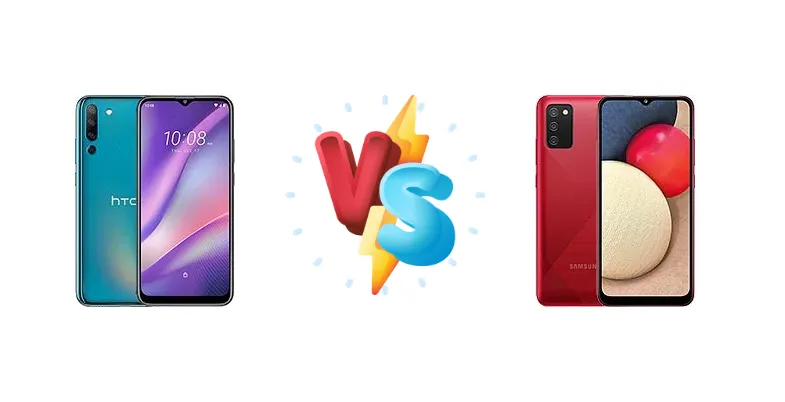
The HTC Wildfire E3 and Samsung Galaxy A02s represent the extreme end of the smartphone price spectrum. Both aim to deliver essential functionality at a minimal cost, but they achieve this with different approaches to chipset selection and feature prioritization. This comparison dissects their strengths and weaknesses to help you determine which device offers the best value.
🏆 Quick Verdict
For the average user prioritizing a slightly brighter display and faster charging, the Samsung Galaxy A02s emerges as the better choice. While both phones share a similar CPU architecture, the A02s’ 15W charging and measured 406 nits brightness provide a tangible advantage in daily use.
| Network |
|---|
| 2G bands | GSM 850 / 900 / 1800 / 1900 | GSM 850 / 900 / 1800 / 1900 |
| 3G bands | HSDPA 900 / 2100 | HSDPA 850 / 900 / 2100 |
| 4G bands | 1, 3, 5, 7, 8, 20, 38, 40 | 1, 3, 5, 7, 8, 20, 28, 38, 40, 41 |
| Speed | HSPA 42.2/5.76 Mbps, LTE Cat4 150/75 Mbps | HSPA 42.2/5.76 Mbps, LTE Cat4 150/50 Mbps |
| Technology | GSM / HSPA / LTE | GSM / HSPA / LTE |
| Launch |
|---|
| Announced | 2021, March 15 | 2020, November 24. Released 2021, January 04 |
| Status | Available. Released 2021, April 11 | Discontinued |
| Body |
|---|
| Build | Glass front, plastic back, plastic frame | Glass front, plastic back, plastic frame |
| Dimensions | 165.7 x 76.6 x 9 mm (6.52 x 3.02 x 0.35 in) | 164.2 x 75.9 x 9.1 mm (6.46 x 2.99 x 0.36 in) |
| SIM | Nano-SIM + Nano-SIM | · Nano-SIM· Nano-SIM + Nano-SIM |
| Weight | 186 g (6.56 oz) | 196 g (6.91 oz) |
| Display |
|---|
| Protection | - | Scratch-resistant glass |
| Resolution | 720 x 1560 pixels, 19.5:9 ratio (~264 ppi density) | 720 x 1600 pixels, 20:9 ratio (~270 ppi density) |
| Size | 6.52 inches, 104.4 cm2 (~82.2% screen-to-body ratio) | 6.5 inches, 102.0 cm2 (~81.8% screen-to-body ratio) |
| Type | IPS LCD | PLS LCD |
| Platform |
|---|
| CPU | Octa-core 1.8 GHz Cortex-A53 | Octa-core 1.8 GHz Cortex-A53 |
| Chipset | Mediatek MT6762 Helio P22 (12 nm) | Qualcomm SDM450 Snapdragon 450 (14 nm) |
| GPU | PowerVR GE8320 | Adreno 506 |
| OS | Android 10 | Android 10, upgradable to Android 12, One UI 4.1 |
| Memory |
|---|
| Card slot | microSDXC (uses shared SIM slot) | microSDXC (dedicated slot) |
| Internal | 64GB 4GB RAM, 128GB 4GB RAM | 16GB 1GB RAM, 32GB 2GB RAM, 32GB 3GB RAM, 32GB 4GB RAM, 64GB 3GB RAM, 64GB 4GB RAM |
| | eMMC 5.1 | eMMC 5.1 |
| Main Camera |
|---|
| Features | LED flash, HDR, panorama | LED flash |
| Quad | 13 MP, f/2.0, (wide), PDAF
8 MP, f/2.2, (ultrawide)
2 MP (macro)
Auxiliary lens | - |
| Single | - | 3.15 MP |
| Triple | - | 13 MP, f/2.2, (wide), AF
2 MP (macro)
Auxiliary lens |
| Video | 1080p@30fps | 1080p@30fps |
| Selfie camera |
|---|
| Single | 13 MP, f/2.0, (wide), 1/3.1", 1.12µm | 5 MP, f/2.2 |
| Video | 720p@30fps | - |
| Sound |
|---|
| 3.5mm jack | Yes | Yes |
| 35mm jack | Yes | Yes |
| Loudspeaker | Yes | Yes |
| Comms |
|---|
| Bluetooth | 4.2, A2DP, LE | 4.2, A2DP |
| NFC | No | No |
| Positioning | GPS, GLONASS, GALILEO, BDS | GPS, GLONASS, GALILEO, BDS |
| Radio | FM radio | Unspecified |
| USB | USB Type-C 2.0, OTG | USB Type-C 2.0 |
| WLAN | Wi-Fi 802.11 a/b/g/n/ac, dual-band, Wi-Fi Direct | Wi-Fi 802.11 b/g/n, Wi-Fi Direct |
| Features |
|---|
| Sensors | Fingerprint (rear-mounted), accelerometer, proximity, compass | Accelerometer, proximity |
| Battery |
|---|
| Charging | 10W wired | 15W wired |
| Stand-by | - | Up to 530 h (2G) / Up to 530 h (3G) |
| Talk time | - | Up to 6 h 12 min (2G) / Up to 6 h 18 min (3G) |
| Type | Li-Po 4000 mAh | Li-Po 5000 mAh |
| Misc |
|---|
| Colors | Blue, Black | Black, White, Red, Blue |
| Models | - | SM-A025F, SM-A025F/DS, SM-A025G, SM-A025G/DS, SM-A025M, SM-A025M/DS, SM-A025U, SM-A025V, SM-A025A, SM-A025U1, SM-A025AZ, SM-S124DL |
| Price | About 130 EUR | About 110 EUR |
| SAR | - | 1.15 W/kg (head) 0.79 W/kg (body) |
| SAR EU | - | 0.40 W/kg (head) 1.37 W/kg (body) |
| Tests |
|---|
| Audio quality | - |
Noise -81.4dB / Crosstalk -80.5dB |
| Battery life | - |
Endurance rating 114h
|
| Camera | - |
Photo / Video |
| Display | - |
Contrast ratio: 1765:1 (nominal) |
| Loudspeaker | - |
-29.8 LUFS (Average)
|
| Performance | - |
AnTuTu: 90811 (v8)
GeekBench: 495 (v5.1)
GFXBench: 6.1fps (ES 3.1 onscreen) |
HTC Wildfire E3
- Potentially slightly better power efficiency due to 12nm process.
- Brand recognition for existing HTC users.
- Simple, straightforward Android experience.
- Slower 10W charging.
- Less detailed display specifications suggest lower quality.
- Chipset may offer marginally lower performance than Snapdragon 450.
Samsung Galaxy A02s
- Faster 15W charging for quicker top-ups.
- Brighter display (406 nits) for better outdoor visibility.
- Qualcomm chipset benefits from established software optimization.
- 14nm process node may result in slightly higher power consumption.
- 2MP macro camera is likely of limited practical use.
- Samsung’s software can include bloatware.
Display Comparison
The Samsung Galaxy A02s boasts a measured peak brightness of 406 nits, a significant advantage over the unmeasured brightness of the Wildfire E3. While both share a similar 1765:1 contrast ratio, the higher brightness of the A02s translates to better visibility in direct sunlight. The Wildfire E3’s display specifications are less detailed, suggesting a potentially lower quality panel, though both are likely LCDs given the price point. Bezels are expected to be substantial on both devices, reflecting their budget nature.
Camera Comparison
Both devices feature 'Photo / Video' capabilities, but detailed camera specifications are lacking. Given the price bracket, image quality will likely be comparable, with both struggling in low-light conditions. The presence of a 2MP macro camera on the A02s is unlikely to provide significant benefit due to its low resolution and limited optics. Focusing on the main sensor performance, the A02s may have a slight edge due to Samsung’s image processing algorithms, but without specific sensor details, it’s difficult to definitively assess.
Performance
Both the HTC Wildfire E3 and Samsung Galaxy A02s are powered by octa-core Cortex-A53 CPUs clocked at 1.8 GHz. However, they differ in their underlying chipsets: the Wildfire E3 utilizes the Mediatek MT6762 Helio P22 (12nm), while the A02s employs the Qualcomm Snapdragon 450 (14nm). The 12nm process node of the Helio P22 *should* offer slightly better power efficiency compared to the 14nm Snapdragon 450, but real-world performance differences will likely be minimal for basic tasks. Neither chipset is suited for demanding gaming or multitasking.
Battery Life
Both phones achieve an endurance rating of 114 hours, indicating similar battery life under typical usage. However, the Samsung Galaxy A02s supports 15W wired charging, while the HTC Wildfire E3 is limited to 10W. This difference in charging speed is significant; the A02s will recharge considerably faster, reducing downtime. While both have similar endurance, the faster charging of the A02s provides a more convenient user experience.
Buying Guide
Buy the HTC Wildfire E3 if you prioritize brand familiarity within the HTC ecosystem and are comfortable with slower charging speeds. Buy the Samsung Galaxy A02s if you prefer a brighter screen for outdoor visibility and appreciate the convenience of faster 15W charging, making it ideal for users who frequently top up their battery throughout the day.
Frequently Asked Questions
❓ Is the Snapdragon 450 in the Galaxy A02s capable of running popular social media apps smoothly?
Yes, the Snapdragon 450 is sufficient for running most popular social media applications like Facebook, Instagram, and TikTok without significant lag. However, multitasking between several apps simultaneously may result in some slowdowns due to the limited RAM typically found in these devices.
❓ How long does it realistically take to fully charge the HTC Wildfire E3 with its 10W charger?
Given the 10W charging and likely battery capacity around 4000mAh (based on market segment), a full charge from 0% to 100% on the HTC Wildfire E3 will likely take between 3 to 4 hours. This is considerably slower than the Samsung Galaxy A02s.
❓ Does the Samsung Galaxy A02s support any form of fast charging beyond 15W?
No, the Samsung Galaxy A02s officially supports up to 15W charging. While it may technically accept power from a higher wattage charger, it will not charge any faster than its maximum supported rate of 15W. Using a higher wattage charger won't provide any additional benefit.