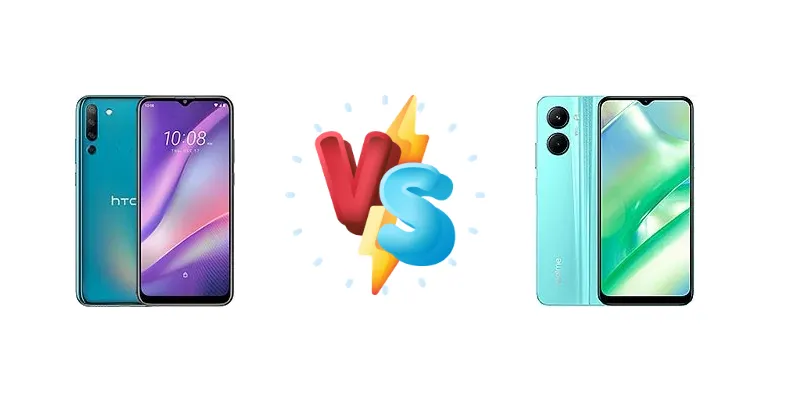
The sub-$150 smartphone market is fiercely competitive. Both the HTC Wildfire E3 and the Realme C33 2023 aim to deliver essential smartphone functionality at an accessible price. However, they take different approaches to achieving this, primarily in their chipset choices. This comparison dissects those differences and helps you determine which device best suits your needs.
🏆 Quick Verdict
For most users, the Realme C33 2023 is the better choice. Its Unisoc Tiger T612 chipset, featuring Cortex-A75 cores, provides a noticeable performance uplift over the HTC Wildfire E3’s older Helio P22, making it more responsive for everyday tasks and light gaming. While both offer 10W charging, the C33’s superior processing power justifies its slight price premium.
| Network |
|---|
| 2G bands | GSM 850 / 900 / 1800 / 1900 | GSM 850 / 900 / 1800 / 1900 |
| 3G bands | HSDPA 900 / 2100 | HSDPA 850 / 900 / 2100 |
| 4G bands | 1, 3, 5, 7, 8, 20, 38, 40 | 1, 3, 5, 8, 38, 40, 41 |
| Speed | HSPA 42.2/5.76 Mbps, LTE Cat4 150/75 Mbps | HSPA, LTE |
| Technology | GSM / HSPA / LTE | GSM / HSPA / LTE |
| Launch |
|---|
| Announced | 2021, March 15 | 2023, March 14 |
| Status | Available. Released 2021, April 11 | Available. Released 2023, March 14 |
| Body |
|---|
| Build | Glass front, plastic back, plastic frame | Glass front, plastic frame, plastic back |
| Dimensions | 165.7 x 76.6 x 9 mm (6.52 x 3.02 x 0.35 in) | 164.2 x 75.7 x 8.3 mm (6.46 x 2.98 x 0.33 in) |
| SIM | Nano-SIM + Nano-SIM | Nano-SIM + Nano-SIM |
| Weight | 186 g (6.56 oz) | 187 g (6.60 oz) |
| Display |
|---|
| Resolution | 720 x 1560 pixels, 19.5:9 ratio (~264 ppi density) | 720 x 1600 pixels, 20:9 ratio (~270 ppi density) |
| Size | 6.52 inches, 104.4 cm2 (~82.2% screen-to-body ratio) | 6.5 inches, 102.0 cm2 (~82.1% screen-to-body ratio) |
| Type | IPS LCD | IPS LCD, 400 nits (typ) |
| Platform |
|---|
| CPU | Octa-core 1.8 GHz Cortex-A53 | Octa-core (2x1.8 GHz Cortex-A75 & 6x1.8 GHz Cortex-A55) |
| Chipset | Mediatek MT6762 Helio P22 (12 nm) | Unisoc Tiger T612 (12 nm) |
| GPU | PowerVR GE8320 | Mali-G57 |
| OS | Android 10 | Android 12, Realme UI S |
| Memory |
|---|
| Card slot | microSDXC (uses shared SIM slot) | microSDXC (dedicated slot) |
| Internal | 64GB 4GB RAM, 128GB 4GB RAM | 64GB 4GB RAM, 128GB 4GB RAM |
| | eMMC 5.1 | UFS 2.2 |
| Main Camera |
|---|
| Dual | - | 50 MP, (wide), PDAF
Auxiliary lens |
| Features | LED flash, HDR, panorama | LED flash, HDR, panorama |
| Quad | 13 MP, f/2.0, (wide), PDAF
8 MP, f/2.2, (ultrawide)
2 MP (macro)
Auxiliary lens | - |
| Single | - | 5 MP, f/2.2, 27mm (wide), 1/5.0", 1.12µm |
| Video | 1080p@30fps | 1080p@30fps |
| Selfie camera |
|---|
| Features | - | HDR |
| Single | 13 MP, f/2.0, (wide), 1/3.1", 1.12µm | 5 MP, f/2.2, 27mm (wide), 1/5.0", 1.12µm |
| Video | 720p@30fps | 720p@30fps |
| Sound |
|---|
| 3.5mm jack | Yes | Yes |
| 35mm jack | Yes | Yes |
| Loudspeaker | Yes | Yes |
| Comms |
|---|
| Bluetooth | 4.2, A2DP, LE | 5.0, A2DP, LE |
| NFC | No | No |
| Positioning | GPS, GLONASS, GALILEO, BDS | GPS, GLONASS, GALILEO, BDS |
| Radio | FM radio | Unspecified |
| USB | USB Type-C 2.0, OTG | microUSB 2.0 |
| WLAN | Wi-Fi 802.11 a/b/g/n/ac, dual-band, Wi-Fi Direct | Wi-Fi 802.11 b/g/n |
| Features |
|---|
| Sensors | Fingerprint (rear-mounted), accelerometer, proximity, compass | Fingerprint (side-mounted), accelerometer, proximity |
| Battery |
|---|
| Charging | 10W wired | 10W wired |
| Type | Li-Po 4000 mAh | 5000 mAh |
| Misc |
|---|
| Colors | Blue, Black | Sandy Gold, Aqua Blue, Night Sea |
| Models | - | RMX3627 |
| Price | About 130 EUR | About 110 EUR |
HTC Wildfire E3
- Established Brand (HTC)
- Simple User Interface
- Potentially Lower Price (depending on region)
- Outdated Helio P22 Chipset
- Slower Performance
- Less Efficient for Gaming
Realme C33 2023
- More Powerful Unisoc T612 Chipset
- Improved Multitasking Capabilities
- Better Gaming Performance
- Less Brand Recognition (Realme)
- Potential for More Bloatware
- Similar Charging Speed to Competitor
Display Comparison
Neither device boasts a standout display. Both likely utilize LCD panels, a common trait in this price bracket. The focus here isn't on visual fidelity, but on basic usability. Without specific display specs, it's difficult to differentiate, but Realme generally offers slightly better color calibration in its budget offerings. Bezels are expected to be substantial on both, prioritizing cost reduction over an immersive viewing experience.
Camera Comparison
Camera performance is likely to be similar, leaning towards basic functionality on both devices. Without sensor size or aperture information, it’s safe to assume both rely on budget sensors. Realme often employs software enhancements to improve image quality, potentially giving it a slight edge in well-lit conditions. The presence of a 2MP macro camera on the C33 is largely a marketing tactic; its utility is limited due to the low resolution and lack of optical image stabilization. Expect acceptable results for social media sharing in good lighting, but poor performance in low-light scenarios on both.
Performance
The core difference lies in the chipsets. The Realme C33 2023’s Unisoc Tiger T612 is a significant upgrade over the HTC Wildfire E3’s MediaTek Helio P22. The T612 utilizes two Cortex-A75 cores clocked at 1.8 GHz alongside six Cortex-A55 cores, providing a substantial boost in single-core and multi-core performance compared to the P22’s all-Cortex-A53 configuration. This translates to snappier app launches, smoother scrolling, and a more enjoyable overall user experience. The P22, while adequate for basic tasks, will struggle with demanding applications. Both are built on a 12nm process, so thermal efficiency will be similar, but the T612 will complete tasks faster, reducing sustained load.
Battery Life
Both phones feature 10W wired charging, indicating similar charging speeds – expect around 2.5 to 3 hours for a full charge. Battery capacity isn't specified, but typical capacities for this segment are around 5000mAh. The Realme C33 2023’s more efficient Unisoc T612 chipset will likely result in slightly better battery life, as it completes tasks faster and spends more time in a low-power state. However, the difference will likely be marginal, with both phones offering a full day of light to moderate use.
Buying Guide
Buy the HTC Wildfire E3 if you prioritize brand recognition and a simple, no-frills experience, and your usage is limited to basic communication and very light app usage. Buy the Realme C33 2023 if you want a more responsive device capable of handling multitasking, social media, and casual gaming without significant lag, and you value a more modern chipset architecture.
Frequently Asked Questions
❓ Will the Realme C33 2023 handle popular games like PUBG Mobile or Call of Duty Mobile?
The Unisoc Tiger T612 in the Realme C33 2023 can run PUBG Mobile and Call of Duty Mobile, but you’ll need to lower the graphics settings to medium or low to achieve playable frame rates. The Helio P22 in the HTC Wildfire E3 will struggle significantly with these titles, even on the lowest settings.
❓ Is the Realme C33 2023 a good choice for someone who primarily uses WhatsApp, Facebook, and YouTube?
Yes, the Realme C33 2023 is well-suited for these common tasks. The Unisoc T612 provides a smoother experience for social media browsing and video streaming compared to the HTC Wildfire E3’s Helio P22, resulting in faster loading times and less lag.
❓ Does either phone support fast charging, and how long does it take to fully charge?
Neither phone supports fast charging; both are limited to 10W wired charging. Expect approximately 2.5 to 3 hours to fully charge from 0% to 100% on both devices.
❓ Which phone is likely to receive more software updates?
Realme generally provides more consistent software updates and security patches for its devices compared to HTC, which has scaled back its smartphone operations. While neither phone is guaranteed long-term support, the Realme C33 2023 is more likely to receive updates.