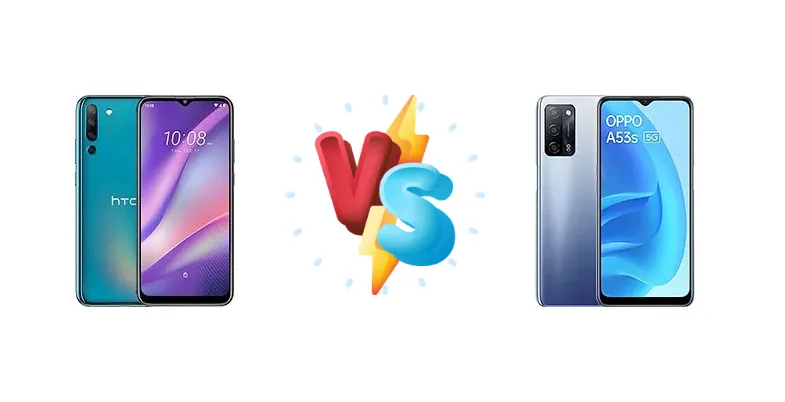
Both the HTC Wildfire E3 and Oppo A53s 5G target the ultra-budget smartphone market, but they approach it with vastly different internal hardware. The Wildfire E3 relies on the older Mediatek Helio P22, while the A53s 5G boasts the more modern Dimensity 700, bringing 5G connectivity to the table. This comparison will dissect the implications of these chipset choices and determine which phone offers the best value for users prioritizing performance and future-proofing.
🏆 Quick Verdict
For the average user, the Oppo A53s 5G is the clear winner. The Dimensity 700 chipset provides a significantly faster and more responsive experience than the Helio P22 in the Wildfire E3, justifying the potentially slight price premium. While both phones share 10W charging, the A53s 5G’s superior processing power makes it the better choice for everyday tasks and light gaming.
| Network |
|---|
| 2G bands | GSM 850 / 900 / 1800 / 1900 | GSM 850 / 900 / 1800 / 1900 |
| 3G bands | HSDPA 900 / 2100 | HSDPA 800 / 850 / 900 / 2100 |
| 4G bands | 1, 3, 5, 7, 8, 20, 38, 40 | 1, 3, 5, 8, 34, 38, 39, 40, 41 |
| 5G bands | - | 1, 28, 41, 77, 78 SA/NSA |
| Speed | HSPA 42.2/5.76 Mbps, LTE Cat4 150/75 Mbps | HSPA, LTE, 5G |
| Technology | GSM / HSPA / LTE | GSM / HSPA / LTE / 5G |
| Launch |
|---|
| Announced | 2021, March 15 | 2021, April 27 |
| Status | Available. Released 2021, April 11 | Available. Released 2021, May 07 |
| Body |
|---|
| Build | Glass front, plastic back, plastic frame | - |
| Dimensions | 165.7 x 76.6 x 9 mm (6.52 x 3.02 x 0.35 in) | 164 x 75.7 x 8.4 mm (6.46 x 2.98 x 0.33 in) |
| SIM | Nano-SIM + Nano-SIM | Nano-SIM + Nano-SIM |
| Weight | 186 g (6.56 oz) | 189.6 g (6.70 oz) |
| Display |
|---|
| Resolution | 720 x 1560 pixels, 19.5:9 ratio (~264 ppi density) | 720 x 1600 pixels, 20:9 ratio (~269 ppi density) |
| Size | 6.52 inches, 104.4 cm2 (~82.2% screen-to-body ratio) | 6.52 inches, 102.6 cm2 (~82.7% screen-to-body ratio) |
| Type | IPS LCD | IPS LCD, 480 nits (typ) |
| Platform |
|---|
| CPU | Octa-core 1.8 GHz Cortex-A53 | Octa-core (2x2.2 GHz Cortex-A76 & 6x2.0 GHz Cortex-A55) |
| Chipset | Mediatek MT6762 Helio P22 (12 nm) | Mediatek Dimensity 700 (7 nm) |
| GPU | PowerVR GE8320 | Mali-G57 MC2 |
| OS | Android 10 | Android 11, ColorOS 11.1 |
| Memory |
|---|
| Card slot | microSDXC (uses shared SIM slot) | microSDXC (dedicated slot) |
| Internal | 64GB 4GB RAM, 128GB 4GB RAM | 128GB 6GB RAM, 128GB 8GB RAM |
| | eMMC 5.1 | UFS 2.2 |
| Main Camera |
|---|
| Features | LED flash, HDR, panorama | LED flash, HDR, panorama |
| Quad | 13 MP, f/2.0, (wide), PDAF
8 MP, f/2.2, (ultrawide)
2 MP (macro)
Auxiliary lens | - |
| Single | - | 8 MP, f/2.0, 26mm (wide) |
| Triple | - | 13 MP, f/2.2, 25mm (wide), 1/3.06", 1.12µm, PDAF
2 MP (macro)
Auxiliary lens |
| Video | 1080p@30fps | 1080p@30fps |
| Selfie camera |
|---|
| Features | - | HDR |
| Single | 13 MP, f/2.0, (wide), 1/3.1", 1.12µm | 8 MP, f/2.0, 26mm (wide) |
| Video | 720p@30fps | 1080p@30fps |
| Sound |
|---|
| 3.5mm jack | Yes | Yes |
| 35mm jack | Yes | Yes |
| Loudspeaker | Yes | Yes |
| Comms |
|---|
| Bluetooth | 4.2, A2DP, LE | 5.0, A2DP, LE, aptX HD |
| NFC | No | No |
| Positioning | GPS, GLONASS, GALILEO, BDS | GPS, GLONASS, GALILEO, BDS, QZSS |
| Radio | FM radio | No |
| USB | USB Type-C 2.0, OTG | USB Type-C 2.0, OTG |
| WLAN | Wi-Fi 802.11 a/b/g/n/ac, dual-band, Wi-Fi Direct | Wi-Fi 802.11 a/b/g/n/ac, dual-band, Wi-Fi Direct |
| Features |
|---|
| Sensors | Fingerprint (rear-mounted), accelerometer, proximity, compass | Fingerprint (side-mounted), accelerometer, gyro, proximity, compass |
| Battery |
|---|
| Charging | 10W wired | 10W wired |
| Type | Li-Po 4000 mAh | Li-Po 5000 mAh |
| Misc |
|---|
| Colors | Blue, Black | Crystal Blue, Ink Black |
| Models | - | CPH2321 |
| Price | About 130 EUR | About 170 EUR |
HTC Wildfire E3
- Potentially lower price point
- Simple and straightforward user experience
- Sufficient for basic smartphone tasks
- Significantly slower performance
- Limited multitasking capabilities
- Outdated chipset architecture
Oppo A53s 5G
- Faster and more responsive performance
- 5G connectivity for future network compatibility
- More efficient chipset for longer battery life
- Potentially slightly higher price
- Slow 10W charging
- May still struggle with demanding games
Display Comparison
Neither HTC nor Oppo provide detailed display specifications beyond the basic panel size. However, the core difference lies in the processing power needed to drive the display. The Helio P22 in the Wildfire E3 may struggle with smoother animations and faster refresh rates (if supported by the panel), while the Dimensity 700 in the A53s 5G has ample headroom. Expect potentially less stuttering and a more responsive touch experience on the Oppo device. The lack of detailed specs makes precise color accuracy and brightness comparisons impossible.
Camera Comparison
Without detailed camera sensor information, a direct comparison is difficult. However, the processing power of the Dimensity 700 in the Oppo A53s 5G will likely result in better image processing, including noise reduction and dynamic range optimization. The Helio P22 in the Wildfire E3 will struggle to handle complex image processing algorithms as effectively. While both phones likely feature similar basic camera setups, the A53s 5G will likely produce more detailed and visually appealing photos, especially in challenging lighting conditions. We can assume both will include a basic macro lens, but its utility will be limited on both devices.
Performance
The performance gap between these two phones is substantial. The Oppo A53s 5G’s Mediatek Dimensity 700, built on a 7nm process, features a combination of Cortex-A76 and Cortex-A55 cores clocked up to 2.2GHz. This is a significant upgrade over the HTC Wildfire E3’s Mediatek Helio P22 (12nm) and its eight Cortex-A53 cores running at 1.8GHz. The Dimensity 700’s architecture delivers considerably better single-core and multi-core performance, translating to faster app launches, smoother multitasking, and improved gaming capabilities. The 7nm process also contributes to better thermal efficiency, reducing the likelihood of throttling under sustained load.
Battery Life
Both devices are equipped with 10W wired charging, indicating a similar charging experience – slow by modern standards. The actual battery capacity isn’t specified, but the Dimensity 700’s superior power efficiency in the Oppo A53s 5G could offset a potentially smaller battery size. Users should expect a full charge to take well over two hours on both devices. The A53s 5G’s more efficient chipset will likely result in longer battery life during typical usage, despite the shared charging speed.
Buying Guide
Buy the HTC Wildfire E3 if you need a basic smartphone for essential tasks like calls, texts, and light social media, and are on an extremely tight budget. Its Helio P22 chipset is sufficient for these limited use cases. Buy the Oppo A53s 5G if you prioritize smoother multitasking, faster app loading times, 5G connectivity for future network upgrades, and a more enjoyable overall user experience, even if it means spending a little more upfront.
Frequently Asked Questions
❓ Will the Oppo A53s 5G actually get good 5G speeds in my area?
5G performance depends heavily on network availability and your carrier. The Dimensity 700 supports a wide range of 5G bands, increasing the likelihood of compatibility, but actual speeds will vary based on your location and network infrastructure. Check your carrier's 5G coverage map before relying on 5G functionality.
❓ Can the HTC Wildfire E3 handle popular games like PUBG Mobile or Call of Duty Mobile?
The Helio P22 in the Wildfire E3 will struggle with demanding games like PUBG Mobile or Call of Duty Mobile. You may be able to run them at the lowest graphics settings, but expect significant frame rate drops and stuttering. The Oppo A53s 5G, with its Dimensity 700, will offer a much smoother gaming experience, though still likely requiring reduced graphics settings for optimal performance.
❓ Is the 10W charging on either phone really that bad?
Yes, 10W charging is significantly slower than the fast charging technologies found on many modern smartphones. Expect a full charge to take over two hours. This is a compromise made to keep the cost of these devices down, but it can be inconvenient for users accustomed to faster charging speeds.