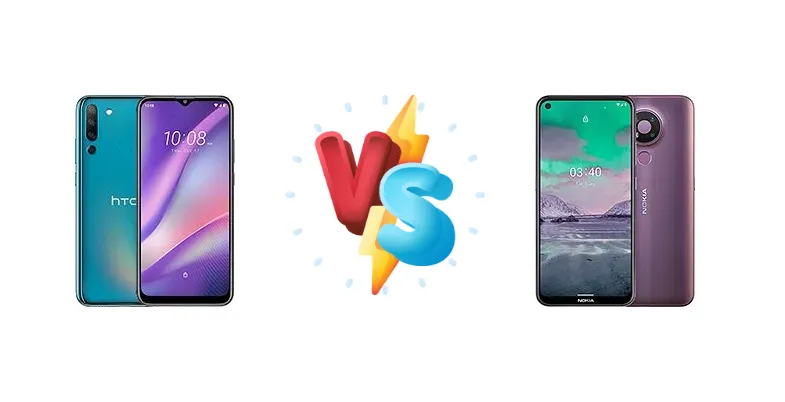
The sub-$150 smartphone market is fiercely competitive. Both the HTC Wildfire E3 and Nokia 3.4 aim to deliver a functional Android experience at an accessible price point. However, they take different approaches to achieving this, primarily through their choice of chipset. This comparison dives deep into the specifications and real-world implications of the Mediatek Helio P22 in the Wildfire E3 versus the Qualcomm Snapdragon 460 in the Nokia 3.4.
🏆 Quick Verdict
For the average user prioritizing responsiveness and future-proofing, the Nokia 3.4 is the better choice. Its Snapdragon 460, built on an 11nm process, offers a noticeable performance advantage over the Wildfire E3’s Helio P22, despite both sharing the same 1.8GHz clock speed on some cores. While both phones offer similar battery and charging capabilities, the Nokia 3.4’s more efficient chipset translates to better sustained performance.
| Network |
|---|
| 2G bands | GSM 850 / 900 / 1800 / 1900 | GSM 850 / 900 / 1800 / 1900 |
| 3G bands | HSDPA 900 / 2100 | HSDPA 850 / 900 / 1700(AWS) / 1900 / 2100 |
| 4G bands | 1, 3, 5, 7, 8, 20, 38, 40 | 1, 2, 3, 4, 5, 7, 8, 12, 17, 13, 28, 66 |
| Speed | HSPA 42.2/5.76 Mbps, LTE Cat4 150/75 Mbps | HSPA, LTE |
| Technology | GSM / HSPA / LTE | GSM / HSPA / LTE |
| Launch |
|---|
| Announced | 2021, March 15 | 2020, September 22. Released 2020, October 26 |
| Status | Available. Released 2021, April 11 | Discontinued |
| Body |
|---|
| Build | Glass front, plastic back, plastic frame | - |
| Dimensions | 165.7 x 76.6 x 9 mm (6.52 x 3.02 x 0.35 in) | 161 x 76 x 8.7 mm (6.34 x 2.99 x 0.34 in) |
| SIM | Nano-SIM + Nano-SIM | · Nano-SIM· Nano-SIM + Nano-SIM |
| Weight | 186 g (6.56 oz) | 180 g (6.35 oz) |
| Display |
|---|
| Resolution | 720 x 1560 pixels, 19.5:9 ratio (~264 ppi density) | 720 x 1560 pixels, 19.5:9 ratio (~269 ppi density) |
| Size | 6.52 inches, 104.4 cm2 (~82.2% screen-to-body ratio) | 6.39 inches, 100.2 cm2 (~81.9% screen-to-body ratio) |
| Type | IPS LCD | IPS LCD, 400 nits (typ) |
| Platform |
|---|
| CPU | Octa-core 1.8 GHz Cortex-A53 | Octa-core (4x1.8 GHz Cortex-A73 & 4x1.8 GHz Cortex-A53) |
| Chipset | Mediatek MT6762 Helio P22 (12 nm) | Qualcomm SM4250 Snapdragon 460 (11 nm) |
| GPU | PowerVR GE8320 | Adreno 610 |
| OS | Android 10 | Android 10, upgradable to Android 11 |
| Memory |
|---|
| Card slot | microSDXC (uses shared SIM slot) | microSDXC (dedicated slot) |
| Internal | 64GB 4GB RAM, 128GB 4GB RAM | 32GB 3GB RAM, 64GB 3GB RAM, 64GB 4GB RAM |
| | eMMC 5.1 | eMMC 5.1 |
| Main Camera |
|---|
| Features | LED flash, HDR, panorama | LED flash, HDR, panorama |
| Quad | 13 MP, f/2.0, (wide), PDAF
8 MP, f/2.2, (ultrawide)
2 MP (macro)
Auxiliary lens | - |
| Triple | - | 13 MP, (wide), PDAF
5 MP, (ultrawide)
Auxiliary lens |
| Video | 1080p@30fps | 1080p@30fps |
| Selfie camera |
|---|
| Single | 13 MP, f/2.0, (wide), 1/3.1", 1.12µm | 8 MP, (wide) |
| Video | 720p@30fps | 1080p@30fps |
| Sound |
|---|
| 3.5mm jack | Yes | Yes |
| 35mm jack | Yes | Yes |
| Loudspeaker | Yes | Yes |
| Comms |
|---|
| Bluetooth | 4.2, A2DP, LE | 4.2, A2DP, aptX |
| NFC | No | Yes (market/region dependent) |
| Positioning | GPS, GLONASS, GALILEO, BDS | GPS, GLONASS, GALILEO, BDS |
| Radio | FM radio | FM radio |
| USB | USB Type-C 2.0, OTG | USB Type-C 2.0 |
| WLAN | Wi-Fi 802.11 a/b/g/n/ac, dual-band, Wi-Fi Direct | Wi-Fi 802.11 b/g/n |
| Features |
|---|
| Sensors | Fingerprint (rear-mounted), accelerometer, proximity, compass | Fingerprint (rear-mounted), accelerometer, gyro, proximity |
| Battery |
|---|
| Charging | 10W wired | 10W wired |
| Type | Li-Po 4000 mAh | Li-Po 4000 mAh |
| Misc |
|---|
| Colors | Blue, Black | Fjord, Dusk, Charcoal |
| Models | - | TA-1288, TA-1285, TA-1283 |
| Price | About 130 EUR | About 100 EUR |
| SAR | - | 0.83 W/kg (head) 1.05 W/kg (body) |
| SAR EU | - | 0.36 W/kg (head) 1.56 W/kg (body) |
HTC Wildfire E3
- Potentially lower price point
- Simple and straightforward Android experience
- Lightweight and compact design (likely)
- Significantly weaker performance compared to the Nokia 3.4
- Less efficient chipset leading to potentially shorter battery life
- Limited software support and updates
Nokia 3.4
- Superior performance thanks to the Snapdragon 460
- More efficient chipset for better battery life
- Better camera image processing
- Likely better software support from Nokia
- May be slightly more expensive than the HTC Wildfire E3
- 10W charging is slow compared to some competitors
- Still a budget device with inherent limitations
Display Comparison
Neither HTC nor Nokia provide detailed display specifications beyond resolution. However, the core difference lies beneath the surface. While both likely utilize LCD panels, the chipset’s graphics capabilities will impact the smoothness of scrolling and animations. The Nokia 3.4’s Snapdragon 460 has a more capable Adreno 610 GPU, which will provide a better visual experience, even if the panels themselves are similar. Bezels are expected to be comparable on both devices, reflecting their budget positioning.
Camera Comparison
Detailed camera specs are unavailable, but both phones likely feature basic camera setups geared towards social media sharing. The Nokia 3.4 benefits from Qualcomm’s image signal processor (ISP), which generally delivers better image processing and noise reduction compared to Mediatek’s ISP in the Wildfire E3. While megapixel counts may be similar, the Nokia 3.4 is likely to produce more detailed and vibrant photos, particularly in challenging lighting conditions. Expect both to struggle with low-light photography.
Performance
The performance gap is the most significant differentiator. The Nokia 3.4’s Qualcomm Snapdragon 460, fabricated on an 11nm process, is architecturally superior to the HTC Wildfire E3’s Mediatek Helio P22 (12nm). While both feature octa-core CPUs clocked at 1.8GHz, the Snapdragon 460 utilizes a combination of Cortex-A73 and A53 cores, offering significantly better single-core performance than the Wildfire E3’s all-Cortex-A53 configuration. This translates to snappier app launches and smoother multitasking. The Snapdragon 460’s Adreno 610 GPU also provides a substantial boost in graphics performance, making the Nokia 3.4 more suitable for casual gaming.
Battery Life
Both the HTC Wildfire E3 and Nokia 3.4 feature 10W wired charging, indicating a similar charging experience – expect around 2.5 to 3 hours for a full charge. Battery capacity is not specified, but given their similar size and target market, they likely fall within the 4000-5000 mAh range. The Snapdragon 460’s 11nm process offers better power efficiency, meaning the Nokia 3.4 may achieve slightly longer battery life under similar usage conditions, despite potentially having a similar capacity battery.
Buying Guide
Buy the HTC Wildfire E3 if you need a very basic smartphone for essential tasks like calls, texts, and light social media use, and are comfortable with a potentially slower experience. Buy the Nokia 3.4 if you prefer a more responsive device capable of handling multitasking, moderate gaming, and benefit from Qualcomm’s generally better software support and optimization for Android.
Frequently Asked Questions
❓ Will the Nokia 3.4 struggle with demanding games like PUBG Mobile?
While the Snapdragon 460 isn't a gaming powerhouse, it can handle PUBG Mobile at lower settings (balanced graphics, medium frame rate). Expect some occasional frame drops during intense action. The HTC Wildfire E3’s Helio P22 will likely struggle significantly more, requiring even lower settings and potentially resulting in an unplayable experience.
❓ Does the HTC Wildfire E3 run Android Go Edition?
Yes, the HTC Wildfire E3 is designed to run Android Go Edition, a lightweight version of Android optimized for devices with limited RAM and processing power. This means it comes with streamlined versions of Google apps and a focus on efficiency, but may lack some features found in the full Android experience.
❓ How long will software updates be supported on the Nokia 3.4?
Nokia generally provides a good level of software support for its budget devices. The Nokia 3.4 is guaranteed at least 2 years of security updates and one major Android OS upgrade, offering better long-term security and functionality compared to the HTC Wildfire E3, which typically receives limited software support.