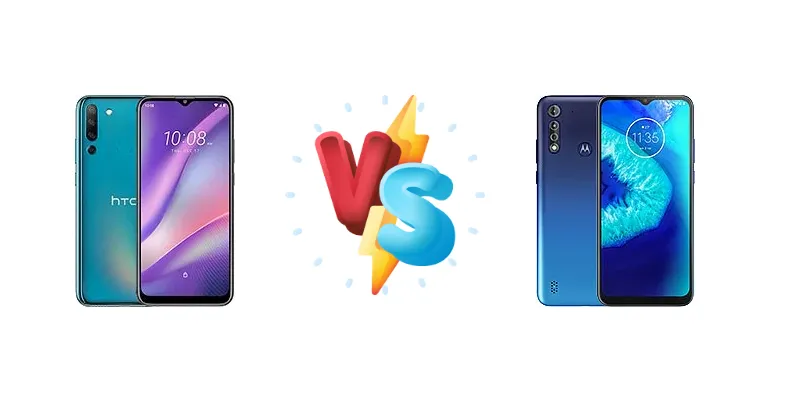
The HTC Wildfire E3 and Motorola Moto G8 Power Lite represent the lower end of the smartphone spectrum, targeting users prioritizing affordability and essential functionality. Both devices utilize Mediatek Helio chipsets, but a closer look reveals key differences in processing power and overall user experience. This comparison dissects those differences to help you choose the best option for your needs.
🏆 Quick Verdict
For most users, the Motorola Moto G8 Power Lite offers a slightly better experience due to its more powerful Helio P35 chipset. While both phones share a 10W charging rate, the G8 Power Lite’s CPU provides a noticeable performance boost for everyday tasks, making it the more practical choice.
| Network |
|---|
| 2G bands | GSM 850 / 900 / 1800 / 1900 | GSM 850 / 900 / 1800 / 1900 |
| 3G bands | HSDPA 900 / 2100 | HSDPA 850 / 900 / 1900 / 2100 |
| 4G bands | 1, 3, 5, 7, 8, 20, 38, 40 | LTE |
| Speed | HSPA 42.2/5.76 Mbps, LTE Cat4 150/75 Mbps | HSPA, LTE |
| Technology | GSM / HSPA / LTE | GSM / HSPA / LTE |
| Launch |
|---|
| Announced | 2021, March 15 | 2020, April 03. Released 2020, April 03 |
| Status | Available. Released 2021, April 11 | Discontinued |
| Body |
|---|
| Build | Glass front, plastic back, plastic frame | Glass front, plastic back, plastic frame |
| Dimensions | 165.7 x 76.6 x 9 mm (6.52 x 3.02 x 0.35 in) | 164.9 x 75.8 x 9.2 mm (6.49 x 2.98 x 0.36 in) |
| SIM | Nano-SIM + Nano-SIM | · Nano-SIM· Nano-SIM + Nano-SIM |
| Weight | 186 g (6.56 oz) | 200 g (7.05 oz) |
| | - | Water-repellent coating |
| Display |
|---|
| Resolution | 720 x 1560 pixels, 19.5:9 ratio (~264 ppi density) | 720 x 1600 pixels, 20:9 ratio (~269 ppi density) |
| Size | 6.52 inches, 104.4 cm2 (~82.2% screen-to-body ratio) | 6.5 inches, 102.8 cm2 (~82.2% screen-to-body ratio) |
| Type | IPS LCD | IPS LCD |
| Platform |
|---|
| CPU | Octa-core 1.8 GHz Cortex-A53 | Octa-core (4x2.3 GHz Cortex-A53 & 4x1.8 GHz Cortex-A53) |
| Chipset | Mediatek MT6762 Helio P22 (12 nm) | Mediatek MT6765 Helio P35 (12 nm) |
| GPU | PowerVR GE8320 | PowerVR GE8320 |
| OS | Android 10 | Android 9.0 (Pie) |
| Memory |
|---|
| Card slot | microSDXC (uses shared SIM slot) | microSDXC (dedicated slot) |
| Internal | 64GB 4GB RAM, 128GB 4GB RAM | 64GB 4GB RAM |
| | eMMC 5.1 | eMMC 5.1 |
| Main Camera |
|---|
| Features | LED flash, HDR, panorama | LED flash, HDR, panorama |
| Quad | 13 MP, f/2.0, (wide), PDAF
8 MP, f/2.2, (ultrawide)
2 MP (macro)
Auxiliary lens | - |
| Triple | - | 16 MP, f/2.0, (wide), 1.0µm, PDAF
2 MP (macro)
Auxiliary lens |
| Video | 1080p@30fps | 1080p@30fps |
| Selfie camera |
|---|
| Features | - | HDR |
| Single | 13 MP, f/2.0, (wide), 1/3.1", 1.12µm | 8 MP, f/2.0, (wide), 1.12µm |
| Video | 720p@30fps | 1080p@30fps |
| Sound |
|---|
| 3.5mm jack | Yes | Yes |
| 35mm jack | Yes | Yes |
| Loudspeaker | Yes | Yes |
| Comms |
|---|
| Bluetooth | 4.2, A2DP, LE | 4.2, A2DP, LE |
| NFC | No | No |
| Positioning | GPS, GLONASS, GALILEO, BDS | GPS, GLONASS, GALILEO |
| Radio | FM radio | FM radio |
| USB | USB Type-C 2.0, OTG | microUSB 2.0 |
| WLAN | Wi-Fi 802.11 a/b/g/n/ac, dual-band, Wi-Fi Direct | Wi-Fi 802.11 b/g/n, Wi-Fi Direct |
| Features |
|---|
| Sensors | Fingerprint (rear-mounted), accelerometer, proximity, compass | Fingerprint (rear-mounted), accelerometer, gyro, proximity |
| Battery |
|---|
| Charging | 10W wired | 10W wired |
| Type | Li-Po 4000 mAh | Li-Po 5000 mAh |
| Misc |
|---|
| Colors | Blue, Black | Arctic Blue, Royal Blue |
| Models | - | XT2055-2 |
| Price | About 130 EUR | About 160 EUR |
HTC Wildfire E3
- Potentially more compact design (based on brand history)
- Simple and straightforward user experience
- Affordable price point
- Less powerful Helio P22 chipset
- Slower app loading times
- Limited multitasking capabilities
Motorola Moto G8 Power Lite
- More powerful Helio P35 chipset
- Improved multitasking performance
- Slightly better camera image processing
- May have a larger footprint
- 10W charging is slow
- Still limited for demanding tasks
Display Comparison
Neither HTC nor Motorola provide detailed display specifications beyond resolution. However, given the price point, both likely utilize IPS LCD panels. The real difference lies in the processing power driving them. A smoother user interface on the G8 Power Lite, thanks to the faster CPU, will translate to a more pleasant visual experience, even if the panels themselves are similar. Expect standard 60Hz refresh rates on both.
Camera Comparison
Both phones likely feature basic camera setups, and detailed sensor information is scarce. Focusing on the chipsets, the image signal processor (ISP) within the Helio P35 is likely more capable than the one in the Helio P22, resulting in slightly better image processing, particularly in low-light conditions. Expect similar limitations in dynamic range and detail on both devices. The presence of a 2MP macro lens on either phone is largely a marketing gimmick and shouldn't be a deciding factor.
Performance
The core distinction between these devices is the chipset. The Motorola Moto G8 Power Lite’s Mediatek Helio P35 features a more complex CPU configuration: an octa-core setup with 4x2.3 GHz Cortex-A53 cores alongside 4x1.8 GHz Cortex-A53 cores. This contrasts with the HTC Wildfire E3’s Helio P22, which utilizes a homogenous octa-core 1.8 GHz Cortex-A53 configuration. The higher clock speeds on four cores of the P35 provide a tangible performance advantage in multi-tasking and app loading times. While both are 12nm chips, the P35’s architecture is more efficient for demanding tasks. Neither chipset is suited for graphically intensive gaming.
Battery Life
Both the HTC Wildfire E3 and Motorola Moto G8 Power Lite are equipped with 10W wired charging, indicating similar charging speeds. While battery capacity isn't specified in the provided data, the G8 Power Lite’s more efficient chipset could translate to slightly better battery life in real-world usage, even if the capacities are identical. The P35’s ability to complete tasks faster means less time spent with the CPU at full load, conserving power.
Buying Guide
Buy the HTC Wildfire E3 if you prioritize a compact form factor and are primarily focused on extremely basic smartphone functions like calls, texts, and light social media. Buy the Motorola Moto G8 Power Lite if you need a phone capable of handling slightly more demanding tasks, such as browsing with multiple tabs open, or running a wider range of apps without significant lag. The G8 Power Lite is the better option for users who want a more responsive experience.
Frequently Asked Questions
❓ Will the Motorola Moto G8 Power Lite struggle with popular social media apps like Facebook and Instagram?
While the Helio P35 isn't a powerhouse, it's capable of running Facebook and Instagram without significant issues. Expect some loading times and occasional lag when scrolling through image-heavy feeds, but it should be usable for most casual users. The Wildfire E3’s P22 will likely exhibit more noticeable lag.
❓ Is either phone suitable for playing mobile games like PUBG Mobile or Call of Duty Mobile?
Neither the HTC Wildfire E3 nor the Motorola Moto G8 Power Lite are well-suited for playing demanding games like PUBG Mobile or Call of Duty Mobile. While you might be able to run them at the lowest settings, expect very low frame rates and significant lag. These phones are better suited for simpler, less graphically intensive games.
❓ How long will it take to fully charge either phone from 0%?
With both phones utilizing 10W charging, expect a full charge to take approximately 3-4 hours. The slow charging speed is a limitation of both devices, and a power bank is recommended for users who frequently find themselves away from a power outlet.