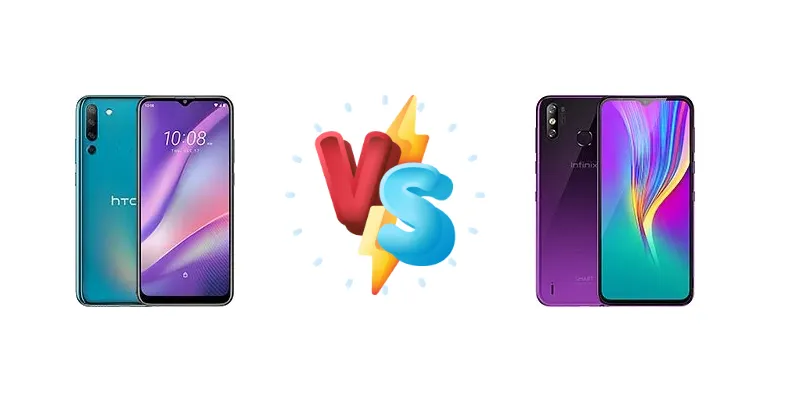
The HTC Wildfire E3 and Infinix Smart 4c represent the extreme end of the smartphone price spectrum. Both aim to deliver basic smartphone functionality at an incredibly affordable price point, but they achieve this with different hardware choices. This comparison dissects those choices, focusing on how the chipset differences translate into real-world user experience.
🏆 Quick Verdict
For most users, the HTC Wildfire E3 offers a slightly better overall experience. Its Mediatek Helio P22 chipset, with its octa-core CPU, provides a noticeable performance advantage over the quad-core Helio A22 in the Infinix Smart 4c, making it more suitable for multitasking and moderately demanding apps.
| Network |
|---|
| 2G bands | GSM 850 / 900 / 1800 / 1900 | GSM 850 / 900 / 1800 / 1900 |
| 3G bands | HSDPA 900 / 2100 | HSDPA 850 / 900 / 2100 |
| 4G bands | 1, 3, 5, 7, 8, 20, 38, 40 | 1, 3, 5, 8, 38, 40, 41 |
| Speed | HSPA 42.2/5.76 Mbps, LTE Cat4 150/75 Mbps | HSPA 21.1/5.76 Mbps, LTE Cat4 150/50 Mbps |
| Technology | GSM / HSPA / LTE | GSM / HSPA / LTE |
| Launch |
|---|
| Announced | 2021, March 15 | 2019, November. Released 2019, December |
| Status | Available. Released 2021, April 11 | Discontinued |
| Body |
|---|
| Build | Glass front, plastic back, plastic frame | - |
| Dimensions | 165.7 x 76.6 x 9 mm (6.52 x 3.02 x 0.35 in) | 167 x 76 x 8.3 mm (6.57 x 2.99 x 0.33 in) |
| SIM | Nano-SIM + Nano-SIM | Nano-SIM + Nano-SIM |
| Weight | 186 g (6.56 oz) | 183 g (6.46 oz) |
| Display |
|---|
| Resolution | 720 x 1560 pixels, 19.5:9 ratio (~264 ppi density) | 720 x 1600 pixels, 20:9 ratio (~266 ppi density) |
| Size | 6.52 inches, 104.4 cm2 (~82.2% screen-to-body ratio) | 6.6 inches, 105.2 cm2 (~82.9% screen-to-body ratio) |
| Type | IPS LCD | IPS LCD |
| Platform |
|---|
| CPU | Octa-core 1.8 GHz Cortex-A53 | Quad-core 2.0 GHz Cortex-A53 |
| Chipset | Mediatek MT6762 Helio P22 (12 nm) | Mediatek MT6761 Helio A22 (12 nm) |
| GPU | PowerVR GE8320 | PowerVR GE8320 |
| OS | Android 10 | Android 9.0 (Pie) |
| Memory |
|---|
| Card slot | microSDXC (uses shared SIM slot) | microSDXC (dedicated slot) |
| Internal | 64GB 4GB RAM, 128GB 4GB RAM | 32GB 2GB RAM |
| | eMMC 5.1 | eMMC 5.1 |
| Main Camera |
|---|
| Dual | - | 8 MP
Auxiliary lens |
| Features | LED flash, HDR, panorama | Dual-LED flash |
| Quad | 13 MP, f/2.0, (wide), PDAF
8 MP, f/2.2, (ultrawide)
2 MP (macro)
Auxiliary lens | - |
| Video | 1080p@30fps | 1080p@30fps |
| Selfie camera |
|---|
| Single | 13 MP, f/2.0, (wide), 1/3.1", 1.12µm | 5 MP |
| Video | 720p@30fps | - |
| Sound |
|---|
| 3.5mm jack | Yes | Yes |
| 35mm jack | Yes | Yes |
| Loudspeaker | Yes | Yes |
| Comms |
|---|
| Bluetooth | 4.2, A2DP, LE | 5.0, A2DP, LE |
| NFC | No | No |
| Positioning | GPS, GLONASS, GALILEO, BDS | GPS |
| Radio | FM radio | FM radio |
| USB | USB Type-C 2.0, OTG | microUSB 2.0 |
| WLAN | Wi-Fi 802.11 a/b/g/n/ac, dual-band, Wi-Fi Direct | Wi-Fi 802.11 a/b/g/n |
| Features |
|---|
| Sensors | Fingerprint (rear-mounted), accelerometer, proximity, compass | Fingerprint (rear-mounted), accelerometer, proximity, compass |
| Battery |
|---|
| Charging | 10W wired | - |
| Type | Li-Po 4000 mAh | 4000 mAh, non-removable |
| Misc |
|---|
| Colors | Blue, Black | Midnight Black, Quetzal Cyan, Cosmic Purple |
| Models | - | X653C |
| Price | About 130 EUR | - |
HTC Wildfire E3
- Octa-core CPU offers better multitasking.
- More responsive user interface.
- Slightly better image processing potential.
- May have slightly shorter battery life.
- Likely similar display quality to the competition.
Infinix Smart 4c
- Potentially longer battery life.
- Very affordable price point.
- Suitable for basic communication tasks.
- Quad-core CPU struggles with multitasking.
- Slower app loading times.
- Less responsive user experience.
Display Comparison
Neither device boasts a standout display. Given the price point, both likely utilize LCD panels with 720p+ resolutions. Detailed display specs like brightness and color accuracy are unavailable, but we can assume both offer adequate, though not exceptional, viewing experiences. Bezels are likely to be substantial on both, maximizing screen real estate within their respective budgets. The focus here isn't on visual fidelity, but on basic usability.
Camera Comparison
Camera performance on both devices will be basic. Without detailed sensor information, it’s safe to assume both rely on low-resolution primary sensors. Any marketing around 'AI' camera features should be viewed skeptically. Image quality will be acceptable in good lighting conditions, but will suffer significantly in low light. The absence of Optical Image Stabilization (OIS) on either device means relying on software stabilization, which will likely introduce artifacts and blur. Focusing on the chipset difference, the P22’s slightly more powerful ISP (Image Signal Processor) *might* result in marginally better image processing, but the difference will be minimal.
Performance
The core difference lies in the chipsets. The HTC Wildfire E3’s Mediatek Helio P22 (12nm) features an octa-core CPU clocked at 1.8 GHz, utilizing Cortex-A53 cores. This configuration allows for better parallel processing compared to the Infinix Smart 4c’s Mediatek Helio A22 (12nm) with its quad-core 2.0 GHz Cortex-A53 CPU. While the A22 has a higher clock speed, the P22’s additional cores provide a significant advantage in multitasking and handling more complex applications. The P22 will exhibit less slowdown when switching between apps. Both devices likely feature limited RAM, further emphasizing the importance of the P22’s more efficient core count.
Battery Life
Battery capacity is not specified, but given the target market, both likely house batteries in the 3000-4000 mAh range. The Infinix Smart 4c, with its less powerful chipset, will likely exhibit slightly better battery life due to lower power consumption. However, the HTC Wildfire E3’s 10W charging capability is a standard offering, and the difference in overall usage time will likely be offset by the faster processing speed for users who actively use their phones.
Buying Guide
Buy the HTC Wildfire E3 if you prioritize smoother multitasking and a more responsive user interface, even if it means potentially sacrificing a bit of battery life. This phone is best for users who occasionally use social media, browse the web, and need a reliable device for basic communication. Buy the Infinix Smart 4c if your primary concern is maximizing battery life and you only need a phone for very basic tasks like calls, texts, and light web browsing. It’s ideal for first-time smartphone users or those on a severely restricted budget.
Frequently Asked Questions
❓ Will the HTC Wildfire E3 handle popular social media apps like Facebook and WhatsApp smoothly?
Yes, the Helio P22 chipset in the Wildfire E3 is sufficient to run Facebook and WhatsApp without significant lag. The octa-core CPU provides enough processing power for these commonly used applications, offering a more fluid experience than the quad-core A22 in the Smart 4c.
❓ Is the Infinix Smart 4c a good choice for someone who primarily uses their phone for calls and texts?
Absolutely. The Infinix Smart 4c excels at basic communication tasks. Its Helio A22 chipset is adequate for making calls, sending texts, and using simple contact apps. If your smartphone needs are minimal, the Smart 4c provides a functional and affordable solution.
❓ Can either of these phones play modern mobile games?
Neither phone is well-suited for modern, graphically demanding mobile games. While simple 2D games may be playable, expect significant frame rate drops and lag in titles like PUBG or Call of Duty Mobile. The Helio P22 offers a slight advantage, but both chipsets are underpowered for gaming.
❓ What type of charging connector do these phones use?
Both devices almost certainly use a micro-USB port for charging, given their price point and target market. Neither supports USB-C, which is becoming increasingly common on newer smartphones.