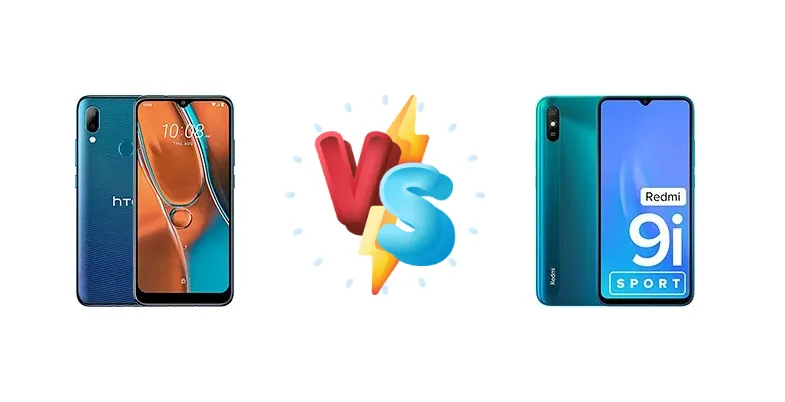
The HTC Wildfire E2 and Xiaomi Redmi 9i Sport represent the fiercely competitive sub-$150 Android market. Both devices aim to deliver essential smartphone functionality at an incredibly accessible price point. However, subtle differences in their chipsets and overall design can significantly impact the user experience. This comparison dissects these nuances to determine which phone offers the best value.
🏆 Quick Verdict
For the average user prioritizing basic performance and occasional gaming, the Xiaomi Redmi 9i Sport emerges as the better choice. Its Helio G25 chipset, with its higher clocked Cortex-A53 cores, provides a noticeable performance uplift over the Wildfire E2’s Helio P22, making it more responsive for everyday tasks and light gaming.
| Network |
|---|
| 2G bands | GSM 850 / 900 / 1800 / 1900 | GSM 850 / 900 / 1800 / 1900 |
| 3G bands | HSDPA 850 / 900 / 1900 / 2100 | HSDPA 850 / 900 / 2100 |
| 4G bands | LTE | 1, 3, 5, 8, 40, 41 |
| Speed | HSPA, LTE | HSPA, LTE |
| Technology | GSM / HSPA / LTE | GSM / HSPA / LTE |
| Launch |
|---|
| Announced | 2020, August 06. Released 2020, August 06 | 2021, September 28 |
| Status | Discontinued | Available. Released 2021, September 28 |
| Body |
|---|
| Build | Glass front, plastic back, plastic frame | - |
| Dimensions | 158.4 x 75.9 x 9 mm (6.24 x 2.99 x 0.35 in) | 164.9 x 77.1 x 9 mm (6.49 x 3.04 x 0.35 in) |
| SIM | Nano-SIM + Nano-SIM | Nano-SIM + Nano-SIM |
| Weight | 173.5 g (6.14 oz) | 194 g (6.84 oz) |
| | - | Water-repellent coating |
| Display |
|---|
| Resolution | 720 x 1560 pixels, 19.5:9 ratio (~276 ppi density) | 720 x 1600 pixels, 20:9 ratio (~269 ppi density) |
| Size | 6.22 inches, 95.0 cm2 (~79.0% screen-to-body ratio) | 6.53 inches, 102.9 cm2 (~81.0% screen-to-body ratio) |
| Type | IPS LCD | IPS LCD, 400 nits (typ) |
| Platform |
|---|
| CPU | Octa-core 1.8 GHz Cortex-A53 | Octa-core (4x2.0 GHz Cortex-A53 & 4x1.5 GHz Cortex-A53) |
| Chipset | Mediatek MT6762D Helio P22 (12 nm) | Mediatek MT6762G Helio G25 (12 nm) |
| GPU | PowerVR GE8320 | PowerVR GE8320 |
| OS | Android 10 | Android 10, MIUI 12 |
| Memory |
|---|
| Card slot | microSDXC (uses shared SIM slot) | microSDXC (dedicated slot) |
| Internal | 64GB 4GB RAM | 64GB 4GB RAM, 128GB 4GB RAM |
| | eMMC 5.1 | eMMC 5.1 |
| Main Camera |
|---|
| Dual | 16 MP, f/2.2, (wide), PDAF
Auxiliary lens | - |
| Features | Dual-LED dual-tone flash, HDR, panorama | LED flash, HDR |
| Single | - | 13 MP, f/2.2, 28mm (wide), 1.0µm, PDAF |
| Video | 1080p@30fps | 1080p@30fps |
| Selfie camera |
|---|
| Features | - | HDR |
| Single | 8 MP, f/2.2, (wide) | 5 MP, f/2.2, (wide), 1.12µm |
| Video | 1080p@30fps | 1080p@30fps |
| Sound |
|---|
| 3.5mm jack | Yes | Yes |
| 35mm jack | Yes | Yes |
| Loudspeaker | Yes | Yes |
| Comms |
|---|
| Bluetooth | 5.0, A2DP, LE | 5.0, A2DP, LE |
| NFC | No | No |
| Positioning | GPS, GLONASS, GALILEO, BDS | GPS, GLONASS, BDS |
| Radio | FM radio | FM radio |
| USB | USB Type-C 2.0, OTG | microUSB 2.0, OTG |
| WLAN | Wi-Fi 802.11 a/b/g/n/ac, dual-band, Wi-Fi Direct | Wi-Fi 802.11 а/b/g/n, Wi-Fi Direct |
| Features |
|---|
| Sensors | Fingerprint (rear-mounted), accelerometer, proximity, compass | Accelerometer, proximity, compass |
| Battery |
|---|
| Charging | 10W wired | 10W wired |
| Type | Li-Po 4000 mAh | Li-Po 5000 mAh |
| Misc |
|---|
| Colors | Blue | Carbon Black, Coral Green, Metallic Blue |
| Price | About 100 EUR | About 100 EUR |
HTC Wildfire E2
- Established brand (HTC)
- Potentially cleaner software experience (depending on region)
- Compact and lightweight design
- Less powerful chipset (Helio P22)
- Likely slower app loading times
- Limited gaming capabilities
Xiaomi Redmi 9i Sport
- More powerful chipset (Helio G25)
- Faster app loading and multitasking
- Slightly better gaming performance
- Xiaomi’s MIUI software can be heavily customized
- Potential for bloatware
- Build quality may feel less premium
Display Comparison
Neither device boasts a standout display. Both likely utilize LCD panels, typical for this price bracket. Specifics like resolution and brightness are not provided, but we can assume they are similar – likely 720p+ and adequate for indoor use. The focus here isn't on visual fidelity, but rather on basic readability. Bezels are expected to be substantial on both, maximizing screen real estate within a compact form factor.
Camera Comparison
Camera performance is likely to be similar and underwhelming on both devices. Without specific sensor details, it’s safe to assume both rely on basic sensors for their primary cameras. The inclusion of a 2MP macro lens on the Redmi 9i Sport is largely a marketing gimmick, offering limited practical benefit due to its low resolution. Image processing will likely be heavily reliant on software algorithms to enhance detail and reduce noise, but don't expect flagship-level results. Both phones will struggle in low-light conditions.
Performance
The core difference lies in the chipsets. The Xiaomi Redmi 9i Sport’s Mediatek Helio G25 features a dual-cluster configuration: four cores clocked at 2.0 GHz and four at 1.5 GHz, all Cortex-A53. This contrasts with the HTC Wildfire E2’s Helio P22, which utilizes eight Cortex-A53 cores clocked uniformly at 1.8 GHz. While both are 12nm chips, the G25’s higher peak clock speed on half its cores translates to better responsiveness in demanding applications. This means faster app loading times and smoother multitasking on the Redmi 9i Sport. The G25 also includes a slightly more capable IMG PowerVR GE8320 GPU, offering a marginal improvement in gaming performance.
Battery Life
Both devices feature 10W wired charging, indicating similar charging speeds – expect around 2.5 to 3 hours for a full charge. Battery capacity isn't specified, but given the target price point, both likely house batteries in the 4000-5000 mAh range. The slightly more efficient Helio G25 in the Redmi 9i Sport *may* translate to marginally better battery life, but real-world usage will depend heavily on individual usage patterns.
Buying Guide
Buy the HTC Wildfire E2 if you prioritize a brand with a longer, albeit turbulent, history in the smartphone market and are content with extremely basic performance for essential tasks like calls and messaging. Buy the Xiaomi Redmi 9i Sport if you prefer a more modern chipset offering a smoother experience for social media, video streaming, and casual gaming, even if it means opting for a brand known for its aggressive pricing and software customization.
Frequently Asked Questions
❓ Will the Redmi 9i Sport struggle with popular apps like WhatsApp and Facebook?
No, the Helio G25 chipset in the Redmi 9i Sport is sufficient to run popular social media apps like WhatsApp and Facebook smoothly. While it won't offer a blazing-fast experience, it will handle these apps without significant lag or slowdown.
❓ Is the HTC Wildfire E2 a good option for someone who primarily makes calls and sends texts?
Yes, the HTC Wildfire E2 is a perfectly adequate option for basic communication. Its Helio P22 chipset is capable of handling calls and text messaging without issue. However, be aware that it will struggle with more demanding tasks.
❓ Can I play PUBG Mobile on either of these phones?
PUBG Mobile is playable on both, but expect a very low-graphics, low-framerate experience. The Redmi 9i Sport’s G25 will offer a slightly smoother experience, but neither phone is designed for serious gaming. Expect significant frame drops and lag, even on the lowest settings.
❓ Which phone is likely to receive more software updates?
Historically, Xiaomi has a better track record of providing software updates, even for its budget devices, compared to HTC. However, don't expect frequent or long-term support for either phone. Both are entry-level devices and will likely receive limited updates.