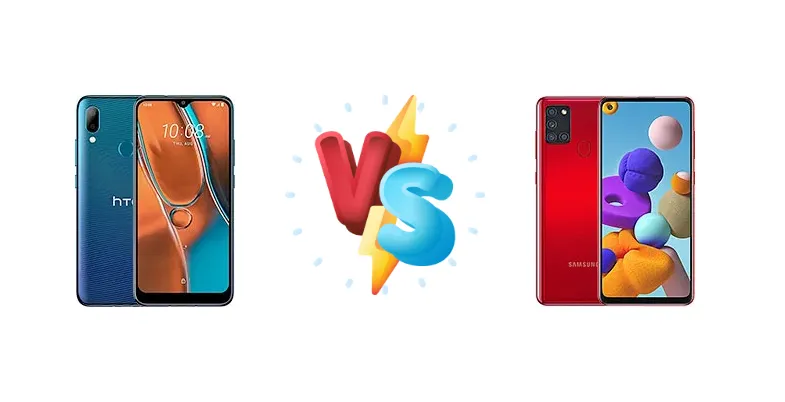
The HTC Wildfire E2 and Samsung Galaxy A21s represent two approaches to the ultra-budget smartphone market. The Wildfire E2 aims for simplicity, while the A21s attempts to pack in more features. This comparison dissects their key differences to determine which device delivers the best value for users prioritizing affordability.
🏆 Quick Verdict
For most users, the Samsung Galaxy A21s is the better choice. Its Exynos 850 chipset provides a noticeable performance uplift over the Wildfire E2’s Helio P22, and the brighter 490-nit display enhances usability. While both offer similar battery endurance, the A21s’ 15W charging is a significant advantage.
| Network |
|---|
| 2G bands | GSM 850 / 900 / 1800 / 1900 | GSM 850 / 900 / 1800 / 1900 |
| 3G bands | HSDPA 850 / 900 / 1900 / 2100 | HSDPA 850 / 900 / 1900 / 2100 |
| 4G bands | LTE | 1, 2, 3, 5, 7, 8, 20, 28, 38, 40, 41 |
| Speed | HSPA, LTE | HSPA, LTE |
| Technology | GSM / HSPA / LTE | GSM / HSPA / LTE |
| Launch |
|---|
| Announced | 2020, August 06. Released 2020, August 06 | 2020, May 15. Released 2020, June 02 |
| Status | Discontinued | Discontinued |
| Body |
|---|
| Build | Glass front, plastic back, plastic frame | Glass front, plastic frame, plastic back |
| Dimensions | 158.4 x 75.9 x 9 mm (6.24 x 2.99 x 0.35 in) | 163.7 x 75.3 x 8.9 mm (6.44 x 2.96 x 0.35 in) |
| SIM | Nano-SIM + Nano-SIM | · Nano-SIM· Nano-SIM + Nano-SIM |
| Weight | 173.5 g (6.14 oz) | 192 g (6.77 oz) |
| Display |
|---|
| Resolution | 720 x 1560 pixels, 19.5:9 ratio (~276 ppi density) | 720 x 1600 pixels, 20:9 ratio (~270 ppi density) |
| Size | 6.22 inches, 95.0 cm2 (~79.0% screen-to-body ratio) | 6.5 inches, 102.0 cm2 (~82.8% screen-to-body ratio) |
| Type | IPS LCD | PLS LCD |
| Platform |
|---|
| CPU | Octa-core 1.8 GHz Cortex-A53 | Octa-core (4x2.0 GHz Cortex-A55 & 4x2.0 GHz Cortex-A55) |
| Chipset | Mediatek MT6762D Helio P22 (12 nm) | Exynos 850 (8 nm) |
| GPU | PowerVR GE8320 | Mali-G52 |
| OS | Android 10 | Android 10, upgradable to Android 12, One UI 4.1 |
| Memory |
|---|
| Card slot | microSDXC (uses shared SIM slot) | microSDXC (dedicated slot) |
| Internal | 64GB 4GB RAM | 32GB 2GB RAM, 32GB 3GB RAM, 32GB 4GB RAM, 64GB 3GB RAM, 64GB 4GB RAM, 64GB 6GB RAM, 128GB 2GB RAM, 128GB 3GB RAM, 128GB 4/6GB RAM |
| | eMMC 5.1 | eMMC 5.1 |
| Main Camera |
|---|
| Dual | 16 MP, f/2.2, (wide), PDAF
Auxiliary lens | - |
| Features | Dual-LED dual-tone flash, HDR, panorama | LED flash, panorama, HDR |
| Quad | - | 48 MP, f/2.0, 26mm (wide), 1/2.0", 0.8µm, PDAF
8 MP, f/2.2, 123˚ (ultrawide), 1/4.0", 1.12µm
2 MP (macro)
Auxiliary lens |
| Video | 1080p@30fps | 1080p@30fps |
| Selfie camera |
|---|
| Single | 8 MP, f/2.2, (wide) | 13 MP, f/2.2, (wide), 1/3.1", 1.12µm |
| Video | 1080p@30fps | 1080p@30fps |
| Sound |
|---|
| 3.5mm jack | Yes | Yes |
| 35mm jack | Yes | Yes |
| Loudspeaker | Yes | Yes |
| Comms |
|---|
| Bluetooth | 5.0, A2DP, LE | 5.0, A2DP, LE |
| NFC | No | Yes (market/region dependent) |
| Positioning | GPS, GLONASS, GALILEO, BDS | GPS, GLONASS, GALILEO, BDS |
| Radio | FM radio | FM radio, RDS, recording |
| USB | USB Type-C 2.0, OTG | USB Type-C 2.0 |
| WLAN | Wi-Fi 802.11 a/b/g/n/ac, dual-band, Wi-Fi Direct | Wi-Fi 802.11 a/b/g/n/ac, dual-band, Wi-Fi Direct |
| Features |
|---|
| Sensors | Fingerprint (rear-mounted), accelerometer, proximity, compass | Fingerprint (rear-mounted), accelerometer, gyro, proximity, compass |
| Battery |
|---|
| Charging | 10W wired | 15W wired |
| Type | Li-Po 4000 mAh | Li-Po 5000 mAh |
| Misc |
|---|
| Colors | Blue | Black, White, Blue, Red |
| Models | - | SM-A217F, SM-A217F/DS, SM-A217F/DSN, SM-A217M, SM-A217M/DS, SM-A217N |
| Price | About 100 EUR | About 220 EUR |
| SAR EU | - | 0.42 W/kg (head) 1.54 W/kg (body) |
| Tests |
|---|
| Battery life | - | Endurance rating 119h |
| Camera | - |
Photo / Video |
| Display | - |
Contrast ratio: 1287:1 (nominal) |
| Loudspeaker | - |
-30.0 LUFS (Average) |
| Performance | - |
AnTuTu: 107157 (v8)
GeekBench: 1100 (v5.1)
GFXBench: 11fps (ES 3.1 onscreen) |
HTC Wildfire E2
- Potentially lower price point
- Simple, uncluttered Android experience
- Compact form factor (likely)
- Significantly weaker performance
- Dimmer, less vibrant display
- Slower charging speed
Samsung Galaxy A21s
- Faster and more efficient Exynos 850 chipset
- Brighter and more viewable display
- Faster 15W charging
- May be slightly more expensive
- Samsung’s One UI can be resource-intensive
- Larger form factor (potentially)
Display Comparison
The Samsung Galaxy A21s boasts a significantly more usable display, achieving a measured peak brightness of 490 nits compared to the Wildfire E2’s unspecified brightness. Both share a contrast ratio of 1287:1, suggesting similar color reproduction capabilities, but the higher brightness of the A21s makes it far more legible outdoors. The Wildfire E2’s display specifications are not readily available, making a detailed comparison difficult, but it’s likely to be dimmer and less vibrant.
Camera Comparison
Both devices list 'Photo / Video' capabilities, but lack specific details. Given the market positioning, image quality will likely be similar in good lighting conditions. However, the A21s benefits from Samsung’s image processing algorithms, potentially offering more refined results. The Wildfire E2’s camera system is likely to be more basic, and the absence of details suggests a less sophisticated setup. It's reasonable to assume the A21s will offer a more versatile camera experience, even if neither phone excels in low-light photography.
Performance
The core difference lies in the chipsets. The Samsung Galaxy A21s utilizes the Exynos 850, built on an 8nm process, featuring an octa-core CPU with four Cortex-A55 cores clocked at 2.0 GHz. This contrasts sharply with the HTC Wildfire E2’s Mediatek Helio P22 (12nm) and its octa-core Cortex-A53 CPU clocked at 1.8 GHz. The 8nm process and newer Cortex-A55 architecture of the Exynos 850 translate to better power efficiency and noticeably improved performance in everyday tasks and light gaming. The A21s will handle multitasking and app loading times with greater ease.
Battery Life
Both the HTC Wildfire E2 and Samsung Galaxy A21s achieve an endurance rating of 119 hours, indicating comparable battery life under similar usage patterns. However, the A21s has a clear advantage in charging speed, supporting 15W wired charging compared to the Wildfire E2’s slower 10W charging. This means the A21s can replenish its battery significantly faster, reducing downtime and offering greater convenience.
Buying Guide
Buy the HTC Wildfire E2 if you absolutely need the lowest possible price and prioritize a minimalist Android experience. It’s suitable for basic communication and light tasks. Buy the Samsung Galaxy A21s if you value a more responsive user experience, a brighter and more viewable display, and faster charging – even if it means spending a little more.
Frequently Asked Questions
❓ Does the Exynos 850 in the Galaxy A21s get noticeably warm during extended use, like gaming?
The Exynos 850, built on an 8nm process, is relatively efficient. While it will warm up during prolonged gaming sessions, it’s unlikely to experience significant throttling like some higher-performance chipsets. The larger chassis of the A21s also helps dissipate heat.
❓ Is the 2MP macro camera on the Galaxy A21s actually useful for taking detailed close-up photos?
Realistically, the 2MP macro camera on the A21s is limited. The low resolution results in images lacking detail and sharpness. It's best used for casual snapshots in good lighting, but don't expect professional-quality macro photography.
❓ Can the Samsung Galaxy A21s handle popular games like PUBG Mobile at acceptable frame rates?
The Galaxy A21s can run PUBG Mobile, but you'll likely need to lower the graphics settings to medium or low to achieve consistently smooth frame rates. Expect around 30-40 FPS, which is playable but not ideal for competitive gaming.
❓ How long does it realistically take to fully charge the HTC Wildfire E2 with its 10W charger?
With its 10W charging, the HTC Wildfire E2 will likely take over 3 hours to fully charge from 0% to 100%. This is significantly slower than the Samsung Galaxy A21s, making it less convenient for users who need a quick top-up.