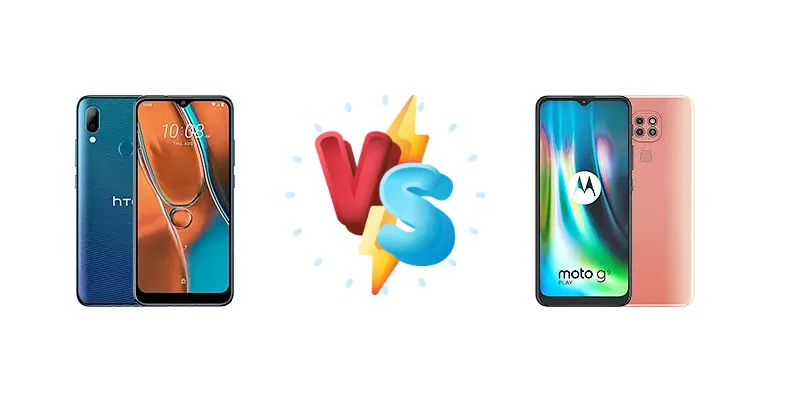
The sub-$200 smartphone market is fiercely competitive. The HTC Wildfire E2 and Motorola Moto G9 Play both aim to deliver essential smartphone functionality at an accessible price point, but they take different approaches. The Wildfire E2 relies on MediaTek’s Helio P22, while the Moto G9 Play opts for Qualcomm’s Snapdragon 662. This comparison dissects these choices, revealing which phone offers the best experience for your money.
🏆 Quick Verdict
For most users, the Motorola Moto G9 Play is the superior choice. Its Snapdragon 662 chipset provides a noticeable performance boost over the Wildfire E2’s Helio P22, and the 20W charging significantly reduces downtime. While the Wildfire E2 is cheaper, the G9 Play’s improved usability justifies the price difference.
| Network |
|---|
| 2G bands | GSM 850 / 900 / 1800 / 1900 | GSM 850 / 900 / 1800 / 1900 |
| 3G bands | HSDPA 850 / 900 / 1900 / 2100 | HSDPA 850 / 900 / 1900 / 2100 |
| 4G bands | LTE | 1, 2, 3, 5, 7, 8, 18, 19, 20, 26, 28, 38, 40, 41 |
| EDGE | - | Class 10 |
| GPRS | - | Class 10 |
| Speed | HSPA, LTE | HSPA 42.2/5.76 Mbps, LTE Cat4 150/50 Mbps |
| Technology | GSM / HSPA / LTE | GSM / HSPA / LTE |
| Launch |
|---|
| Announced | 2020, August 06. Released 2020, August 06 | 2020, August 24. Released 2020, August 28 |
| Status | Discontinued | Discontinued |
| Body |
|---|
| Build | Glass front, plastic back, plastic frame | Glass front, plastic back, plastic frame |
| Dimensions | 158.4 x 75.9 x 9 mm (6.24 x 2.99 x 0.35 in) | 165.2 x 75.7 x 9.2 mm (6.50 x 2.98 x 0.36 in) |
| Keyboard | - | QWERTY |
| SIM | Nano-SIM + Nano-SIM | · Nano-SIM· Nano-SIM + Nano-SIM |
| Weight | 173.5 g (6.14 oz) | 200 g (7.05 oz) |
| | - | Water-repellent coating |
| Display |
|---|
| Resolution | 720 x 1560 pixels, 19.5:9 ratio (~276 ppi density) | 720 x 1600 pixels, 20:9 ratio (~269 ppi density) |
| Size | 6.22 inches, 95.0 cm2 (~79.0% screen-to-body ratio) | 6.5 inches, 102.8 cm2 (~82.2% screen-to-body ratio) |
| Type | IPS LCD | IPS LCD |
| Platform |
|---|
| CPU | Octa-core 1.8 GHz Cortex-A53 | Octa-core (4x2.0 GHz Kryo 260 Gold & 4x1.8 GHz Kryo 260 Silver) |
| Chipset | Mediatek MT6762D Helio P22 (12 nm) | Qualcomm SM6115 Snapdragon 662 (11 nm) |
| GPU | PowerVR GE8320 | Adreno 610 |
| OS | Android 10 | Android 10, upgradable to Android 11 |
| Memory |
|---|
| Card slot | microSDXC (uses shared SIM slot) | microSDXC (uses shared SIM slot) |
| Internal | 64GB 4GB RAM | 64GB 4GB RAM, 128GB 4GB RAM |
| | eMMC 5.1 | - |
| Main Camera |
|---|
| Dual | 16 MP, f/2.2, (wide), PDAF
Auxiliary lens | - |
| Features | Dual-LED dual-tone flash, HDR, panorama | LED flash, HDR, panorama |
| Single | - | 1.3 MP |
| Triple | - | 48 MP, f/1.7, (wide), 1/2.0", 0.8µm, PDAF
2 MP (macro)
Auxiliary lens |
| Video | 1080p@30fps | 1080p@30/60fps |
| Selfie camera |
|---|
| Features | - | HDR |
| Single | 8 MP, f/2.2, (wide) | 8 MP, f/2.2, 1.12µm |
| Video | 1080p@30fps | 1080p@30fps |
| Sound |
|---|
| 3.5mm jack | Yes | Yes |
| 35mm jack | Yes | Yes |
| Loudspeaker | Yes | Yes |
| Comms |
|---|
| Bluetooth | 5.0, A2DP, LE | 5.0, A2DP, LE |
| Infrared port | - | Yes |
| NFC | No | Yes |
| Positioning | GPS, GLONASS, GALILEO, BDS | GPS, GLONASS, GALILEO |
| Radio | FM radio | FM radio |
| USB | USB Type-C 2.0, OTG | USB Type-C 2.0 |
| WLAN | Wi-Fi 802.11 a/b/g/n/ac, dual-band, Wi-Fi Direct | Wi-Fi 802.11 a/b/g/n/ac, dual-band, Wi-Fi Direct |
| Features |
|---|
| Browser | - | WAP 2.0/xHTML, HTML (PocketIE) |
| Sensors | Fingerprint (rear-mounted), accelerometer, proximity, compass | Fingerprint (rear-mounted), accelerometer, gyro, proximity |
| Battery |
|---|
| Charging | 10W wired | 20W wired |
| Type | Li-Po 4000 mAh | Li-Po 5000 mAh |
| Misc |
|---|
| Colors | Blue | Forest Green, Sapphire Blue, Spring Pink |
| Models | - | XT2083, XT2083-1 |
| Price | About 100 EUR | About 430 EUR |
| Tests |
|---|
| Camera | - |
Photo / Video |
| Display | - |
Contrast ratio: 1944:1 |
| Loudspeaker | - |
-27.6 LUFS (Good)
|
| Performance | - |
AnTuTu: 170064 (v8)
GeekBench: 1402 (v5.1)
GFXBench: 13fps (ES 3.1 onscreen) |
HTC Wildfire E2
- Extremely affordable price point
- Simple and straightforward user experience
- Compact and lightweight design (likely)
- Weak processor performance
- Slow 10W charging
- Limited camera capabilities
Motorola Moto G9 Play
- Faster Snapdragon 662 processor
- 20W fast charging
- Brighter display for better visibility
- Slightly higher price than the Wildfire E2
- May have more bloatware (typical of Motorola)
- Larger size may not suit all users
Display Comparison
The Motorola Moto G9 Play boasts a brighter display, measured at 465 nits, compared to the HTC Wildfire E2, for which brightness data is unavailable. This higher brightness translates to better visibility outdoors. Both displays share a 1944:1 contrast ratio, suggesting similar color depth and black levels. However, the lack of detailed display specifications for the Wildfire E2 – such as panel type or color gamut coverage – suggests a more basic viewing experience. The G9 Play’s brighter panel is a clear advantage for media consumption and general usability.
Camera Comparison
Both phones offer 'Photo / Video' capabilities, but details are sparse. Without specific sensor sizes or aperture information for the Wildfire E2, it’s difficult to assess its camera performance. The Moto G9 Play likely benefits from Qualcomm’s image signal processor (ISP) within the Snapdragon 662, which provides better image processing capabilities. While both phones may include multiple lenses, the absence of details on the Wildfire E2’s camera setup suggests a less sophisticated imaging experience. The G9 Play’s ISP will likely deliver better dynamic range and noise reduction.
Performance
The core difference lies in the chipsets. The Motorola Moto G9 Play’s Qualcomm Snapdragon 662 (11nm) is architecturally superior to the HTC Wildfire E2’s MediaTek Helio P22 (12nm). The Snapdragon 662 utilizes a combination of Kryo 260 Gold (2.0 GHz) and Silver (1.8 GHz) cores, offering a more efficient and powerful processing experience. The Helio P22’s all-Cortex-A53 core configuration, clocked at 1.8 GHz, is less capable in both single-core and multi-core tasks. This translates to snappier app launches, smoother multitasking, and better gaming performance on the Moto G9 Play. The 11nm process node of the Snapdragon 662 also contributes to improved thermal efficiency, reducing the likelihood of throttling during sustained workloads.
Battery Life
The Motorola Moto G9 Play’s 20W wired charging is a significant advantage over the HTC Wildfire E2’s 10W charging. This means the G9 Play can replenish its battery much faster, minimizing downtime. While battery capacity isn’t specified for either device, the faster charging speed of the G9 Play effectively mitigates any potential capacity disadvantage. A full charge on the G9 Play will take considerably less time, making it more convenient for users who rely heavily on their smartphones throughout the day.
Buying Guide
Buy the HTC Wildfire E2 if your primary need is an extremely affordable device for basic communication – calls, texts, and light app usage. It’s a suitable option for first-time smartphone users or as a backup phone. Buy the Motorola Moto G9 Play if you prioritize a smoother user experience, faster charging, and a more capable camera for everyday photography and occasional gaming. It’s the better all-rounder for users who demand more from their smartphone.
Frequently Asked Questions
❓ Is the Snapdragon 662 in the Moto G9 Play capable of playing demanding games like PUBG Mobile?
Yes, the Snapdragon 662 is capable of running PUBG Mobile, though likely at medium settings to maintain a stable frame rate. While it’s not a gaming powerhouse, it offers a significantly better gaming experience than the Helio P22 in the Wildfire E2.
❓ How long will it take to fully charge the Motorola Moto G9 Play with the 20W charger?
While exact charging times vary, the Motorola Moto G9 Play should fully charge from 0% to 100% in approximately 1 hour and 45 minutes to 2 hours using the included 20W charger. This is considerably faster than the HTC Wildfire E2’s 10W charging.
❓ Does the Motorola Moto G9 Play have a dedicated microSD card slot for expandable storage?
Yes, the Motorola Moto G9 Play includes a dedicated microSD card slot, allowing you to expand the storage capacity beyond the internal storage options. This is a valuable feature for users who store a lot of photos, videos, or other media.
❓ Is the HTC Wildfire E2 a good option for someone who primarily uses their phone for calls and texts?
Yes, the HTC Wildfire E2 is a suitable option for basic communication. Its affordability and simplicity make it a good choice for users who don't require advanced features or high performance. However, be prepared for slower app loading times and a less responsive user experience.