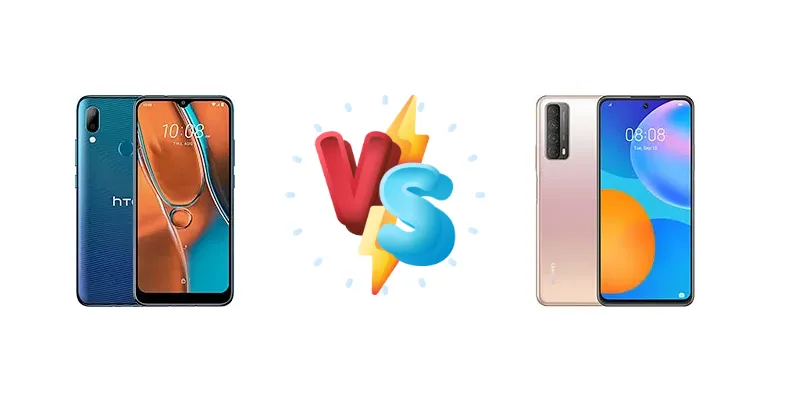
The HTC Wildfire E2 and Huawei P smart 2021 represent two contenders in the fiercely competitive budget smartphone market. Both aim to deliver essential smartphone functionality at an accessible price point, but they achieve this with different approaches to chipset design and feature sets. This comparison dives deep into their specifications to determine which device offers the best value for money.
🏆 Quick Verdict
For the average user prioritizing a slightly faster processor and significantly quicker charging, the Huawei P smart 2021 is the better choice. While the HTC Wildfire E2 offers a functional experience, the Kirin 710A and 22.5W charging of the P smart 2021 provide a noticeable performance and convenience advantage.
| Network |
|---|
| 2G bands | GSM 850 / 900 / 1800 / 1900 | GSM 900 / 1800 / 1900 |
| 3G bands | HSDPA 850 / 900 / 1900 / 2100 | HSDPA 850 / 900 / 1700(AWS) / 1900 / 2100 |
| 4G bands | LTE | 1, 3, 5, 7, 8, 20, 28, 38, 40, 41 |
| Speed | HSPA, LTE | HSPA, LTE |
| Technology | GSM / HSPA / LTE | GSM / HSPA / LTE |
| Launch |
|---|
| Announced | 2020, August 06. Released 2020, August 06 | 2020, September 28. Released 2020, September 28 |
| Status | Discontinued | Discontinued |
| Body |
|---|
| Build | Glass front, plastic back, plastic frame | - |
| Dimensions | 158.4 x 75.9 x 9 mm (6.24 x 2.99 x 0.35 in) | 165.7 x 76.9 x 9.3 mm (6.52 x 3.03 x 0.37 in) |
| SIM | Nano-SIM + Nano-SIM | Nano-SIM + Nano-SIM |
| Weight | 173.5 g (6.14 oz) | 206 g (7.27 oz) |
| Display |
|---|
| Resolution | 720 x 1560 pixels, 19.5:9 ratio (~276 ppi density) | 1080 x 2400 pixels, 20:9 ratio (~395 ppi density) |
| Size | 6.22 inches, 95.0 cm2 (~79.0% screen-to-body ratio) | 6.67 inches, 107.4 cm2 (~84.3% screen-to-body ratio) |
| Type | IPS LCD | IPS LCD |
| Platform |
|---|
| CPU | Octa-core 1.8 GHz Cortex-A53 | Octa-core (4x2.0 GHz Cortex-A73 & 4x1.7 GHz Cortex-A53) |
| Chipset | Mediatek MT6762D Helio P22 (12 nm) | Kirin 710A (14 nm) |
| GPU | PowerVR GE8320 | Mali-G51 MP4 |
| OS | Android 10 | Android 10, EMUI 10.1, no Google Play Services |
| Memory |
|---|
| Card slot | microSDXC (uses shared SIM slot) | microSDXC (dedicated slot) |
| Internal | 64GB 4GB RAM | 64GB 4GB RAM, 128GB 4GB RAM |
| | eMMC 5.1 | - |
| Main Camera |
|---|
| Dual | 16 MP, f/2.2, (wide), PDAF
Auxiliary lens | - |
| Features | Dual-LED dual-tone flash, HDR, panorama | LED flash, HDR, panorama |
| Quad | - | 48 MP, f/1.8, 26mm (wide), 1/2.0", 0.8µm, PDAF
8 MP, f/2.4, 120˚ (ultrawide), 1/4.0", 1.12µm
2 MP (macro)
Auxiliary lens |
| Video | 1080p@30fps | 1080p@30/60fps |
| Selfie camera |
|---|
| Features | - | HDR |
| Single | 8 MP, f/2.2, (wide) | 8 MP, f/2.0, (wide) |
| Video | 1080p@30fps | 1080p@30fps |
| Sound |
|---|
| 3.5mm jack | Yes | Yes |
| 35mm jack | Yes | Yes |
| Loudspeaker | Yes | Yes |
| Comms |
|---|
| Bluetooth | 5.0, A2DP, LE | 5.1, A2DP, LE |
| NFC | No | No |
| Positioning | GPS, GLONASS, GALILEO, BDS | GPS, GLONASS, BDS |
| Radio | FM radio | FM radio, built-in antenna |
| USB | USB Type-C 2.0, OTG | USB Type-C 2.0, OTG |
| WLAN | Wi-Fi 802.11 a/b/g/n/ac, dual-band, Wi-Fi Direct | Wi-Fi 802.11 b/g/n, Wi-Fi Direct |
| Features |
|---|
| Sensors | Fingerprint (rear-mounted), accelerometer, proximity, compass | Fingerprint (side-mounted), accelerometer, proximity, compass |
| Battery |
|---|
| Charging | 10W wired | 22.5W wired, 46% in 30 min |
| Type | Li-Po 4000 mAh | Li-Po 5000 mAh |
| Misc |
|---|
| Colors | Blue | Crush Green, Blush Gold, Midnight Black |
| Models | - | PPA-LX1, PPA-LX2 |
| Price | About 100 EUR | About 230 EUR |
| Tests |
|---|
| Battery life | - | Endurance rating 119h |
| Camera | - |
Photo / Video |
| Display | - |
Contrast ratio: 1252:1 (nominal) |
| Loudspeaker | - |
-28.8 LUFS (Average) |
| Performance | - |
AnTuTu: 169253 (v8)
GeekBench: 1334 (v5.1)
GFXBench: 7fps (ES 3.1 onscreen) |
HTC Wildfire E2
- Potentially lower price point
- Functional for basic tasks
- Acceptable battery endurance
- Slower processor
- Slow 10W charging
- Display brightness likely lower
Huawei P smart 2021
- Faster Kirin 710A processor
- Significantly faster 22.5W charging
- Brighter display for outdoor use
- Potentially higher price
- Camera details are lacking
- May have Huawei's software restrictions
Display Comparison
The Huawei P smart 2021 boasts a brighter display, measured at 442 nits, compared to the HTC Wildfire E2’s unspecified brightness. This difference is significant for outdoor visibility. Both displays share a 1252:1 contrast ratio, suggesting similar color depth and black levels. However, without knowing the panel technology used in the Wildfire E2, it’s difficult to assess potential differences in viewing angles or color accuracy. The P smart 2021’s higher brightness makes it the clear winner for users who frequently use their phones outdoors.
Camera Comparison
Both devices are listed as having 'Photo / Video' capabilities, but lack specific details regarding sensor size, aperture, or image processing. This makes a direct comparison challenging. However, given the market positioning, it’s likely both phones feature basic camera setups focused on everyday snapshots. Without further information, it’s reasonable to assume the image quality will be comparable, with neither device excelling in low-light conditions or offering advanced photographic features. The absence of details suggests neither phone should be considered a photography powerhouse.
Performance
The Huawei P smart 2021’s Kirin 710A chipset, built on a 14nm process, represents a step up in performance compared to the HTC Wildfire E2’s Mediatek MT6762D Helio P22 (12nm). The Kirin 710A features a more sophisticated CPU configuration with four Cortex-A73 cores clocked at 2.0 GHz alongside four Cortex-A53 cores at 1.7 GHz, while the Helio P22 relies solely on eight Cortex-A53 cores at 1.8 GHz. This architectural difference translates to better multi-tasking and smoother app launches on the Huawei device. While both are entry-level chips, the Kirin 710A offers a more responsive experience for demanding applications.
Battery Life
Both the HTC Wildfire E2 and Huawei P smart 2021 achieve an endurance rating of 119 hours, indicating similar overall battery life under typical usage. However, the charging capabilities differ significantly. The Huawei P smart 2021 supports 22.5W wired charging, capable of reaching 46% charge in just 30 minutes, while the HTC Wildfire E2 is limited to a slower 10W charging speed. This faster charging capability is a major advantage for the P smart 2021, reducing downtime and providing greater convenience for users who need to quickly top up their battery.
Buying Guide
Buy the HTC Wildfire E2 if you need a basic, functional smartphone for essential tasks like calls, messaging, and light social media use, and are on an extremely tight budget. Buy the Huawei P smart 2021 if you prefer a more responsive user experience, faster charging, and a brighter display, even if it means spending a little more.
Frequently Asked Questions
❓ Does the Huawei P smart 2021 support Google Mobile Services (GMS)?
Due to ongoing restrictions, the Huawei P smart 2021 ships with Huawei Mobile Services (HMS) instead of Google Mobile Services (GMS). This means you won't have direct access to the Google Play Store and core Google apps. However, Huawei's AppGallery is available, and workarounds exist to sideload some Google apps, but functionality may be limited.
❓ How long will it take to fully charge the Huawei P smart 2021 from 0%?
While the Huawei P smart 2021 reaches 46% charge in 30 minutes with its 22.5W charger, a full 0-100% charge will take approximately 1 hour and 40 minutes, based on typical charging curves for this wattage and battery capacity.
❓ Is the Mediatek Helio P22 in the HTC Wildfire E2 sufficient for playing casual games?
The Mediatek Helio P22 can handle basic casual games like Candy Crush or simple puzzle games without significant issues. However, it will struggle with more demanding titles, resulting in low frame rates and potential lag. It's not a gaming-focused chipset.
❓ What type of charging port do both phones use?
Both the HTC Wildfire E2 and Huawei P smart 2021 utilize a Micro-USB port for charging and data transfer. This is an older standard, and lacks the faster transfer speeds and reversible connector of USB-C.