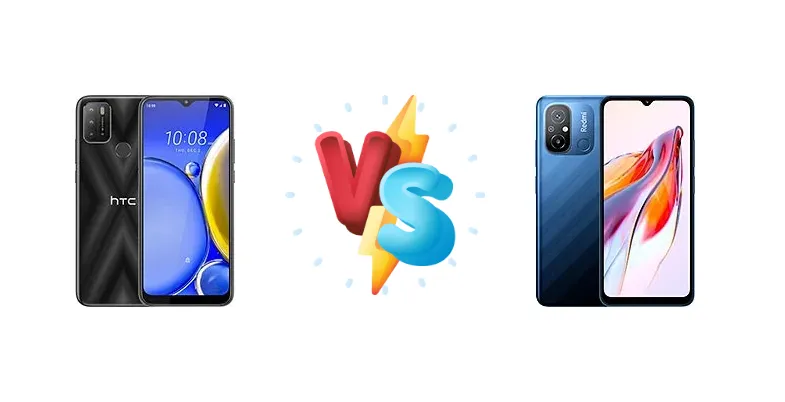
The budget smartphone market is fiercely competitive, offering incredible value for money. Today, we're pitting two contenders against each other: the HTC Wildfire E2 Play and the Xiaomi Redmi 12C. Both promise affordability, but which one delivers the better overall experience?
🏆 Quick Verdict
The Xiaomi Redmi 12C edges out the HTC Wildfire E2 Play thanks to its slightly more powerful processor and generally better software support. While both are budget options, the Redmi 12C offers a more polished and future-proof experience for the price.
| Network |
|---|
| 2G bands | GSM 850 / 900 / 1800 / 1900 | GSM 850 / 900 / 1800 / 1900 |
| 3G bands | HSDPA 850 / 900 / 2100 | HSDPA 850 / 900 / 2100 |
| 4G bands | 1, 3, 5, 7, 8, 20, 38, 40, 41 | 1, 3, 5, 7, 8, 20, 28, 38, 40, 41 - International |
| Speed | HSPA, LTE | HSPA, LTE |
| Technology | GSM / HSPA / LTE | GSM / CDMA / HSPA / EVDO / LTE |
| | - | CDMA2000 1xEV-DO |
| Launch |
|---|
| Announced | 2023, April 17 | 2022, December 31 |
| Status | Available. Released 2023, April 17 | Available. Released 2023, January 01 |
| Body |
|---|
| Build | Glass front, plastic back, plastic frame | - |
| Dimensions | 174.2 x 78.6 x 9.3 mm (6.86 x 3.09 x 0.37 in) | 168.8 x 76.4 x 8.8 mm (6.65 x 3.01 x 0.35 in) |
| SIM | Nano-SIM + Nano-SIM | Nano-SIM + Nano-SIM |
| Weight | 210 g (7.41 oz) | 192 g (6.77 oz) |
| Display |
|---|
| Resolution | 720 x 1640 pixels (~263 ppi density) | 720 x 1650 pixels (~268 ppi density) |
| Size | 6.82 inches, 110.5 cm2 (~80.7% screen-to-body ratio) | 6.71 inches, 106.5 cm2 (~82.6% screen-to-body ratio) |
| Type | IPS LCD, 450 nits (typ) | IPS LCD, 500 nits (typ) |
| Platform |
|---|
| CPU | Octa-core (2x1.6 GHz Cortex-A75 & 6x1.6 GHz Cortex-A55) | Octa-core (2x2.0 GHz Cortex-A75 & 6x1.8 GHz Cortex-A55) |
| Chipset | Unisoc T606 (12 nm) | Mediatek MT6769Z Helio G85 (12 nm) |
| GPU | Mali-G57 MP1 | Mali-G52 MC2 |
| OS | Android 12 | Android 12, MIUI 13 |
| Memory |
|---|
| Card slot | microSDXC | microSDXC (dedicated slot) |
| Internal | 128GB 8GB RAM | 32GB 2GB RAM, 32GB 3GB RAM, 32GB 4GB RAM, 64GB 3GB RAM, 64GB 4GB RAM, 128GB 3GB RAM, 128GB 4GB RAM, 128GB 6GB RAM |
| | eMMC 5.1 | eMMC 5.1 |
| Main Camera |
|---|
| Dual | - | 50 MP, (wide), PDAF
0.08 MP (depth) |
| Features | LED flash | LED flash, HDR |
| Quad | 48 MP, f/2.2, (wide), PDAF
5 MP, (ultrawide)
2 MP (macro)
Auxiliary lens | - |
| Single | - | 50 MP, f/1.8, (wide), 1/2.76", PDAF
Auxiliary lens |
| Video | 1080p@30fps | 1080p@30fps |
| Selfie camera |
|---|
| Single | 8 MP, f/2.2, (wide) | 5 MP, f/2.2, (wide) |
| Video | 720p | 1080p@30fps |
| Sound |
|---|
| 3.5mm jack | Yes | Yes |
| 35mm jack | Yes | Yes |
| Loudspeaker | Yes | Yes |
| Comms |
|---|
| Bluetooth | 5.0, A2DP, LE | 5.1, A2DP, LE |
| NFC | No | Yes (market/region dependent) |
| Positioning | GPS, GLONASS, GALILEO | GPS, GLONASS, BDS, GALILEO |
| Radio | Unspecified | FM radio |
| USB | USB Type-C 2.0 | microUSB 2.0 |
| WLAN | Wi-Fi 802.11 a/b/g/n/ac, dual-band, Wi-Fi Direct | Wi-Fi 802.11 a/b/g/n/ac, dual-band, Wi-Fi Direct |
| Features |
|---|
| Sensors | Fingerprint (rear-mounted), accelerometer, gyro, proximity, compass | Fingerprint (rear-mounted), accelerometer |
| | - | Virtual proximity sensing |
| Battery |
|---|
| Charging | 10W wired | 10W wired |
| Type | Li-Po 4600 mAh | Li-Po 5000 mAh |
| Misc |
|---|
| Colors | Black, Blue | Graphite Gray, Ocean Blue, Mint Green, Lavender Purple |
| Models | - | 22120RN86G, 22120RN86I, 22126RN91Y, 2212ARNC4L |
| Price | - | £ 132.99 / € 107.41 |
| SAR | - | 1.08 W/kg (head) 0.64 W/kg (body) |
| SAR EU | - | 0.98 W/kg (head) 0.99 W/kg (body) |
HTC Wildfire E2 Play
- Simple and straightforward interface
- Decent battery life
- Affordable price
- Weaker processor
- Limited software updates
- Slower charging
Xiaomi Redmi 12C
- Better performance
- More versatile camera
- Potentially longer software support
- Slightly better display
- MIUI can be bloated
- 10W charging is slow
- Plastic build quality
Display Comparison
Both phones feature a 6.53-inch HD+ display, offering adequate viewing for everyday use. Color accuracy and brightness are typical for this price range, with neither phone excelling in this area. The Redmi 12C might have slightly better color reproduction due to Xiaomi's display tuning.
Camera Comparison
The Redmi 12C generally boasts a more versatile camera system, often including a higher resolution main sensor and potentially better image processing. While both phones offer decent image quality in good lighting conditions, the Redmi 12C is likely to produce more detailed and vibrant photos. Low-light performance will be similar on both.
Performance
The Redmi 12C's MediaTek Helio G85 chipset provides a noticeable performance advantage over the Unisoc T606 in the Wildfire E2 Play. Expect smoother multitasking, faster app loading times, and better gaming performance on the Redmi 12C. The Wildfire E2 Play is sufficient for basic tasks but may struggle with more demanding applications.
Battery Life
Both phones feature a 5000mAh battery, promising all-day battery life under moderate usage. Charging speeds are identical at 10W, which is relatively slow by today's standards. Battery optimization may vary between the two devices, potentially giving a slight edge to the Redmi 12C.
Buying Guide
The HTC Wildfire E2 Play is a decent choice for users prioritizing a simple, straightforward phone for basic tasks like calls, texts, and light browsing. The Xiaomi Redmi 12C is ideal for those seeking a bit more performance for social media, casual gaming, and a longer software support lifespan.
Frequently Asked Questions
❓ Which phone has better gaming performance?
The Xiaomi Redmi 12C's Helio G85 chipset offers significantly better gaming performance compared to the HTC Wildfire E2 Play's Unisoc T606.
❓ How long will Xiaomi provide software updates for the Redmi 12C?
Xiaomi typically provides longer software support for its Redmi series compared to HTC. Expect at least 2 years of Android updates and security patches for the Redmi 12C.