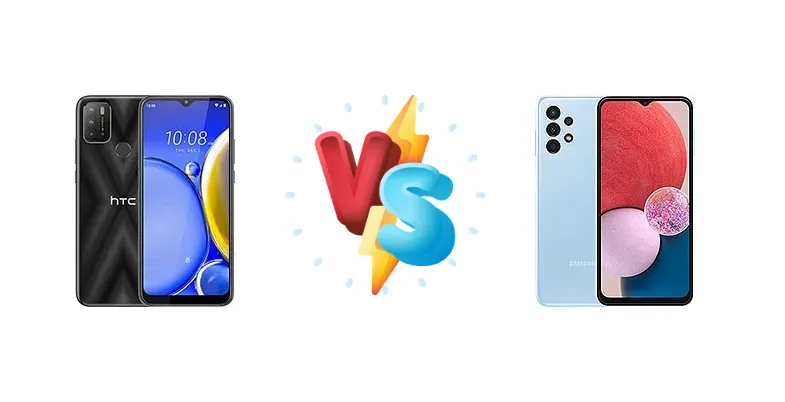
The HTC Wildfire E2 Play and Samsung Galaxy A13 represent the lower end of the Android smartphone spectrum, targeting users prioritizing affordability. However, even within this segment, key differences emerge. This comparison dissects the core specifications to determine which device delivers the best experience for the price, focusing on performance, battery life, and overall usability.
🏆 Quick Verdict
For the average user, the Samsung Galaxy A13 (SM-A137) is the better choice. While both phones aim for the budget market, the A13’s Mediatek Helio G80 chipset offers a noticeable performance advantage over the HTC’s Unisoc T606, and its 15W charging is a welcome improvement over the E2 Play’s 10W.
| Network |
|---|
| 2G bands | GSM 850 / 900 / 1800 / 1900 | GSM 850 / 900 / 1800 / 1900 |
| 3G bands | HSDPA 850 / 900 / 2100 | HSDPA 850 / 900 / 2100 |
| 4G bands | 1, 3, 5, 7, 8, 20, 38, 40, 41 | 1, 3, 5, 7, 8, 20, 28, 38, 40, 41 |
| Speed | HSPA, LTE | HSPA, LTE |
| Technology | GSM / HSPA / LTE | GSM / HSPA / LTE |
| Launch |
|---|
| Announced | 2023, April 17 | 2022, June |
| Status | Available. Released 2023, April 17 | Available. Released 2022, July |
| Body |
|---|
| Build | Glass front, plastic back, plastic frame | Glass front (Gorilla Glass 5), plastic frame, plastic back |
| Dimensions | 174.2 x 78.6 x 9.3 mm (6.86 x 3.09 x 0.37 in) | 165.1 x 76.4 x 8.8 mm (6.5 x 3.01 x 0.35 in) |
| SIM | Nano-SIM + Nano-SIM | · Nano-SIM· Nano-SIM + Nano-SIM |
| Weight | 210 g (7.41 oz) | 195 g (6.88 oz) |
| Display |
|---|
| Protection | - | Corning Gorilla Glass 5 |
| Resolution | 720 x 1640 pixels (~263 ppi density) | 1080 x 2408 pixels, 20:9 ratio (~400 ppi density) |
| Size | 6.82 inches, 110.5 cm2 (~80.7% screen-to-body ratio) | 6.6 inches, 104.9 cm2 (~83.2% screen-to-body ratio) |
| Type | IPS LCD, 450 nits (typ) | PLS LCD |
| Platform |
|---|
| CPU | Octa-core (2x1.6 GHz Cortex-A75 & 6x1.6 GHz Cortex-A55) | Octa-core (2x2.0 GHz Cortex-A75 & 6x1.8 GHz Cortex-A55) |
| Chipset | Unisoc T606 (12 nm) | Mediatek MT6769V/CU Helio G80 (12 nm) |
| GPU | Mali-G57 MP1 | Mali-G52 MC2 |
| OS | Android 12 | Android 12, upgradable to Android 14, One UI 6.1 |
| Memory |
|---|
| Card slot | microSDXC | microSDXC (dedicated slot) |
| Internal | 128GB 8GB RAM | 32GB 3GB RAM, 32GB 4GB RAM, 64GB 4GB RAM, 128GB 4GB RAM |
| | eMMC 5.1 | eMMC 5.1 |
| Main Camera |
|---|
| Features | LED flash | LED flash, panorama, HDR |
| Quad | 48 MP, f/2.2, (wide), PDAF
5 MP, (ultrawide)
2 MP (macro)
Auxiliary lens | 50 MP, f/1.8, (wide), PDAF
5 MP, f/2.2, 123˚ (ultrawide), 1/5.0", 1.12µm
2 MP (macro)
Auxiliary lens |
| Single | - | 8 MP, f/2.2, (wide) |
| Video | 1080p@30fps | 1080p@30fps |
| Selfie camera |
|---|
| Single | 8 MP, f/2.2, (wide) | 8 MP, f/2.2, (wide) |
| Video | 720p | 1080p@30fps |
| Sound |
|---|
| 3.5mm jack | Yes | Yes |
| 35mm jack | Yes | Yes |
| Loudspeaker | Yes | Yes |
| Comms |
|---|
| Bluetooth | 5.0, A2DP, LE | 5.2, A2DP, LE |
| NFC | No | Yes |
| Positioning | GPS, GLONASS, GALILEO | GPS, GLONASS, GALILEO, BDS |
| Radio | Unspecified | No |
| USB | USB Type-C 2.0 | USB Type-C 2.0, OTG |
| WLAN | Wi-Fi 802.11 a/b/g/n/ac, dual-band, Wi-Fi Direct | Wi-Fi 802.11 a/b/g/n/ac, dual-band, Wi-Fi Direct |
| Features |
|---|
| Sensors | Fingerprint (rear-mounted), accelerometer, gyro, proximity, compass | Fingerprint (side-mounted), accelerometer, compass |
| | - | Virtual proximity sensing |
| Battery |
|---|
| Charging | 10W wired | 15W wired |
| Type | Li-Po 4600 mAh | Li-Po 5000 mAh |
| Misc |
|---|
| Colors | Black, Blue | Black, White, Blue |
| Models | - | SM-A137F, SM-A137F/DSN, SM-A137F/DS |
| Price | - | About 180 EUR |
| SAR EU | - | 0.35 W/kg (head) 1.22 W/kg (body) |
HTC Wildfire E2 Play
- Potentially lower price point
- Simple and straightforward user experience
- Reliable brand reputation (HTC)
- Slower processor (Unisoc T606)
- Slower charging (10W)
- Likely less refined camera software
Samsung Galaxy A13 (SM-A137)
- More powerful processor (Helio G80)
- Faster charging (15W)
- Potentially better camera software
- Slightly higher price
- Samsung’s software bloatware (potential)
- May not be as durable as some HTC devices
Display Comparison
Neither device boasts a standout display. Both utilize 12nm chipsets, suggesting a focus on cost reduction over premium display features. While specific display specs (resolution, panel type) are missing, the A13 likely benefits from Samsung’s display expertise, potentially offering slightly better color accuracy and viewing angles. The absence of high refresh rates on either device is typical for this price point, prioritizing battery life over visual fluidity.
Camera Comparison
Without detailed camera specifications, a direct comparison is difficult. However, it’s safe to assume both phones feature basic camera setups geared towards casual photography. The market segment suggests both will include a primary sensor, likely accompanied by depth or macro lenses of limited utility. Image processing will likely be more refined on the Samsung Galaxy A13, leveraging Samsung’s established camera software algorithms. The A13’s potential for better dynamic range and low-light performance is higher due to Samsung’s software optimization.
Performance
The core difference lies in the chipsets. The Samsung Galaxy A13’s Mediatek Helio G80 (2x2.0 GHz Cortex-A75 & 6x1.8 GHz Cortex-A55) has a clock speed advantage over the HTC Wildfire E2 Play’s Unisoc T606 (2x1.6 GHz Cortex-A75 & 6x1.6 GHz Cortex-A55). This translates to a more responsive user experience, particularly when multitasking or running demanding applications. The A75 cores are identical in architecture, but the higher clock speed on the Helio G80 provides a tangible performance boost. Both utilize an octa-core configuration, but the G80’s architecture is optimized for gaming, offering a slight edge in graphical performance.
Battery Life
Battery capacity is not specified for either device, but the charging wattage provides a key differentiator. The Samsung Galaxy A13’s 15W wired charging is significantly faster than the HTC Wildfire E2 Play’s 10W. This means the A13 will reach a full charge in less time, reducing downtime. While a larger battery capacity on the E2 Play could partially offset the slower charging, the convenience of the A13’s faster charging is a significant advantage for users who rely heavily on their phones throughout the day.
Buying Guide
Buy the HTC Wildfire E2 Play if you absolutely need the lowest possible price and are primarily using the phone for basic communication – calls, texts, and light app usage. Buy the Samsung Galaxy A13 (SM-A137) if you want a more responsive experience for social media, streaming, and occasional gaming, and appreciate the convenience of faster charging, even if it comes at a slightly higher cost.
Frequently Asked Questions
❓ Will the Mediatek Helio G80 in the Samsung Galaxy A13 struggle with demanding games like PUBG Mobile?
While the Helio G80 isn't a flagship gaming chip, it's capable of running PUBG Mobile at medium settings with reasonable frame rates. Expect some occasional stuttering during intense firefights, but it's a playable experience. The Unisoc T606 in the HTC Wildfire E2 Play will likely require even lower settings and may experience more significant performance drops.
❓ Is the 10W charging on the HTC Wildfire E2 Play noticeably slow in everyday use?
Yes, 10W charging is considerably slower than the 15W charging on the Samsung Galaxy A13. Expect it to take significantly longer to fully charge the E2 Play, potentially requiring overnight charging to ensure a full battery in the morning. This is a major convenience factor favoring the A13.
❓ Does either phone support fast charging standards like Power Delivery or Quick Charge?
Neither phone is likely to support advanced fast charging standards like Power Delivery or Quick Charge. Both utilize standard USB charging, and the 10W/15W ratings represent the maximum charging speeds supported by the devices and their included chargers.
❓ How does the software experience differ between the HTC Wildfire E2 Play and the Samsung Galaxy A13?
The Samsung Galaxy A13 will run Samsung’s One UI, which is feature-rich but can include pre-installed apps (bloatware). The HTC Wildfire E2 Play likely runs a cleaner version of Android, closer to stock, which some users prefer for its simplicity and lack of unnecessary apps. However, Samsung generally provides longer software support.