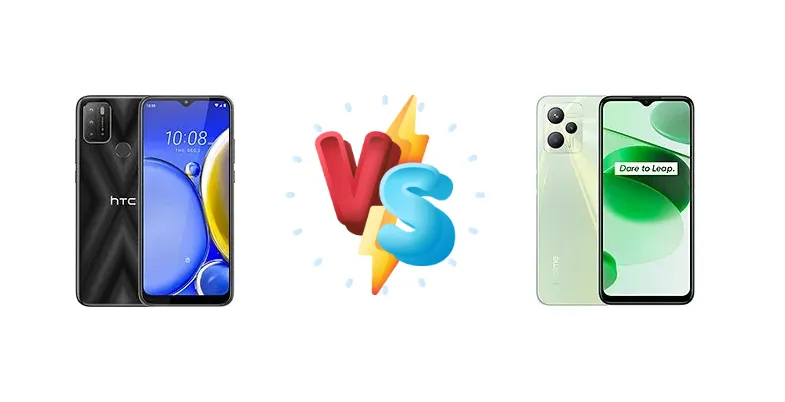
The sub-$150 smartphone market is fiercely competitive. Both the HTC Wildfire E2 Play and the Realme C35 aim to deliver essential smartphone functionality at an accessible price. However, they take slightly different approaches, primarily in chipset choice and charging capabilities. This comparison dissects those differences to help you determine which device best suits your needs.
🏆 Quick Verdict
For most users, the Realme C35 is the better choice. Its Unisoc Tiger T616 chipset offers a noticeable performance boost over the Wildfire E2 Play’s T606, and the 18W charging significantly reduces downtime. While the HTC offers a familiar brand, the Realme delivers more for the money.
| Network |
|---|
| 2G bands | GSM 850 / 900 / 1800 / 1900 | GSM 850 / 900 / 1800 / 1900 |
| 3G bands | HSDPA 850 / 900 / 2100 | HSDPA 850 / 900 / 2100 |
| 4G bands | 1, 3, 5, 7, 8, 20, 38, 40, 41 | 1, 3, 5, 7, 8, 20, 28, 38, 40, 41 |
| Speed | HSPA, LTE | HSPA, LTE |
| Technology | GSM / HSPA / LTE | GSM / HSPA / LTE |
| Launch |
|---|
| Announced | 2023, April 17 | 2022, February 10 |
| Status | Available. Released 2023, April 17 | Available. Released 2022, February 14 |
| Body |
|---|
| Build | Glass front, plastic back, plastic frame | Glass front, plastic frame, plastic back |
| Dimensions | 174.2 x 78.6 x 9.3 mm (6.86 x 3.09 x 0.37 in) | 164.4 x 75.6 x 8.1 mm (6.47 x 2.98 x 0.32 in) |
| SIM | Nano-SIM + Nano-SIM | Nano-SIM + Nano-SIM |
| Weight | 210 g (7.41 oz) | 189 g (6.67 oz) |
| Display |
|---|
| Protection | - | Panda Glass |
| Resolution | 720 x 1640 pixels (~263 ppi density) | 1080 x 2408 pixels, 20:9 ratio (~401 ppi density) |
| Size | 6.82 inches, 110.5 cm2 (~80.7% screen-to-body ratio) | 6.6 inches, 104.4 cm2 (~84.0% screen-to-body ratio) |
| Type | IPS LCD, 450 nits (typ) | IPS LCD, 480 nits (typ), 600 nits (HBM) |
| Platform |
|---|
| CPU | Octa-core (2x1.6 GHz Cortex-A75 & 6x1.6 GHz Cortex-A55) | Octa-core (2x2.0 GHz Cortex-A75 & 6x1.8 GHz Cortex-A55) |
| Chipset | Unisoc T606 (12 nm) | Unisoc Tiger T616 (12 nm) |
| GPU | Mali-G57 MP1 | Mali-G57 MP1 |
| OS | Android 12 | Android 11, Realme UI 2.0 |
| Memory |
|---|
| Card slot | microSDXC | microSDXC (dedicated slot) |
| Internal | 128GB 8GB RAM | 64GB 4GB RAM, 64GB 6GB RAM, 128GB 4GB RAM, 128GB 6GB RAM |
| | eMMC 5.1 | UFS 2.2 |
| Main Camera |
|---|
| Features | LED flash | LED flash, HDR, panorama |
| Quad | 48 MP, f/2.2, (wide), PDAF
5 MP, (ultrawide)
2 MP (macro)
Auxiliary lens | - |
| Single | - | 8 MP, f/2.0, 26mm (wide), 1/4.0", 1.12µm |
| Triple | - | 50 MP, f/1.8, 26mm (wide), 1/2.76", 0.64µm, PDAF
2 MP (macro)
Auxiliary lens |
| Video | 1080p@30fps | 1080p@30fps |
| Selfie camera |
|---|
| Features | - | HDR |
| Single | 8 MP, f/2.2, (wide) | 8 MP, f/2.0, 26mm (wide), 1/4.0", 1.12µm |
| Video | 720p | 720p@30fps |
| Sound |
|---|
| 3.5mm jack | Yes | Yes |
| 35mm jack | Yes | Yes |
| Loudspeaker | Yes | Yes |
| Comms |
|---|
| Bluetooth | 5.0, A2DP, LE | 5.0, A2DP, LE |
| NFC | No | Yes (market/region dependent) |
| Positioning | GPS, GLONASS, GALILEO | GPS, GLONASS, GALILEO, BDS |
| Radio | Unspecified | FM radio |
| USB | USB Type-C 2.0 | USB Type-C 2.0, OTG |
| WLAN | Wi-Fi 802.11 a/b/g/n/ac, dual-band, Wi-Fi Direct | Wi-Fi 802.11 a/b/g/n/ac, dual-band |
| Features |
|---|
| Sensors | Fingerprint (rear-mounted), accelerometer, gyro, proximity, compass | Fingerprint (side-mounted), accelerometer, gyro, proximity, compass |
| Battery |
|---|
| Charging | 10W wired | 18W wired |
| Type | Li-Po 4600 mAh | 5000 mAh |
| Misc |
|---|
| Colors | Black, Blue | Glowing Black, Glowing Green |
| Models | - | RMX3511 |
| Price | - | £ 129.99 / ₹ 7,999 |
| SAR | - | 1.19 W/kg (head) 1.13 W/kg (body) |
HTC Wildfire E2 Play
- Familiar HTC brand
- Simple and straightforward Android experience
- Potentially lower price (depending on region)
- Slower Unisoc T606 chipset
- Slow 10W charging
- Likely less refined camera processing
Realme C35
- Faster Unisoc Tiger T616 chipset
- Faster 18W charging
- Larger display size
- Less established brand in some markets
- Potentially more bloatware
- Similar camera specs to the HTC
Display Comparison
Neither device boasts a standout display. Both utilize standard LCD panels, and detailed specifications like resolution and peak brightness are not provided. However, the Realme C35’s larger screen size (6.6 inches vs. the Wildfire E2 Play’s 6.5 inches) offers a slightly more immersive viewing experience. Without knowing the nits rating, it's difficult to assess outdoor visibility, but both will likely struggle in direct sunlight. The absence of high refresh rates on either device is typical for this price bracket.
Camera Comparison
Camera performance is likely to be similar, given the lack of detailed sensor information. Both phones will likely feature a primary camera accompanied by auxiliary sensors of limited utility. Without knowing the megapixel count or aperture of the main sensors, it’s difficult to make a definitive judgment. However, the Realme C35’s image processing algorithms are likely more refined, offering potentially better dynamic range and color accuracy. The absence of Optical Image Stabilization (OIS) on either device means low-light photography will be challenging.
Performance
The core difference lies in the chipsets. The Realme C35’s Unisoc Tiger T616, with its 2x2.0 GHz Cortex-A75 cores and 6x1.8 GHz Cortex-A55 cores, represents a clear upgrade over the HTC Wildfire E2 Play’s Unisoc T606 (2x1.6 GHz Cortex-A75 & 6x1.6 GHz Cortex-A55). The higher clock speeds on the T616 translate to snappier app launches and smoother multitasking. While both are 12nm chips, the T616’s architectural refinements provide a tangible performance advantage, particularly for users who engage in light gaming or run multiple apps simultaneously. Both devices likely share similar RAM configurations, but the chipset is the bottleneck.
Battery Life
While battery capacity isn’t specified, the Realme C35’s 18W wired charging is a significant advantage over the HTC Wildfire E2 Play’s 10W charging. This translates to substantially faster charging times, reducing the time spent tethered to a power outlet. Even with a similar battery capacity, the faster charging speed makes the Realme C35 more convenient for users who are frequently on the go. The slower charging on the HTC Wildfire E2 Play will require significantly more patience to reach a full charge.
Buying Guide
Buy the HTC Wildfire E2 Play if you prioritize brand recognition and a simple, no-frills Android experience, and are willing to accept slower performance and charging. Buy the Realme C35 if you prioritize performance for everyday tasks, faster charging, and a more modern feature set, even if it means opting for a less established brand in some markets.
Frequently Asked Questions
❓ Will the Realme C35 handle popular games like PUBG Mobile or Call of Duty Mobile?
The Unisoc Tiger T616 in the Realme C35 can run PUBG Mobile and Call of Duty Mobile, but likely at lower graphics settings (Medium or Low) to maintain a stable frame rate. The HTC Wildfire E2 Play’s T606 will struggle more with these titles, requiring even lower settings and potentially experiencing more lag.
❓ How long will it take to fully charge each phone from 0%?
With 18W charging, the Realme C35 should fully charge in approximately 2-2.5 hours, assuming a typical battery capacity for this class of device. The HTC Wildfire E2 Play, with its 10W charging, will likely take 3.5-4 hours to reach 100%, making it less convenient for users who need a quick top-up.
❓ Does either phone support dual SIM functionality?
While not explicitly stated, both the HTC Wildfire E2 Play and Realme C35 are highly likely to support dual SIM functionality, as this is a standard feature in budget smartphones targeting emerging markets. However, confirm the specific SIM slot configuration (e.g., Nano + Nano + microSD) before purchasing.