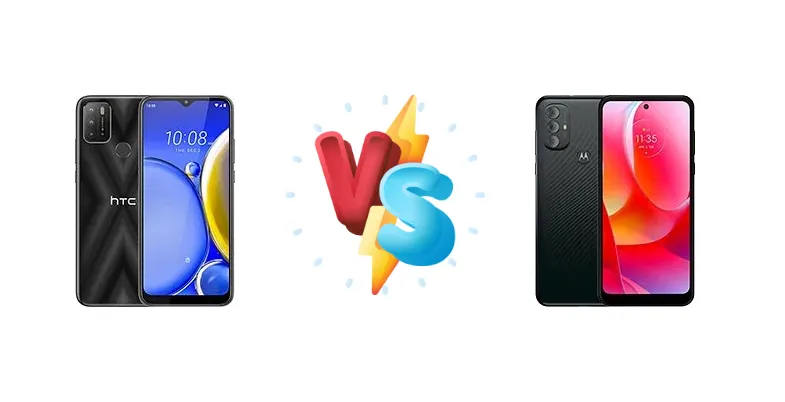
The sub-$200 smartphone market is fiercely competitive. Both the HTC Wildfire E2 Play and the Motorola Moto G Power (2022) aim to deliver essential smartphone functionality at an accessible price. This comparison dissects their core components to determine which device offers the best value for users prioritizing battery life and basic performance.
🏆 Quick Verdict
For the average user, the Motorola Moto G Power (2022) is the better choice. While both phones share the limitation of 10W charging, the Moto G Power’s Mediatek Helio G37 chipset provides a slight performance advantage over the HTC’s Unisoc T606, making it more responsive for everyday tasks.
| Network |
|---|
| 2G bands | GSM 850 / 900 / 1800 / 1900 | GSM 850 / 900 / 1800 / 1900 |
| 3G bands | HSDPA 850 / 900 / 2100 | HSDPA 850 / 900 / 1700(AWS) / 1900 / 2100 |
| 4G bands | 1, 3, 5, 7, 8, 20, 38, 40, 41 | 1, 2, 3, 4, 5, 7, 8, 12, 13, 14, 17, 25, 26, 29, 30, 38, 41, 66, 71 - USA |
| Speed | HSPA, LTE | HSPA, LTE |
| Technology | GSM / HSPA / LTE | GSM / HSPA / LTE |
| Launch |
|---|
| Announced | 2023, April 17 | 2021, November 17 |
| Status | Available. Released 2023, April 17 | Available. Released 2022, February 22 |
| Body |
|---|
| Build | Glass front, plastic back, plastic frame | Glass front, plastic back, plastic frame |
| Dimensions | 174.2 x 78.6 x 9.3 mm (6.86 x 3.09 x 0.37 in) | 167.2 x 76.5 x 9.4 mm (6.58 x 3.01 x 0.37 in) |
| SIM | Nano-SIM + Nano-SIM | Nano-SIM |
| Weight | 210 g (7.41 oz) | 203 g (7.16 oz) |
| | - | Water-repellent coating |
| Display |
|---|
| Resolution | 720 x 1640 pixels (~263 ppi density) | 720 x 1600 pixels, 20:9 ratio (~270 ppi density) |
| Size | 6.82 inches, 110.5 cm2 (~80.7% screen-to-body ratio) | 6.5 inches, 102.0 cm2 (~79.7% screen-to-body ratio) |
| Type | IPS LCD, 450 nits (typ) | IPS LCD, 90Hz |
| Platform |
|---|
| CPU | Octa-core (2x1.6 GHz Cortex-A75 & 6x1.6 GHz Cortex-A55) | - |
| Chipset | Unisoc T606 (12 nm) | Mediatek MT6765 Helio G37 (12 nm) |
| GPU | Mali-G57 MP1 | - |
| OS | Android 12 | Android 11 |
| Memory |
|---|
| Card slot | microSDXC | microSDXC (dedicated slot) |
| Internal | 128GB 8GB RAM | 64GB 4GB RAM, 128GB 4GB RAM |
| | eMMC 5.1 | eMMC 5.1 |
| Main Camera |
|---|
| Features | LED flash | LED flash, HDR |
| Quad | 48 MP, f/2.2, (wide), PDAF
5 MP, (ultrawide)
2 MP (macro)
Auxiliary lens | - |
| Triple | - | 50 MP, f/1.8, (wide), 0.65µm, PDAF
2 MP (macro)
Auxiliary lens |
| Video | 1080p@30fps | 1080p@30fps, gyro-EIS |
| Selfie camera |
|---|
| Single | 8 MP, f/2.2, (wide) | 8 MP, f/2.0, 1.12µm |
| Video | 720p | 1080p@30fps |
| Sound |
|---|
| 3.5mm jack | Yes | Yes |
| 35mm jack | Yes | Yes |
| Loudspeaker | Yes | Yes |
| Comms |
|---|
| Bluetooth | 5.0, A2DP, LE | 5.0, A2DP, LE |
| NFC | No | No |
| Positioning | GPS, GLONASS, GALILEO | GPS, GLONASS, GALILEO |
| Radio | Unspecified | Unspecified |
| USB | USB Type-C 2.0 | USB Type-C 2.0 |
| WLAN | Wi-Fi 802.11 a/b/g/n/ac, dual-band, Wi-Fi Direct | Wi-Fi 802.11 a/b/g/n/ac, dual-band, Wi-Fi Direct |
| Features |
|---|
| Sensors | Fingerprint (rear-mounted), accelerometer, gyro, proximity, compass | Fingerprint (side-mounted), accelerometer, gyro, proximity, compass, barometer |
| Battery |
|---|
| Charging | 10W wired | 10W wired |
| Type | Li-Po 4600 mAh | Li-Po 5000 mAh |
| Misc |
|---|
| Colors | Black, Blue | Black |
| Price | - | About 70 EUR |
HTC Wildfire E2 Play
- Potentially lower price point
- Reliable brand reputation (HTC)
- Simple and straightforward user experience
- Less powerful chipset (Unisoc T606)
- Likely smaller battery capacity
- Limited performance for demanding tasks
Motorola Moto G Power (2022)
- Slightly more powerful chipset (Helio G37)
- Likely larger battery capacity for extended use
- Motorola’s software optimizations
- May be slightly more expensive
- Motorola’s software bloatware (potentially)
- 10W charging is slow
Display Comparison
Neither HTC nor Motorola provide detailed display specifications beyond basic resolution. Given the price point, both likely utilize IPS LCD panels. The absence of high refresh rates or advanced features like LTPO is expected. The real-world difference in display quality will likely be minimal, focusing on viewing angles and color reproduction, which are difficult to assess without direct comparison. Bezels are expected to be substantial on both devices, reflecting their budget nature.
Camera Comparison
Camera performance is likely to be similar, with both devices focusing on basic image capture. Detailed camera specs are unavailable, but given the market segment, expect a primary sensor around 13MP, potentially with a secondary depth or macro sensor on the Moto G Power. Image processing will be crucial, and Motorola’s software optimizations may provide a slight advantage in producing usable photos in various lighting conditions. The 2MP macro sensors often found in this price range offer limited practical benefit due to their low resolution and lack of optical image stabilization (OIS).
Performance
The core difference lies in the chipsets. The Motorola Moto G Power (2022) utilizes the Mediatek Helio G37, built on a 12nm process, while the HTC Wildfire E2 Play features the Unisoc T606, also on a 12nm process. While both are entry-level, the Helio G37 generally benchmarks slightly higher in CPU and GPU performance. The Unisoc T606’s CPU configuration – 2x1.6 GHz Cortex-A75 and 6x1.6 GHz Cortex-A55 – is a common arrangement for this segment, but the Helio G37’s architecture offers a marginal edge in graphics processing. Both devices will likely struggle with demanding games, but the Moto G Power should handle basic multitasking and app switching more smoothly.
Battery Life
The Motorola Moto G Power (2022) is named appropriately, likely featuring a larger battery capacity than the HTC Wildfire E2 Play. While specific mAh figures aren’t provided, Motorola historically prioritizes battery life in its G Power series. Both phones are limited to 10W wired charging, meaning a full charge will take several hours. The larger battery in the Moto G Power will translate to significantly longer screen-on time and overall usage between charges, making it ideal for users who prioritize endurance over quick top-ups.
Buying Guide
Buy the HTC Wildfire E2 Play if you need a very basic, reliable smartphone for calls, texts, and light app usage, and are comfortable with minimal performance headroom. Buy the Motorola Moto G Power (2022) if you prioritize longer battery life for extended use between charges and a slightly smoother experience with everyday apps and multitasking.
Frequently Asked Questions
❓ Will the Unisoc T606 in the HTC Wildfire E2 Play struggle with popular social media apps like TikTok and Instagram?
The Unisoc T606 is an entry-level chipset. While it can run these apps, expect some lag and stuttering, especially when multitasking or using the apps for extended periods. The Motorola Moto G Power’s Helio G37 will offer a smoother experience, though it won’t be flagship-level performance.
❓ How long does it realistically take to fully charge either phone from 0% with the 10W charger?
With 10W charging, expect a full charge to take approximately 3-4 hours. Neither phone supports fast charging, so don't expect a quick top-up. The Moto G Power’s larger battery will take slightly longer to reach 100%.
❓ Are either of these phones suitable for playing mobile games like PUBG Mobile or Call of Duty Mobile?
Both phones will struggle with graphically demanding games like PUBG Mobile or Call of Duty Mobile. You’ll likely need to play on the lowest settings with reduced frame rates to achieve playable performance. The Helio G37 in the Moto G Power will offer a marginally better gaming experience, but don't expect a smooth or immersive experience.