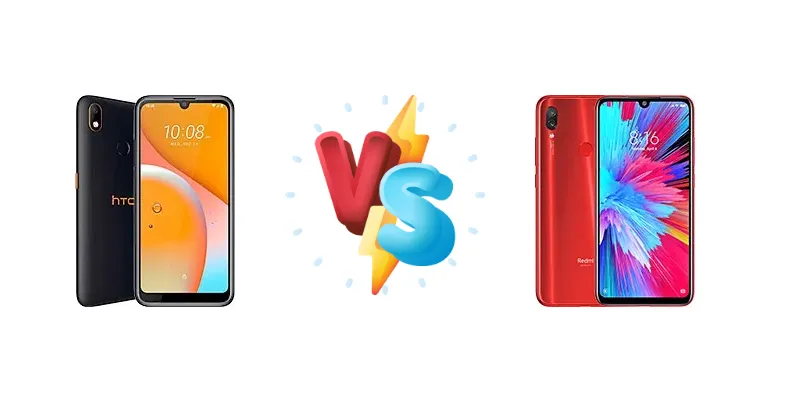
The HTC Wildfire E1 and Xiaomi Redmi Note 7S represent a fascinating intersection in the budget smartphone market. Both devices aimed to deliver a functional smartphone experience at an accessible price point, but they took different approaches under the hood. This comparison dissects the core differences between the Mediatek Helio P23-powered Wildfire E1 and the Qualcomm Snapdragon 660-equipped Redmi Note 7S, focusing on real-world performance implications.
🏆 Quick Verdict
For the average user prioritizing responsiveness and future-proofing, the Xiaomi Redmi Note 7S is the clear winner. The Snapdragon 660’s superior architecture and 14nm process provide a noticeable performance advantage over the Helio P23, especially in multitasking and demanding applications. While the Wildfire E1 offers a basic smartphone experience, the Note 7S delivers a smoother, more capable one.
| Network |
|---|
| 2G bands | GSM 850 / 900 / 1800 / 1900 | GSM 850 / 900 / 1800 / 1900 |
| 3G bands | HSDPA 900 / 2100 | HSDPA 850 / 900 / 1900 / 2100 |
| 4G bands | 1, 3, 7, 20, 38, 40 | 1, 3, 5, 8, 40, 41 |
| Speed | HSPA 42.2/5.76 Mbps, LTE Cat4 150/50 Mbps | HSPA 42.2/5.76 Mbps, LTE (2CA) Cat12 600/150 Mbps |
| Technology | GSM / HSPA / LTE | GSM / HSPA / LTE |
| Launch |
|---|
| Announced | 2019, December 18. Released 2019, December 18 | 2019, May. Released 2019, May |
| Status | Discontinued | Discontinued |
| Body |
|---|
| Build | Glass front, plastic back, plastic frame | Glass front (Gorilla Glass 5), glass back (Gorilla Glass 5), plastic frame |
| Dimensions | 157.5 x 75 x 8.9 mm (6.20 x 2.95 x 0.35 in) | 159.2 x 75.2 x 8.1 mm (6.27 x 2.96 x 0.32 in) |
| SIM | Nano-SIM + Nano-SIM | Nano-SIM + Nano-SIM |
| Weight | 165 g (5.82 oz) | 186 g (6.56 oz) |
| | - | Splash resistant |
| Display |
|---|
| Protection | - | Corning Gorilla Glass 5 |
| Resolution | 720 x 1560 pixels, 19.5:9 ratio (~282 ppi density) | 1080 x 2340 pixels, 19.5:9 ratio (~409 ppi density) |
| Size | 6.09 inches, 91.0 cm2 (~77.1% screen-to-body ratio) | 6.3 inches, 97.4 cm2 (~81.4% screen-to-body ratio) |
| Type | IPS LCD | IPS LCD |
| Platform |
|---|
| CPU | Octa-core (4x2.0 GHz Cortex-A53 & 4x1.5 GHz Cortex-A53) | Octa-core (4x2.2 GHz Kryo 260 Gold & 4x1.8 GHz Kryo 260 Silver) |
| Chipset | Mediatek MT6763 Helio P23 (16 nm) | Qualcomm SDM660 Snapdragon 660 (14 nm) |
| GPU | Mali-G71 MP2 | Adreno 512 |
| OS | Android 9.0 (Pie) | Android 9.0 (Pie), planned upgrade to Android 10, MIUI 12 |
| Memory |
|---|
| Card slot | microSDXC (uses shared SIM slot) | microSDXC (uses shared SIM slot) |
| Internal | 32GB 3GB RAM | 32GB 3GB RAM, 64GB 4GB RAM |
| | eMMC 5.1 | eMMC 5.1 |
| Main Camera |
|---|
| Dual | - | 48 MP, f/1.8, (wide), 1/2.0", 0.8µm, PDAF
Auxiliary lens |
| Features | LED flash | Dual-LED flash, HDR, panorama |
| Single | 13 MP, f/2.2, (wide), AF | - |
| Video | 1080p@30fps | 1080p@30/60/120fps, (gyro-EIS) |
| Selfie camera |
|---|
| Features | - | HDR |
| Single | 5 MP, f/2.2, (wide) | 13 MP, f/2.0, (wide), 1/3.1", 1.12µm |
| Video | 1080p@30fps | 1080p@30fps |
| Sound |
|---|
| 3.5mm jack | Yes | Yes |
| 35mm jack | Yes | Yes |
| Loudspeaker | Yes | Yes |
| Comms |
|---|
| Bluetooth | 4.2, A2DP | 5.0, A2DP, LE |
| Infrared port | - | Yes |
| NFC | No | No |
| Positioning | GPS, GLONASS, GALILEO | GPS, GLONASS, BDS |
| Radio | FM radio | FM radio, recording |
| USB | microUSB 2.0 | USB Type-C 2.0 |
| WLAN | Wi-Fi 802.11 a/b/g/n/ac, dual-band | Wi-Fi 802.11 a/b/g/n/ac, dual-band, Wi-Fi Direct |
| Features |
|---|
| Sensors | Fingerprint (rear-mounted), accelerometer, proximity, compass | Fingerprint (rear-mounted), accelerometer, gyro, proximity, compass |
| Battery |
|---|
| Charging | - | 18W wired, QC4 |
| Type | Li-Ion 3000 mAh | Li-Po 4000 mAh, non-removable |
| Misc |
|---|
| Colors | Black, Gold, Blue/Violet | Onyx Black, Sapphire Blue, Ruby Red, Astro White |
| Models | - | M1901F71 |
| Price | About 90 EUR | About 140 EUR |
HTC Wildfire E1
- Potentially lower price point
- May offer longer standby time due to less powerful processor
- Simple and straightforward user experience
- Significantly slower performance
- Less responsive user interface
- Inferior camera quality
Xiaomi Redmi Note 7S
- Faster and more responsive performance
- Better camera quality and image processing
- 18W Quick Charge support for faster charging
- Potentially higher price
- May have slightly shorter battery life during heavy use
- Larger size and weight
Display Comparison
Neither device is known for a standout display. Details on panel type and resolution are missing for the Wildfire E1, suggesting a basic LCD. The Redmi Note 7S also utilizes an LCD, but its focus was on providing a large viewing area. The key difference lies in processing power impacting UI smoothness on the display. The Snapdragon 660’s GPU will render interfaces and animations more fluidly than the Helio P23’s.
Camera Comparison
While both phones likely feature a multi-camera setup, the Redmi Note 7S’s camera system is expected to be more refined. Details on sensor sizes are missing for both, but Qualcomm’s image signal processor (ISP) within the Snapdragon 660 generally offers superior image processing capabilities compared to Mediatek’s ISP in the Helio P23. This means better dynamic range, noise reduction, and overall image quality on the Redmi Note 7S, particularly in challenging lighting conditions. The Redmi Note 7S’s camera is likely to capture more detail and produce more pleasing results.
Performance
The core of the difference lies in the chipsets. The Xiaomi Redmi Note 7S’s Qualcomm Snapdragon 660 (14nm) boasts a Kryo CPU architecture – 4x2.2 GHz Gold and 4x1.8 GHz Silver – designed for efficient performance scaling. This contrasts with the HTC Wildfire E1’s Mediatek Helio P23 (16nm) using a less efficient Cortex-A53 arrangement (2.0 GHz & 1.5 GHz). The 14nm process of the Snapdragon 660 is more efficient, generating less heat and allowing for sustained performance. This translates to faster app loading times, smoother multitasking, and a more responsive user experience on the Redmi Note 7S. The Snapdragon 660 also benefits from a more capable Adreno GPU, providing a better gaming experience.
Battery Life
Battery capacity details are missing for the Wildfire E1, but given its focus on affordability, it’s likely smaller than the Redmi Note 7S’s. The Redmi Note 7S’s 18W Quick Charge 4 (QC4) support is a significant advantage. While the Wildfire E1 likely supports standard charging, the Redmi Note 7S can replenish its battery much faster, minimizing downtime. The Snapdragon 660’s efficiency also contributes to better battery life during usage, offsetting any potential capacity difference.
Buying Guide
Buy the HTC Wildfire E1 if you need a very basic, ultra-affordable smartphone for essential tasks like calls, texts, and light social media use, and battery life is paramount. Buy the Xiaomi Redmi Note 7S if you prefer a more responsive experience for multitasking, occasional gaming, and capturing photos with better detail, and you value faster charging capabilities.
Frequently Asked Questions
❓ Will the Redmi Note 7S handle popular games like PUBG Mobile smoothly?
The Snapdragon 660 in the Redmi Note 7S is capable of running PUBG Mobile at medium settings with a playable frame rate. While it won't deliver a flagship-level gaming experience, it's significantly better than the Helio P23, which would struggle with consistent performance even at lower settings.
❓ Is the difference in performance between these two phones noticeable for everyday tasks like browsing and social media?
Yes, the difference is quite noticeable. The Snapdragon 660’s faster processor and more efficient architecture result in snappier app loading times, smoother scrolling, and a more responsive overall experience when browsing the web or using social media apps. The Wildfire E1 will feel sluggish in comparison.
❓ Does the Redmi Note 7S support software updates for longer than the Wildfire E1?
Historically, Xiaomi provides longer software support for its devices compared to HTC. The Redmi Note 7S is more likely to receive security patches and potentially even Android version updates for a longer period, extending its usable lifespan.
❓ If I primarily use my phone for calls and texts, is the Redmi Note 7S overkill?
For basic communication, the Wildfire E1 is sufficient. However, even for calls and texts, the Redmi Note 7S’s clearer display and more reliable performance can enhance the experience. The added benefits of a better camera and faster charging are also worth considering, even for light users.