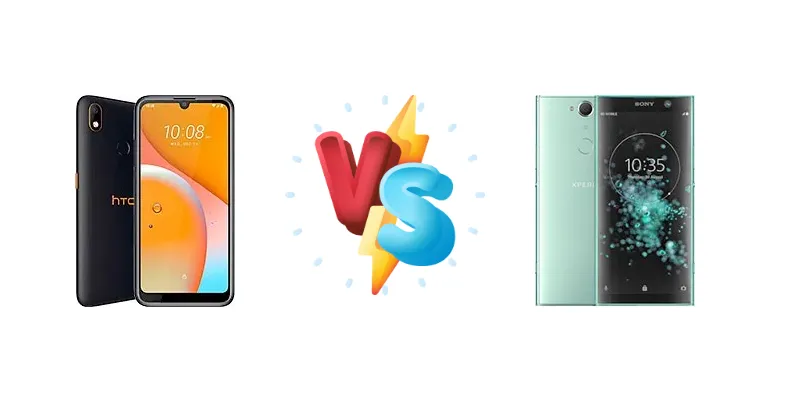
The HTC Wildfire E1 and Sony Xperia XA2 Plus represent different approaches to the budget smartphone market. The Wildfire E1 is a more recent entry, aiming for affordability, while the XA2 Plus, though older, offers a more polished experience and features like Quick Charge 3.0. This comparison dissects their key differences to determine which device delivers the best value.
🏆 Quick Verdict
For the average user prioritizing a slightly smoother experience and faster charging, the Sony Xperia XA2 Plus is the better choice. While the Wildfire E1 offers a newer platform, the Snapdragon 630 in the XA2 Plus provides a more consistent performance profile and benefits from Quick Charge support, offsetting its age.
| Network |
|---|
| 2G bands | GSM 850 / 900 / 1800 / 1900 | GSM 850 / 900 / 1800 / 1900 |
| 3G bands | HSDPA 900 / 2100 | HSDPA 850 / 900 / 1900 / 2100 |
| 4G bands | 1, 3, 7, 20, 38, 40 | 1, 2, 3, 5, 7, 8, 20, 38 - H3413, H4413 |
| Speed | HSPA 42.2/5.76 Mbps, LTE Cat4 150/50 Mbps | HSPA 42.2/5.76 Mbps, LTE (3CA) Cat12 600/150 Mbps |
| Technology | GSM / HSPA / LTE | GSM / HSPA / LTE |
| | - | 1, 2, 3, 5, 7, 8, 28, 38, 39, 40, 41 - H4493 |
| Launch |
|---|
| Announced | 2019, December 18. Released 2019, December 18 | 2018, July. Released 2018, September |
| Status | Discontinued | Discontinued |
| Body |
|---|
| Build | Glass front, plastic back, plastic frame | Glass front (Gorilla Glass 5), plastic back, aluminum frame |
| Dimensions | 157.5 x 75 x 8.9 mm (6.20 x 2.95 x 0.35 in) | 157 x 75 x 9.6 mm (6.18 x 2.95 x 0.38 in) |
| SIM | Nano-SIM + Nano-SIM | · Nano-SIM· Nano-SIM + Nano-SIM |
| Weight | 165 g (5.82 oz) | 205 g (7.23 oz) |
| Display |
|---|
| Protection | - | Corning Gorilla Glass 5 |
| Resolution | 720 x 1560 pixels, 19.5:9 ratio (~282 ppi density) | 1080 x 2160 pixels, 18:9 ratio (~402 ppi density) |
| Size | 6.09 inches, 91.0 cm2 (~77.1% screen-to-body ratio) | 6.0 inches, 92.9 cm2 (~78.9% screen-to-body ratio) |
| Type | IPS LCD | IPS LCD |
| Platform |
|---|
| CPU | Octa-core (4x2.0 GHz Cortex-A53 & 4x1.5 GHz Cortex-A53) | Octa-core 2.2 GHz Cortex-A53 |
| Chipset | Mediatek MT6763 Helio P23 (16 nm) | Qualcomm SDM630 Snapdragon 630 (14 nm) |
| GPU | Mali-G71 MP2 | Adreno 508 |
| OS | Android 9.0 (Pie) | Android 8.0 (Oreo) |
| Memory |
|---|
| Card slot | microSDXC (uses shared SIM slot) | microSDXC (uses shared SIM slot) |
| Internal | 32GB 3GB RAM | 32GB 4GB RAM, 64GB 6GB RAM |
| | eMMC 5.1 | - |
| Main Camera |
|---|
| Features | LED flash | LED flash, HDR, panorama |
| Single | 13 MP, f/2.2, (wide), AF | 23 MP, f/2.0, 24mm (wide), 1/2.3", PDAF |
| Video | 1080p@30fps | 4K@30fps, 1080p@30fps, stereo sound rec., HDR |
| Selfie camera |
|---|
| Single | 5 MP, f/2.2, (wide) | 8 MP, f/2.4, 1/4.0" |
| Video | 1080p@30fps | 1080p@30fps |
| Sound |
|---|
| 3.5mm jack | Yes | Yes |
| 35mm jack | Yes | Yes |
| Loudspeaker | Yes | Yes |
| | - | 24-bit/192kHz audio
|
| Comms |
|---|
| Bluetooth | 4.2, A2DP | 5.0, A2DP, aptX HD, LE |
| NFC | No | Yes |
| Positioning | GPS, GLONASS, GALILEO | GPS, GLONASS |
| Radio | FM radio | FM radio |
| USB | microUSB 2.0 | USB Type-C 2.0, OTG |
| WLAN | Wi-Fi 802.11 a/b/g/n/ac, dual-band | Wi-Fi 802.11 a/b/g/n, Wi-Fi Direct |
| Features |
|---|
| Sensors | Fingerprint (rear-mounted), accelerometer, proximity, compass | Fingerprint (rear-mounted), accelerometer, proximity, compass |
| Battery |
|---|
| Charging | - | 18W wired, QC3 |
| Type | Li-Ion 3000 mAh | Li-Ion 3580 mAh, non-removable |
| Misc |
|---|
| Colors | Black, Gold, Blue/Violet | Silver, Black, Gold, Green |
| Models | - | H4413, H4493, H3413 |
| Price | About 90 EUR | About 240 EUR |
| Tests |
|---|
| Audio quality | - |
Noise -93.6dB / Crosstalk -93.1dB |
| Battery life | - |
Endurance rating 104h
|
| Camera | - |
Photo / Video |
| Display | - |
Contrast ratio: 1522:1 (nominal), 3.445 (sunlight) |
| Loudspeaker | - |
Voice 66dB / Noise 73dB / Ring 79dB
|
| Performance | - |
AnTuTu: 86374 (v7), 107537 (v8)
GeekBench: 4144 (v4.4), 1018 (v5.1)
GFXBench: 5.1fps (ES 3.1 onscreen) |
HTC Wildfire E1
- More recent device (potentially longer software support)
- Lower price point (likely)
- Acceptable battery endurance
- Less powerful chipset (Helio P23)
- No fast charging support
- Limited display information
Sony Xperia XA2 Plus
- Faster chipset (Snapdragon 630)
- 18W Quick Charge 3.0 support
- Sony’s image processing expertise
- Older device (potentially limited software updates)
- May be harder to find new
- Larger size compared to some modern phones
Display Comparison
Both devices share a similar display contrast ratio of 1522:1 (nominal) and 3.445 (sunlight), suggesting comparable visibility in bright conditions. However, the Wildfire E1's display specifications are not detailed, making it difficult to assess its color accuracy or peak brightness. The XA2 Plus, while lacking cutting-edge panel technology, benefits from Sony’s image processing expertise, potentially offering a more color-accurate viewing experience. The absence of detailed display specs for the Wildfire E1 is a significant drawback for discerning users.
Camera Comparison
Both phones are listed as having Photo/Video capabilities, but lack specific details. Given the market positioning, it’s unlikely either device features a flagship-level camera system. The XA2 Plus, benefiting from Sony’s imaging expertise, likely offers superior image processing and potentially better low-light performance. The Wildfire E1, being a budget device, likely relies on simpler image processing algorithms. Without sensor size or aperture information, a definitive camera comparison is impossible, but Sony’s track record suggests an edge for the XA2 Plus.
Performance
The Sony Xperia XA2 Plus’s Qualcomm Snapdragon 630 (14nm) holds a clear advantage over the HTC Wildfire E1’s MediaTek Helio P23 (16nm). The 14nm process node of the Snapdragon 630 is more efficient, leading to better thermal management and sustained performance. While both CPUs utilize octa-core Cortex-A53 architecture, the XA2 Plus boasts a higher clock speed of 2.2 GHz versus the Wildfire E1’s 2.0 GHz/1.5 GHz split. This translates to snappier app launches and smoother multitasking on the XA2 Plus. The Snapdragon 630 also features a more capable Adreno 508 GPU, providing a better gaming experience.
Battery Life
Both the HTC Wildfire E1 and Sony Xperia XA2 Plus achieve an endurance rating of 104 hours, indicating similar battery life under typical usage. However, the XA2 Plus distinguishes itself with 18W wired charging and Quick Charge 3.0 support. This significantly reduces charging times compared to the Wildfire E1, which lacks fast charging capabilities. While both offer comparable longevity, the XA2 Plus’s faster charging is a crucial convenience factor.
Buying Guide
Buy the HTC Wildfire E1 if you need a very basic, affordable smartphone for essential tasks and are comfortable with a potentially less refined software experience. Buy the Sony Xperia XA2 Plus if you prefer a more responsive user interface, faster charging capabilities, and a device that feels more premium despite its age, even if it means sacrificing the latest chipset.
Frequently Asked Questions
❓ Is the Snapdragon 630 in the Xperia XA2 Plus still capable of handling modern apps and games?
While not a flagship chipset, the Snapdragon 630 remains a capable performer for everyday tasks and many popular games. It won't deliver the highest frame rates in demanding titles, but it provides a smooth and responsive experience for most users. It's a significant step up from the Helio P23 in the Wildfire E1.
❓ How much faster is the charging on the Sony Xperia XA2 Plus compared to the HTC Wildfire E1?
The Xperia XA2 Plus supports 18W Quick Charge 3.0, while the Wildfire E1 lacks fast charging. This means the XA2 Plus can charge from 0-100% significantly faster – likely in around 90-120 minutes – compared to the Wildfire E1, which could take upwards of 3-4 hours.
❓ Will I receive software updates on either of these phones?
Given the age of both devices, major Android version updates are unlikely. However, the XA2 Plus may still receive occasional security patches from Sony, while the Wildfire E1’s software support is less certain. Expect a limited software experience on both.