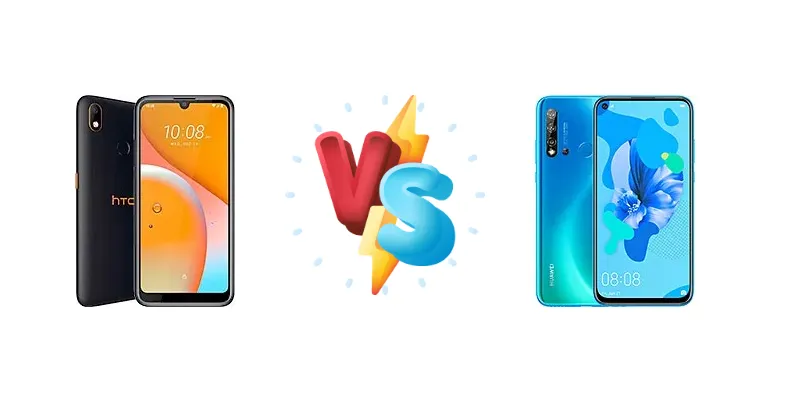
Both the HTC Wildfire E1 and the Huawei P20 lite (2019) represent attempts to deliver affordable smartphone experiences. However, they approach this goal with different hardware philosophies. The P20 lite, released in 2019, benefits from Huawei’s in-house Kirin chipset, while the Wildfire E1 relies on MediaTek’s Helio P23. This comparison dissects these differences to determine which device offers the best value for budget-conscious consumers.
🏆 Quick Verdict
For the average user, the Huawei P20 lite (2019) is the superior choice. Its Kirin 710 chipset, built on a more efficient 12nm process, delivers noticeably better performance than the Wildfire E1’s Helio P23. The inclusion of 18W fast charging is a significant advantage, offsetting the potentially smaller battery capacity (not specified in provided data).
| Network |
|---|
| 2G bands | GSM 850 / 900 / 1800 / 1900 | GSM 850 / 900 / 1800 / 1900 |
| 3G bands | HSDPA 900 / 2100 | HSDPA 850 / 900 / 1700(AWS) / 1900 / 2100 |
| 4G bands | 1, 3, 7, 20, 38, 40 | 1, 3, 4, 5, 7, 8, 20 |
| Speed | HSPA 42.2/5.76 Mbps, LTE Cat4 150/50 Mbps | HSPA, LTE |
| Technology | GSM / HSPA / LTE | GSM / HSPA / LTE |
| Launch |
|---|
| Announced | 2019, December 18. Released 2019, December 18 | 2019, June. Released 2019, July |
| Status | Discontinued | Discontinued |
| Body |
|---|
| Build | Glass front, plastic back, plastic frame | Glass front, plastic back, plastic frame |
| Dimensions | 157.5 x 75 x 8.9 mm (6.20 x 2.95 x 0.35 in) | 159.1 x 75.9 x 8.3 mm (6.26 x 2.99 x 0.33 in) |
| SIM | Nano-SIM + Nano-SIM | · Nano-SIM· Nano-SIM + Nano-SIM |
| Weight | 165 g (5.82 oz) | 178 g (6.28 oz) |
| Display |
|---|
| Resolution | 720 x 1560 pixels, 19.5:9 ratio (~282 ppi density) | 1080 x 2310 pixels (~398 ppi density) |
| Size | 6.09 inches, 91.0 cm2 (~77.1% screen-to-body ratio) | 6.4 inches, 101.4 cm2 (~84.0% screen-to-body ratio) |
| Type | IPS LCD | IPS LCD |
| Platform |
|---|
| CPU | Octa-core (4x2.0 GHz Cortex-A53 & 4x1.5 GHz Cortex-A53) | Octa-core (4x2.2 GHz Cortex-A73 & 4x1.7 GHz Cortex-A53) |
| Chipset | Mediatek MT6763 Helio P23 (16 nm) | Kirin 710 (12 nm) |
| GPU | Mali-G71 MP2 | Mali-G51 MP4 |
| OS | Android 9.0 (Pie) | Android 9.0 (Pie), EMUI 9.1 |
| Memory |
|---|
| Card slot | microSDXC (uses shared SIM slot) | microSDXC (uses shared SIM slot) |
| Internal | 32GB 3GB RAM | 64GB 4GB RAM, 128GB 4GB RAM |
| | eMMC 5.1 | - |
| Main Camera |
|---|
| Features | LED flash | LED flash, HDR, panorama |
| Quad | - | 16 MP, f/1.8, PDAF
8 MP, (ultrawide)
2 MP (macro)
Auxiliary lens |
| Single | 13 MP, f/2.2, (wide), AF | - |
| Video | 1080p@30fps | 1080p@30fps |
| Selfie camera |
|---|
| Features | - | HDR |
| Single | 5 MP, f/2.2, (wide) | 16 MP, f/2.2 |
| Video | 1080p@30fps | 1080p@30fps |
| Sound |
|---|
| 3.5mm jack | Yes | Yes |
| 35mm jack | Yes | Yes |
| Loudspeaker | Yes | Yes |
| Comms |
|---|
| Bluetooth | 4.2, A2DP | 5.0, A2DP, LE, aptX HD |
| NFC | No | Yes (market/region dependent) |
| Positioning | GPS, GLONASS, GALILEO | GPS, GLONASS, BDS |
| Radio | FM radio | FM radio |
| USB | microUSB 2.0 | USB Type-C 2.0, OTG |
| WLAN | Wi-Fi 802.11 a/b/g/n/ac, dual-band | Wi-Fi 802.11 a/b/g/n/ac, dual-band, Wi-Fi Direct |
| Features |
|---|
| Sensors | Fingerprint (rear-mounted), accelerometer, proximity, compass | Fingerprint (rear-mounted), accelerometer, gyro, proximity, compass |
| Battery |
|---|
| Charging | - | 18W wired |
| Type | Li-Ion 3000 mAh | Li-Po 4000 mAh, non-removable |
| Misc |
|---|
| Colors | Black, Gold, Blue/Violet | Midnight Black, Crush Blue, Charming Red |
| Price | About 90 EUR | About 280 EUR |
HTC Wildfire E1
- Potentially lower price point
- Functional for basic smartphone tasks
- MediaTek Helio P23 is a proven chipset
- Inferior performance compared to Kirin 710
- Likely slower charging speeds
- Less efficient 16nm process
Huawei P20 lite (2019)
- Faster and more efficient Kirin 710 chipset
- 18W fast charging support
- Potentially better camera image processing
- May be slightly more expensive
- Older device (released 2019)
- Software support may be limited
Display Comparison
Neither device’s display specifications are provided, but given their market segments, both likely feature LCD panels. The P20 lite, being a slightly older model, may have narrower bezels due to design trends at the time of its release. Color accuracy is likely similar, leaning towards the warmer side typical of many budget displays. Without specific data, it’s difficult to assess brightness or resolution differences, but the P20 lite’s slightly higher price point suggests a potentially better display quality.
Camera Comparison
Without detailed camera specifications, a direct comparison is limited. However, Huawei historically emphasizes camera performance even in its budget offerings. The P20 lite likely benefits from Huawei’s image processing algorithms, potentially delivering more vibrant and detailed photos. The absence of information regarding sensor sizes makes a definitive statement impossible, but a larger sensor in the P20 lite would be expected given its positioning. The prevalence of low-resolution auxiliary cameras (often 2MP) on both devices suggests these are primarily for depth sensing and portrait mode effects, offering limited benefit in standard photography.
Performance
The Kirin 710 in the Huawei P20 lite (2019) represents a clear advantage over the MediaTek Helio P23 in the HTC Wildfire E1. The Kirin 710’s octa-core configuration utilizes 4x2.2 GHz Cortex-A73 cores alongside 4x1.7 GHz Cortex-A53 cores, offering significantly higher peak performance compared to the Helio P23’s 4x2.0 GHz Cortex-A53 and 4x1.5 GHz Cortex-A53 setup. Crucially, the Kirin 710 is fabricated on a 12nm process, while the Helio P23 uses a 16nm process. This smaller node translates to improved power efficiency and reduced thermal throttling, meaning the P20 lite will sustain peak performance for longer periods. Users engaging in gaming or multitasking will experience a smoother, more responsive experience on the P20 lite.
Battery Life
Battery capacity data is missing for both devices. However, the Huawei P20 lite (2019) includes 18W wired charging, a significant advantage over the likely slower charging speeds of the HTC Wildfire E1. This faster charging capability allows for quicker top-ups, reducing downtime. While a larger battery capacity on the Wildfire E1 might offer longer overall runtime, the P20 lite’s faster charging could mitigate the impact of a smaller battery, especially for users who frequently need to recharge throughout the day.
Buying Guide
Buy the HTC Wildfire E1 if your primary need is a basic, functional smartphone for essential tasks like calls, messaging, and light social media use, and you prioritize a potentially lower price point. Buy the Huawei P20 lite (2019) if you prioritize smoother multitasking, a more responsive user experience, and faster charging, even if it means spending slightly more. The P20 lite is better suited for users who occasionally play mobile games or use demanding applications.
Frequently Asked Questions
❓ Is the Kirin 710 in the P20 lite still capable of running modern apps and games?
Yes, the Kirin 710 remains a capable chipset for most modern applications and games, especially at the budget price point of the P20 lite. While it won't deliver flagship-level performance, it provides a smooth and responsive experience for everyday tasks and casual gaming. Expect to play most popular titles at medium settings.
❓ Does the HTC Wildfire E1 receive regular software updates?
HTC’s software update track record has been inconsistent. Given the Wildfire E1’s position as a budget device, it’s unlikely to receive frequent or long-term software updates. Users should expect limited security patches and potentially no major Android version upgrades.
❓ How much faster is the charging on the Huawei P20 lite (2019) compared to a standard 5W charger?
The 18W charging on the P20 lite is significantly faster than a standard 5W charger. While exact 0-100% times depend on battery capacity (not provided), you can expect a full charge in approximately 1.5 to 2 hours with the 18W charger, compared to 3-4 hours with a 5W charger. This is a substantial time saving.