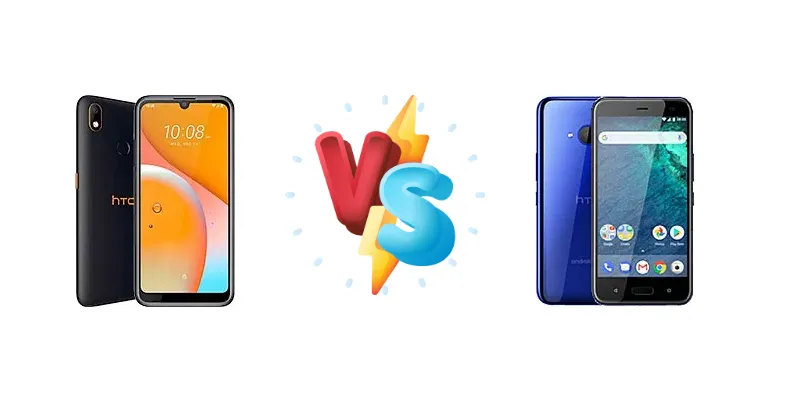
The HTC U11 Life and Wildfire E1 represent different approaches to the budget smartphone market. The U11 Life, released in 2017, aimed for a premium feel with a focus on audio and a respectable feature set. The Wildfire E1, a more recent offering, prioritizes affordability with a Mediatek chipset. This comparison dissects their key differences to determine which provides the best user experience in 2024.
🏆 Quick Verdict
For the average user, the HTC U11 Life emerges as the better choice. While both phones share a 73-hour endurance rating, the Snapdragon 630’s more efficient 14nm process and slightly faster CPU clock speed translate to smoother performance, making it more capable for everyday tasks and light multitasking.
| Network |
|---|
| 2G bands | GSM 850 / 900 / 1800 / 1900 | GSM 850 / 900 / 1800 / 1900 - SIM 1 & SIM 2 (dual-SIM model only) |
| 3G bands | HSDPA 900 / 2100 | HSDPA 850 / 900 / 1700(AWS) / 1900 / 2100 |
| 4G bands | 1, 3, 7, 20, 38, 40 | 1, 2, 3, 4, 5, 7, 12, 13, 17, 20, 28, 66 |
| Speed | HSPA 42.2/5.76 Mbps, LTE Cat4 150/50 Mbps | HSPA 42.2/5.76 Mbps, LTE (3CA) Cat11 600/75 Mbps |
| Technology | GSM / HSPA / LTE | GSM / HSPA / LTE |
| Launch |
|---|
| Announced | 2019, December 18. Released 2019, December 18 | 2017, November. Released 2017, December |
| Status | Discontinued | Discontinued |
| Body |
|---|
| Build | Glass front, plastic back, plastic frame | Glass front (Gorilla Glass 3), plastic back, plastic frame |
| Dimensions | 157.5 x 75 x 8.9 mm (6.20 x 2.95 x 0.35 in) | 149.1 x 72.9 x 8.1 mm (5.87 x 2.87 x 0.32 in) |
| SIM | Nano-SIM + Nano-SIM | · Nano-SIM· Nano-SIM + Nano-SIM |
| Weight | 165 g (5.82 oz) | 142 g (5.01 oz) |
| | - | IP67 dust/water resistant (up to 1m for 30 mins) |
| Display |
|---|
| Protection | - | Corning Gorilla Glass 3 |
| Resolution | 720 x 1560 pixels, 19.5:9 ratio (~282 ppi density) | 1080 x 1920 pixels, 16:9 ratio (~424 ppi density) |
| Size | 6.09 inches, 91.0 cm2 (~77.1% screen-to-body ratio) | 5.2 inches, 74.5 cm2 (~68.6% screen-to-body ratio) |
| Type | IPS LCD | Super LCD |
| Platform |
|---|
| CPU | Octa-core (4x2.0 GHz Cortex-A53 & 4x1.5 GHz Cortex-A53) | Octa-core 2.2 GHz Cortex-A53 |
| Chipset | Mediatek MT6763 Helio P23 (16 nm) | Qualcomm SDM630 Snapdragon 630 (14 nm) |
| GPU | Mali-G71 MP2 | Adreno 508 |
| OS | Android 9.0 (Pie) | Android 8.0 (Oreo), upgradable to Android 9.0 (Pie), Android One |
| Memory |
|---|
| Card slot | microSDXC (uses shared SIM slot) | microSDXC (dedicated slot) - single-SIM modelmicroSDXC (uses shared SIM slot) - dual-SIM model |
| Internal | 32GB 3GB RAM | 32GB 3GB RAM, 64GB 4GB RAM |
| | eMMC 5.1 | - |
| Main Camera |
|---|
| Features | LED flash | LED flash, HDR, panorama |
| Single | 13 MP, f/2.2, (wide), AF | 16 MP, f/2.0, PDAF |
| Video | 1080p@30fps | 4K@30fps, 1080p@30fps |
| Selfie camera |
|---|
| Features | - | HDR, panorama |
| Single | 5 MP, f/2.2, (wide) | 16 MP, f/2.0, 27mm (wide), 1/3.06", 1.0µm |
| Video | 1080p@30fps | 1080p@30fps |
| Sound |
|---|
| 3.5mm jack | Yes | No |
| 35mm jack | Yes | No |
| Loudspeaker | Yes | Yes |
| | - | 24-bit/192kHz audio
|
| Comms |
|---|
| Bluetooth | 4.2, A2DP | 5.0, A2DP, LE |
| NFC | No | Yes |
| Positioning | GPS, GLONASS, GALILEO | GPS, GLONASS, BDS |
| Radio | FM radio | No |
| USB | microUSB 2.0 | USB Type-C 2.0 |
| WLAN | Wi-Fi 802.11 a/b/g/n/ac, dual-band | Wi-Fi 802.11 a/b/g/n/ac, dual-band, Wi-Fi Direct |
| Features |
|---|
| Sensors | Fingerprint (rear-mounted), accelerometer, proximity, compass | Fingerprint (front-mounted), accelerometer, gyro, proximity, compass |
| Battery |
|---|
| Stand-by | - | Up to 670 h (3G) |
| Talk time | - | Up to 17 h (3G) |
| Type | Li-Ion 3000 mAh | Li-Ion 2600 mAh, non-removable |
| Misc |
|---|
| Colors | Black, Gold, Blue/Violet | Brilliant Black, Sapphire Blue, Ice White |
| Models | - | U11 life |
| Price | About 90 EUR | About 210 EUR |
| Tests |
|---|
| Battery life | - | Endurance rating 73h |
| Camera | - |
Photo / Video |
| Display | - |
Contrast ratio: 1529:1 (nominal), 3.108 (sunlight) |
| Loudspeaker | - |
Voice 70dB / Noise 75dB / Ring 88dB |
| Performance | - |
GeekBench: 4140 (v4.4)
GFXBench: 5.3fps (ES 3.1 onscreen) |
HTC Wildfire E1
- Lower price point makes it very accessible.
- Decent battery endurance (73h).
- Functional for basic smartphone tasks.
- Less powerful chipset (Helio P23).
- Likely lower-quality display.
- Limited long-term software support.
HTC U11 Life
- More efficient Snapdragon 630 chipset.
- Better sustained performance.
- Potentially superior camera system.
- Higher build quality (likely).
- Older device with potentially limited software updates.
- May be harder to find new.
- Slightly higher price than the Wildfire E1.
Display Comparison
Both devices share the same contrast ratios of 1529:1 (nominal) and 3.108 (sunlight), suggesting similar outdoor visibility. However, detailed display specs like resolution and panel type are missing for the Wildfire E1. Given its market positioning, it likely utilizes a lower-resolution panel than the U11 Life. The U11 Life’s display, while not cutting-edge, benefits from a more refined manufacturing process and likely better color calibration, contributing to a more pleasant viewing experience.
Camera Comparison
Both phones are listed as having 'Photo / Video' capabilities, but specific details are absent. Considering the U11 Life’s original positioning, it likely featured a more capable camera system with potentially better image processing. The Wildfire E1, targeting a lower price bracket, likely utilizes a simpler camera setup. Without sensor size or aperture information, it’s difficult to make a definitive judgment, but the U11 Life’s age and initial market segment suggest a more feature-rich camera experience.
Performance
The core difference lies in the chipsets. The HTC U11 Life’s Qualcomm Snapdragon 630 (14nm) boasts an octa-core CPU clocked at 2.2 GHz, while the Wildfire E1 uses the Mediatek Helio P23 (16nm) with a similar octa-core configuration but split clock speeds (2.0 GHz & 1.5 GHz). The 14nm process of the Snapdragon 630 is more efficient, meaning it generates less heat and consumes less power for the same level of performance. This translates to potentially better sustained performance and less throttling under load. While both use Cortex-A53 cores, the Snapdragon 630’s architecture is more refined, offering a slight edge in single-core performance.
Battery Life
Interestingly, both devices share an endurance rating of 73 hours. This suggests similar battery optimization and usage patterns were targeted during their development. However, the Snapdragon 630’s superior power efficiency could allow the U11 Life to maintain that endurance rating with slightly heavier usage. Charging speeds are unknown for both devices, but the U11 Life’s more sophisticated power management system might offer more intelligent charging control.
Buying Guide
Buy the HTC Wildfire E1 if you need an extremely affordable device for basic communication – calls, texts, and light social media. Its primary strength is its low price point. Buy the HTC U11 Life if you prioritize a more responsive user experience, slightly better performance for apps, and a phone that feels more polished despite its age. The U11 Life offers a better balance of features and usability.
Frequently Asked Questions
❓ Is the Snapdragon 630 in the U11 Life still capable of running modern apps smoothly?
Yes, the Snapdragon 630 remains a capable chipset for everyday tasks like browsing, social media, and messaging. While it won't handle demanding games at maximum settings, it provides a noticeably smoother experience than the Helio P23 in the Wildfire E1, especially when multitasking.
❓ How does the 16nm vs 14nm process affect the real-world battery life of these phones?
The 14nm process used in the Snapdragon 630 is more efficient than the 16nm process in the Helio P23. This means the Snapdragon 630 consumes less power for the same level of performance, potentially leading to slightly longer battery life and less heat generation during intensive tasks.
❓ Will I receive software updates on either of these phones in 2024?
Software update support is limited for both devices due to their age. The Wildfire E1, being a more recent release, *might* have received a single Android version update, but ongoing security patches are unlikely. The U11 Life is likely no longer receiving any official updates.
❓ Is the camera on the HTC U11 Life significantly better than the Wildfire E1?
While specific camera specs are limited, the U11 Life likely offers a more refined camera experience. HTC historically focused on camera quality, and the U11 Life’s original positioning suggests a more capable sensor and image processing pipeline compared to the budget-focused Wildfire E1.