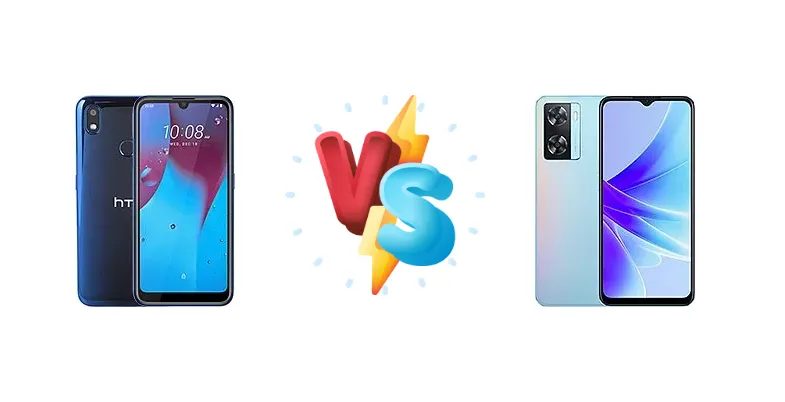
The Oppo A57s and HTC Wildfire E1 Plus represent two approaches to the ultra-budget smartphone market. The A57s leverages a newer Mediatek Helio G35 chipset and faster charging, while the Wildfire E1 Plus aims for affordability with the older Helio P23. This comparison dissects their core specifications to determine which device delivers the best value for users prioritizing everyday tasks and light multimedia consumption.
🏆 Quick Verdict
For most users, the Oppo A57s is the better choice. Its Helio G35 chipset, built on a more efficient 12nm process, provides a noticeable performance uplift over the Wildfire E1 Plus’s Helio P23. The inclusion of 33W fast charging, completing a full charge in just 69 minutes, is a significant convenience factor.
| Network |
|---|
| 2G bands | GSM 850 / 900 / 1800 / 1900 | GSM 850 / 900 / 1800 / 1900 |
| 3G bands | HSDPA 900 / 2100 | HSDPA 850 / 900 / 2100 |
| 4G bands | 1, 3, 7, 20, 38, 40 | 1, 3, 5, 7, 8, 20, 28, 38, 40, 41 |
| Speed | HSPA 42.2/5.76 Mbps, LTE Cat4 150/50 Mbps | HSPA, LTE |
| Technology | GSM / HSPA / LTE | GSM / HSPA / LTE |
| Launch |
|---|
| Announced | 2019, December 18. Released 2019, December 18 | 2022, August 31 |
| Status | Discontinued | Available. Released 2022, September 12 |
| Body |
|---|
| Build | Glass front, plastic back, plastic frame | Glass front (Panda Glass), plastic frame, plastic back |
| Dimensions | 157.5 x 75 x 8.9 mm (6.20 x 2.95 x 0.35 in) | 163.8 x 75 x 8 mm (6.45 x 2.95 x 0.31 in) |
| SIM | Nano-SIM + Nano-SIM | Nano-SIM + Nano-SIM |
| Weight | 165 g (5.82 oz) | 187 g (6.60 oz) |
| | - | IP5X (dust), IPX4 (water) resistance |
| Display |
|---|
| Protection | - | Panda Glass |
| Resolution | 720 x 1560 pixels, 19.5:9 ratio (~282 ppi density) | 720 x 1612 pixels, 20:9 ratio (~269 ppi density) |
| Size | 6.09 inches, 91.0 cm2 (~77.1% screen-to-body ratio) | 6.56 inches, 103.4 cm2 (~84.2% screen-to-body ratio) |
| Type | IPS LCD | IPS LCD, 480 nits (typ), 600 nits (HBM) |
| Platform |
|---|
| CPU | Octa-core (4x2.0 GHz Cortex-A53 & 4x1.5 GHz Cortex-A53) | Octa-core (4x2.3 GHz Cortex-A53 & 4x1.8 GHz Cortex-A53) |
| Chipset | Mediatek MT6763 Helio P23 (16 nm) | Mediatek MT6765G Helio G35 (12 nm) |
| GPU | Mali-G71 MP2 | PowerVR GE8320 |
| OS | Android 9.0 (Pie) | Android 12, ColorOS 12.1 |
| Memory |
|---|
| Card slot | microSDXC (uses shared SIM slot) | microSDXC |
| Internal | 32GB 3GB RAM | 64GB 4GB RAM, 128GB 4GB RAM |
| | eMMC 5.1 | eMMC 5.1 |
| Main Camera |
|---|
| Dual | - | 50 MP, f/1.8, 27mm (wide), PDAF
Auxiliary lens |
| Features | LED flash | LED flash, HDR, panorama |
| Single | 16 MP, f/2.2, (wide), AF | 8 MP, f/2.0, 26mm (wide) |
| Video | 1080p@30fps | 1080p@30fps |
| Selfie camera |
|---|
| Features | - | Panorama |
| Single | 5 MP, f/2.2, (wide) | 8 MP, f/2.0, 26mm (wide) |
| Video | 720p@30fps | 1080p@30fps |
| Sound |
|---|
| 3.5mm jack | Yes | Yes |
| 35mm jack | Yes | Yes |
| Loudspeaker | Yes | Yes, with stereo speakers |
| Comms |
|---|
| Bluetooth | 4.2, A2DP | 5.3, A2DP, LE, aptX HD |
| NFC | No | Yes |
| Positioning | GPS, GLONASS, GALILEO | GPS, GLONASS, BDS, GALILEO, QZSS |
| Radio | FM radio | No |
| USB | microUSB 2.0 | USB Type-C 2.0, OTG |
| WLAN | Wi-Fi 802.11 a/b/g/n/ac, dual-band | Wi-Fi 802.11 a/b/g/n/ac, dual-band, Wi-Fi Direct |
| Features |
|---|
| Sensors | Fingerprint (rear-mounted), accelerometer, proximity, compass | Fingerprint (side-mounted), accelerometer, proximity, compass |
| Battery |
|---|
| Charging | - | 33W wired, 100% in 69 min |
| Type | Li-Ion 3000 mAh | Li-Po 5000 mAh |
| Misc |
|---|
| Colors | Black, Blue, Red | Starry Black, Sky Blue |
| Models | - | CPH2385 |
| Price | About 120 EUR | - |
HTC Wildfire E1 plus
- Potentially lower price point
- Functional for basic smartphone tasks
- Acceptable for users with minimal needs
- Older, less efficient Helio P23 chipset
- Slower performance compared to the A57s
- Likely slower charging speeds
Oppo A57s
- Newer, more efficient Helio G35 chipset
- Faster 33W wired charging (69 minutes to 100%)
- Improved performance for everyday tasks
- Potentially higher price
- Still an entry-level device with limitations
- Camera quality likely remains basic
Display Comparison
Neither device boasts a standout display. Both likely utilize LCD panels, common in this price bracket. The absence of detailed display specifications necessitates focusing on the chipset’s ability to drive the UI smoothly. A more powerful chipset, like the G35 in the A57s, will translate to less lag when scrolling and navigating the interface, regardless of the panel’s inherent quality.
Camera Comparison
Without detailed camera specifications, a direct comparison is difficult. However, it’s safe to assume both phones feature basic camera setups geared towards casual photography. The focus should be on image processing capabilities, which are tied to the chipset. The Helio G35 in the A57s likely offers slightly improved image signal processing (ISP) compared to the P23, potentially resulting in better dynamic range and noise reduction in photos. The prevalence of low-resolution auxiliary cameras (often 2MP) in this segment suggests avoiding expectations of high-quality macro or depth sensing.
Performance
The core difference lies in the chipsets. The Oppo A57s’s Mediatek Helio G35 (12nm) represents a generational improvement over the HTC Wildfire E1 Plus’s Helio P23 (16nm). The G35’s smaller fabrication node generally leads to better power efficiency and thermal management. While both CPUs feature an octa-core configuration with Cortex-A53 cores, the A57s boasts higher clock speeds (4x2.3 GHz vs 4x2.0 GHz), resulting in faster processing for tasks like web browsing and app launching. The G35’s GPU also offers a performance advantage, though neither phone is geared towards demanding gaming.
Battery Life
Battery capacity is not specified for either device. However, the Oppo A57s’s 33W wired charging is a significant advantage. Completing a full charge in 69 minutes provides a substantial convenience boost over slower charging solutions. While a larger battery capacity in the Wildfire E1 Plus might offer longer runtime, the G35’s improved power efficiency could partially offset that difference, making the A57s a more practical choice for users who frequently need to top up their battery.
Buying Guide
Buy the HTC Wildfire E1 Plus if you need a functional smartphone for the absolute lowest possible price and are willing to compromise on performance and charging speed. It’s suitable for basic communication and minimal app usage. Buy the Oppo A57s if you prefer a smoother user experience, faster app loading times, and the convenience of rapid charging, even if it means spending slightly more upfront.
Frequently Asked Questions
❓ Will the Oppo A57s handle popular social media apps like Facebook and Instagram smoothly?
Yes, the Helio G35 chipset in the Oppo A57s is sufficiently powerful to run social media apps without significant lag. The higher clock speeds and improved architecture compared to the Helio P23 in the Wildfire E1 Plus will provide a noticeably smoother experience when scrolling through feeds and loading content.
❓ Is the Helio G35 in the Oppo A57s capable of playing any mobile games?
The Helio G35 can handle less demanding mobile games, such as puzzle games and simple arcade titles. However, it’s not designed for graphically intensive games like PUBG or Call of Duty. Expect to play these games at lower settings and frame rates, and potentially experience some stuttering.
❓ How much faster is the 33W charging on the Oppo A57s compared to a standard 10W charger?
The 33W charging on the Oppo A57s is significantly faster. A standard 10W charger could take several hours to fully charge the battery, while the A57s reaches 100% in just 69 minutes. This is a major convenience factor for users who don't want to wait long for their phone to charge.