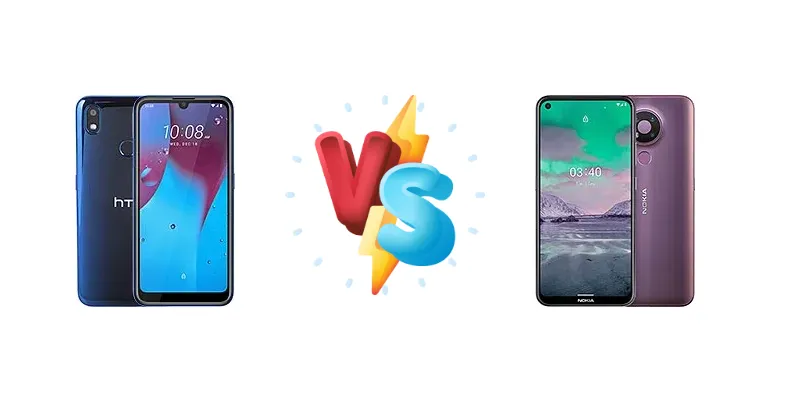
The HTC Wildfire E1 Plus and Nokia 3.4 represent two approaches to the ultra-budget smartphone market. The Wildfire E1 Plus, leveraging Mediatek’s Helio P23, aims for affordability, while the Nokia 3.4, powered by Qualcomm’s Snapdragon 460, attempts to balance cost with a more modern chipset. This comparison dissects their key differences to determine which offers the best value.
🏆 Quick Verdict
For most users, the Nokia 3.4 is the better choice. Its Snapdragon 460 chipset, built on an 11nm process, delivers noticeably improved performance and efficiency compared to the HTC Wildfire E1 Plus’s older 16nm Helio P23. While both phones are entry-level, the Nokia 3.4 offers a smoother user experience and better long-term software support.
| Network |
|---|
| 2G bands | GSM 850 / 900 / 1800 / 1900 | GSM 850 / 900 / 1800 / 1900 |
| 3G bands | HSDPA 900 / 2100 | HSDPA 850 / 900 / 1700(AWS) / 1900 / 2100 |
| 4G bands | 1, 3, 7, 20, 38, 40 | 1, 2, 3, 4, 5, 7, 8, 12, 17, 13, 28, 66 |
| Speed | HSPA 42.2/5.76 Mbps, LTE Cat4 150/50 Mbps | HSPA, LTE |
| Technology | GSM / HSPA / LTE | GSM / HSPA / LTE |
| Launch |
|---|
| Announced | 2019, December 18. Released 2019, December 18 | 2020, September 22. Released 2020, October 26 |
| Status | Discontinued | Discontinued |
| Body |
|---|
| Build | Glass front, plastic back, plastic frame | - |
| Dimensions | 157.5 x 75 x 8.9 mm (6.20 x 2.95 x 0.35 in) | 161 x 76 x 8.7 mm (6.34 x 2.99 x 0.34 in) |
| SIM | Nano-SIM + Nano-SIM | · Nano-SIM· Nano-SIM + Nano-SIM |
| Weight | 165 g (5.82 oz) | 180 g (6.35 oz) |
| Display |
|---|
| Resolution | 720 x 1560 pixels, 19.5:9 ratio (~282 ppi density) | 720 x 1560 pixels, 19.5:9 ratio (~269 ppi density) |
| Size | 6.09 inches, 91.0 cm2 (~77.1% screen-to-body ratio) | 6.39 inches, 100.2 cm2 (~81.9% screen-to-body ratio) |
| Type | IPS LCD | IPS LCD, 400 nits (typ) |
| Platform |
|---|
| CPU | Octa-core (4x2.0 GHz Cortex-A53 & 4x1.5 GHz Cortex-A53) | Octa-core (4x1.8 GHz Cortex-A73 & 4x1.8 GHz Cortex-A53) |
| Chipset | Mediatek MT6763 Helio P23 (16 nm) | Qualcomm SM4250 Snapdragon 460 (11 nm) |
| GPU | Mali-G71 MP2 | Adreno 610 |
| OS | Android 9.0 (Pie) | Android 10, upgradable to Android 11 |
| Memory |
|---|
| Card slot | microSDXC (uses shared SIM slot) | microSDXC (dedicated slot) |
| Internal | 32GB 3GB RAM | 32GB 3GB RAM, 64GB 3GB RAM, 64GB 4GB RAM |
| | eMMC 5.1 | eMMC 5.1 |
| Main Camera |
|---|
| Features | LED flash | LED flash, HDR, panorama |
| Single | 16 MP, f/2.2, (wide), AF | - |
| Triple | - | 13 MP, (wide), PDAF
5 MP, (ultrawide)
Auxiliary lens |
| Video | 1080p@30fps | 1080p@30fps |
| Selfie camera |
|---|
| Single | 5 MP, f/2.2, (wide) | 8 MP, (wide) |
| Video | 720p@30fps | 1080p@30fps |
| Sound |
|---|
| 3.5mm jack | Yes | Yes |
| 35mm jack | Yes | Yes |
| Loudspeaker | Yes | Yes |
| Comms |
|---|
| Bluetooth | 4.2, A2DP | 4.2, A2DP, aptX |
| NFC | No | Yes (market/region dependent) |
| Positioning | GPS, GLONASS, GALILEO | GPS, GLONASS, GALILEO, BDS |
| Radio | FM radio | FM radio |
| USB | microUSB 2.0 | USB Type-C 2.0 |
| WLAN | Wi-Fi 802.11 a/b/g/n/ac, dual-band | Wi-Fi 802.11 b/g/n |
| Features |
|---|
| Sensors | Fingerprint (rear-mounted), accelerometer, proximity, compass | Fingerprint (rear-mounted), accelerometer, gyro, proximity |
| Battery |
|---|
| Charging | - | 10W wired |
| Type | Li-Ion 3000 mAh | Li-Po 4000 mAh |
| Misc |
|---|
| Colors | Black, Blue, Red | Fjord, Dusk, Charcoal |
| Models | - | TA-1288, TA-1285, TA-1283 |
| Price | About 120 EUR | About 100 EUR |
| SAR | - | 0.83 W/kg (head) 1.05 W/kg (body) |
| SAR EU | - | 0.36 W/kg (head) 1.56 W/kg (body) |
HTC Wildfire E1 plus
- Potentially lower price point
- Functional for basic tasks
- May include Android Go Edition for optimized performance on limited hardware
- Older, less efficient chipset
- Likely slower performance
- Potentially limited software updates
Nokia 3.4
- More powerful Snapdragon 460 chipset
- Better power efficiency and battery life
- More responsive user experience
- Likely better software support from Nokia
- Slightly higher price
- Slow 10W charging
- Still an entry-level device with limitations
Display Comparison
Neither device boasts a standout display. Specifications for the Wildfire E1 Plus’s display are not provided, but given its market segment, it likely features a 720p LCD panel. The Nokia 3.4 also utilizes a 720p LCD, but the more modern chipset allows for potentially better image processing. The absence of high refresh rates or advanced panel technologies like LTPO on either device is expected at this price point. Bezels are likely to be substantial on both, impacting the overall screen-to-body ratio.
Camera Comparison
Camera performance is likely to be similar on both devices, with both likely featuring a primary sensor around 13MP. However, the image signal processor (ISP) within the Snapdragon 460 gives the Nokia 3.4 an advantage in image processing, potentially resulting in better dynamic range and noise reduction. The Wildfire E1 Plus’s ISP, tied to the older Helio P23, will likely struggle in low-light conditions. Both phones likely include auxiliary cameras of limited utility (e.g., 2MP depth sensors), which should be largely ignored when evaluating camera quality.
Performance
The core difference lies in the chipsets. The Nokia 3.4’s Qualcomm Snapdragon 460 (11nm) is a significant upgrade over the HTC Wildfire E1 Plus’s Mediatek Helio P23 (16nm). The Snapdragon 460 features a more modern CPU architecture – four Cortex-A73 cores alongside four A53 cores – compared to the Wildfire E1 Plus’s eight Cortex-A53 cores. The A73 cores provide a substantial performance boost in single-core tasks and overall responsiveness. The 11nm manufacturing process of the Snapdragon 460 also contributes to better power efficiency, reducing the likelihood of throttling during sustained use. While neither phone is a gaming powerhouse, the Nokia 3.4 will handle less demanding titles with greater ease.
Battery Life
Battery capacity is not specified for the Wildfire E1 Plus, but it’s likely around 3000-4000mAh, similar to the Nokia 3.4’s 4000mAh battery. However, the Snapdragon 460’s superior power efficiency means the Nokia 3.4 will likely offer longer battery life on a single charge. The Nokia 3.4 supports 10W wired charging, which is slow by modern standards, but adequate for an entry-level device. The Wildfire E1 Plus’s charging speed is unknown, but likely comparable.
Buying Guide
Buy the HTC Wildfire E1 Plus if your primary need is absolute lowest cost and you primarily use your phone for basic communication – calls, texts, and light social media. It’s a functional device for those on a very tight budget. Buy the Nokia 3.4 if you prioritize a more responsive user experience, occasional gaming, and a phone that will feel more capable for a longer period. The Snapdragon 460 provides a tangible performance uplift for everyday tasks.
Frequently Asked Questions
❓ Will the Nokia 3.4 struggle with multitasking compared to more expensive phones?
While the Snapdragon 460 is a capable chipset, it's still entry-level. Expect some slowdown when running multiple demanding apps simultaneously. However, it will handle typical multitasking – switching between messaging, social media, and web browsing – without significant issues. The 3GB or 4GB of RAM (depending on the configuration) is a limiting factor, but the Snapdragon 460's efficiency helps mitigate this.
❓ Is the 10W charging on the Nokia 3.4 a major drawback?
10W charging is slow compared to modern fast charging standards. A full charge will take several hours. However, given the phone's modest battery capacity and typical usage patterns, it's unlikely to be a deal-breaker for most users. Overnight charging is a practical solution.
❓ Can the HTC Wildfire E1 Plus run popular apps like WhatsApp and Facebook smoothly?
The HTC Wildfire E1 Plus *can* run these apps, but the Helio P23's age and lower performance may result in noticeable lag and slower loading times, especially with multiple apps open. The experience won't be as fluid as on the Nokia 3.4.
❓ Does the Nokia 3.4 receive regular software updates?
Nokia is known for providing relatively good software support for its budget phones. The Nokia 3.4 is guaranteed to receive at least two years of security updates and one major Android OS upgrade, ensuring a more secure and up-to-date experience compared to many other phones in this price range.